
A poker trainer is software that deals you a poker decision, makes you commit to an answer, then tells you whether the answer was right and why. That last part is the whole product. Playing hands gives you experience; a trainer gives you corrected experience, which is a different and much faster thing.
The short version
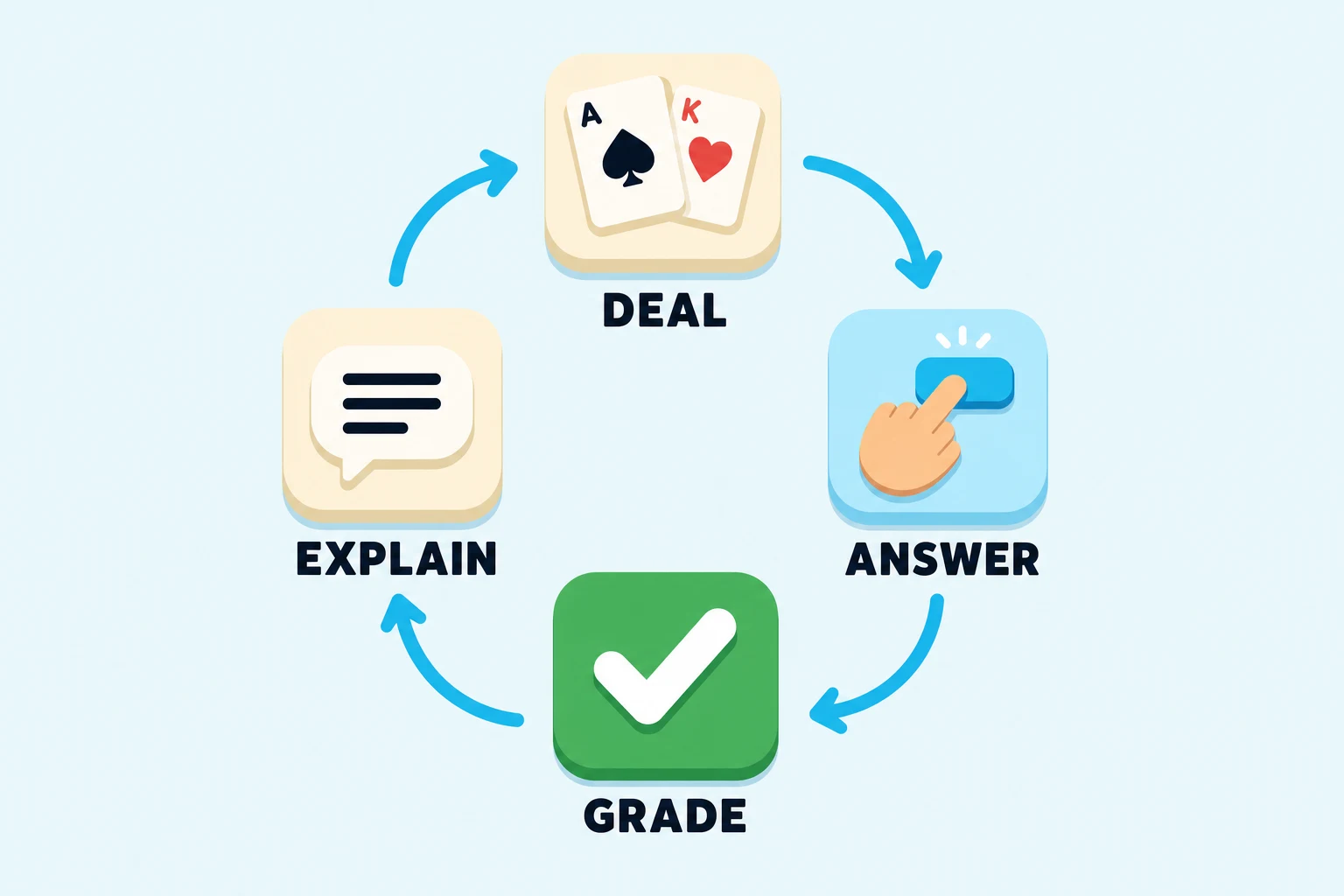
- A trainer runs one loop: deal a decision, take your answer, grade it, explain it, deal the next one.
- The explanation is the value. A tool that only says “wrong” trains frustration, not judgment.
- Four kinds exist: skill drills, GTO trainers, course quizzes, and play-and-coach apps. They teach different things.
- Judge any trainer, ours included, on the quality of its feedback rather than the size of its hand library.
Which kind do you need?
Two questions, in order. The first says whether a trainer is the right category at all; the second says which of the four to open.
| Ask yourself | Where it sends you |
|---|---|
| Do you want to be asked for the answer, or told it? | Asked: a trainer, which is this page. Told: a video course or a written guide, which teaches faster but corrects nothing. |
| Can you read a range grid without stopping to think? | No: skill drills for the fundamentals, or a play-and-coach app for whole hands. Yes: a GTO trainer, which assumes that fluency and gives you numbers instead of teaching. |
A course quiz is the fifth answer, and it only fits if you are already buying the course it belongs to.
What a poker trainer is
A trainer is a study tool built around your decisions instead of someone else’s. It shows you a situation, usually a hand at a specific point in a specific seat, hides the answer, and waits. You choose. Then it grades the choice and explains the reasoning behind the better line.
Compare that to the two things most players do instead. Playing more hands gives you volume with no correction, so a mistake you make on Tuesday is a mistake you repeat on Friday, only smoother. Watching videos gives you explanation with no commitment, and watching a good player decide builds recognition rather than reflex. The trainer sits in the gap: you have to answer first, which is what makes the correction stick.
That is the category. Everything else, the difficulty settings, the streaks, the charts, the score, is packaging around one loop.
Looking for practice reps instead?
If your question is which app gives you the most useful practice sessions rather than what the tool category is, the poker practice app comparison is the page you want. Inside Poker Skill, that practice is Practice vs AI: full hands against AI opponents, heads-up or three-handed, with the AI’s cards shown after every hand. If you specifically want reps without wagering anything, poker decision practice without money covers that path.
How a poker trainer actually works
Three parts do the work: the drill, the feedback, and the order the drills arrive in. The loop diagram at the top of this page is those three parts in one picture.
Drills: one decision at a time
A drill is a single decision stripped of everything that is not the decision. You get your cards, the board, the seat, the action so far, and a short list of choices. No table chat, no ten-minute wait, no session to protect.
Here is a typical one.
Nine hearts give you about 19 percent on the next card, and a bet that small asks for about 20, so with the money you win when the flush arrives, folding gives up a hand that is priced to continue. That is one rep, and it takes under a minute. The drill is testing two things only, outs and pot odds, which is why drilled concepts stick: you use them, alone, over and over.
Isolating decisions this way is why a drill session covers more ground than a playing session. Sit down for an hour of live poker and you might face a dozen decisions worth real thought. Fifteen minutes of drills puts thirty in front of you.
Feedback: why the explanation matters more than the score
A grade tells you that you were wrong. An explanation tells you what you missed, which is the only part you can carry to the next hand.
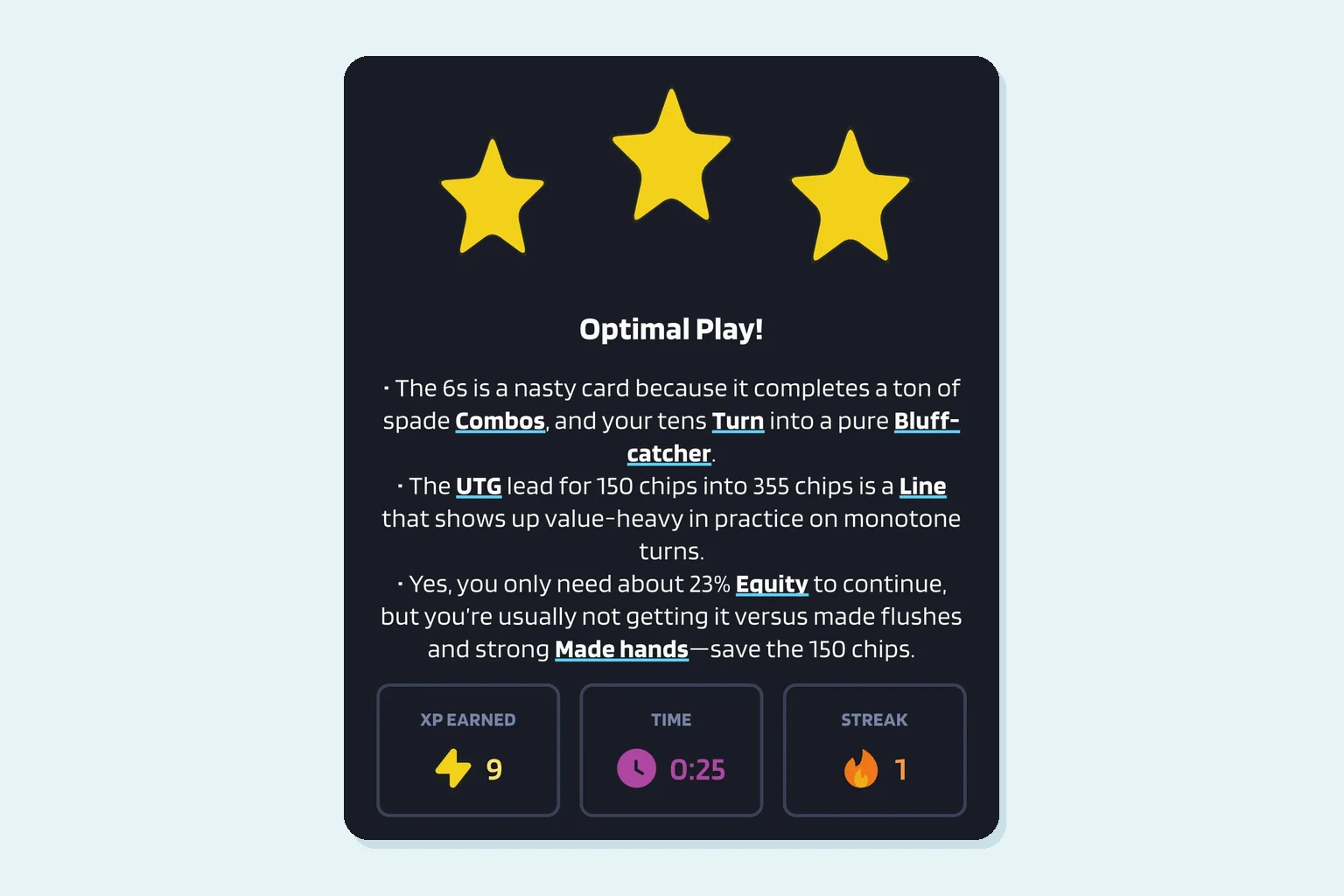
That screen is the part worth judging in any trainer you try. The stars are decoration. The three lines under them, naming the card that changed the hand, the bet size that told the story, and the equity you needed, are the reason the rep was worth taking.
Good feedback names the specific reason: the card that completed a draw, the price you were being offered, the range the bet represents, the reason your hand is now a bluff catcher rather than a value hand. Weak feedback gives you a percentage and a green check. When you test a trainer, this is the thing to test. Answer three spots wrong on purpose and read what comes back. If the tool cannot tell you why, it is a quiz, not a trainer.
The commit-then-check order matters too, and it is not a gimmick. Pulling an answer out of your own head and then finding out you were wrong sticks in a way that reading the same answer in a book does not. Peeking first turns a rep into passive reading, and the rep is the point.
Progression: from hand rankings to whole hands
The third piece is order. A trainer that opens with river bluff catching for a player who is still counting hearts is not training anyone, and a trainer stuck on hand rankings for a player who already knows them is a waste of an evening.
The teaching order in most poker curricula is stable, and it is the order a decent trainer follows: what beats what, then which hands to play from which seat, then the arithmetic of prices and draws, then whole hands played street by street. Six-handed cash games bend this a little, because postflop spots arrive so often that a good path introduces them earlier than a strict syllabus would. What you want to see is a path that moves, with the tool deciding when to move you rather than leaving you to pick a difficulty and guess.
The four kinds of poker trainers
The word covers four fairly different products. One of them is ours, which is worth saying before you read the table.
| Kind | What it drills | What the feedback looks like | Who it fits | Example |
|---|---|---|---|---|
| Skill drills | Isolated skills: preflop ranges, hand rankings, odds, hand reading | Right or wrong plus the correct answer, fast | Newer players building speed on fundamentals | PokerTrainer |
| GTO trainers | Spots you configure yourself, scored against a solver solution | Your action measured against the solution, in GTO and EV terms | Players already fluent in ranges and frequencies | GTO Wizard |
| Course quizzes | Hands attached to a video curriculum | Coach commentary tied to the lesson you just watched | Players who want a syllabus and a teacher’s voice | PokerCoaching |
| Play-and-coach apps | Whole hands inside a guided path | Plain-language coaching on every answer, right or wrong | Players learning from zero or repairing fundamentals | Poker Skill |
Prices and features checked August 2026.
Skill drills
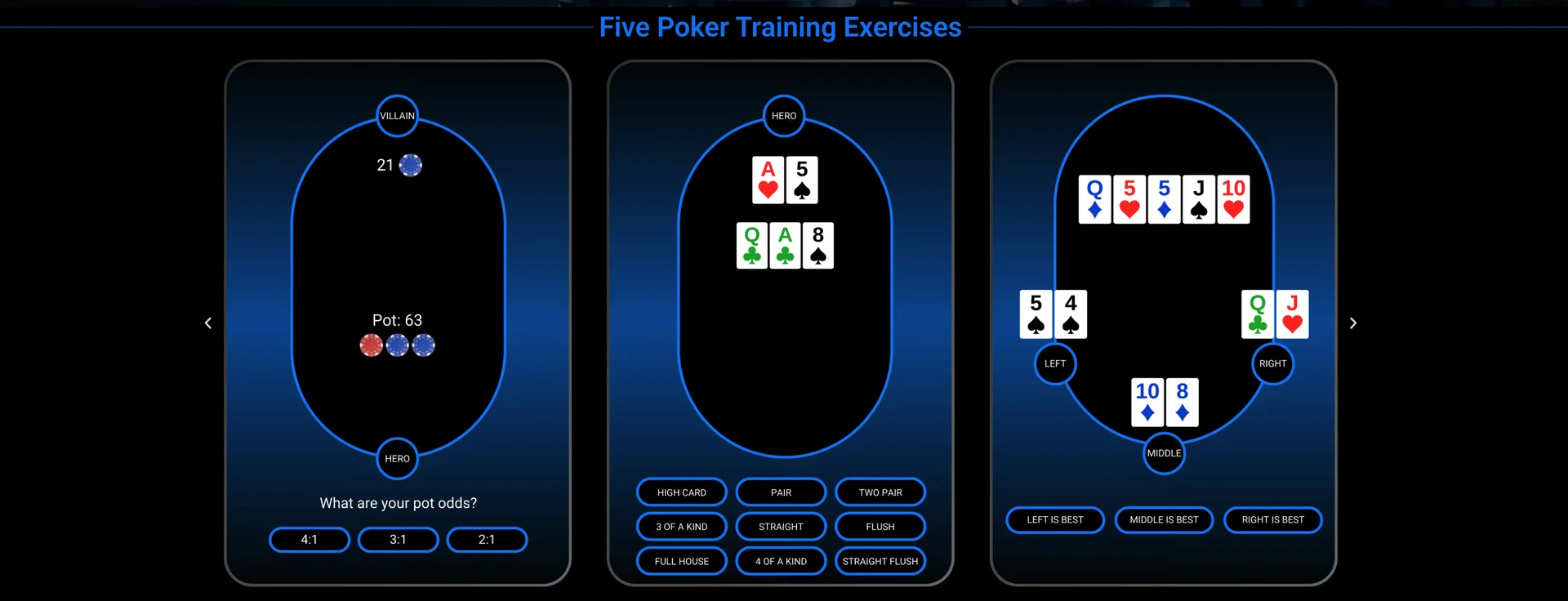
The narrowest kind, and narrow is the feature. PokerTrainer’s app, for example, splits training into five drill types: preflop, postflop, hand ranking, best hand, and odds. Drilling hand rankings until they are instant is genuinely useful, and it is not a thing whole-hand practice does efficiently. If preflop ranges are the skill you want to make instant, the page on the best app to drill preflop ranges compares five trainers by how each one checks your answers.
GTO trainers
These invert the setup: you define the spot, and the tool scores you against a solver solution. GTO Wizard, the best-known example, pairs a solution library with a trainer that reports how your action compares to the solution. The strength is precision. The cost is the fluency it assumes, since a player who cannot yet read a range grid gets numbers rather than teaching.
Course quizzes
These sit inside a training site. PokerCoaching.com, for instance, runs video courses alongside interactive hand quizzes and drills, so the practice reinforces a specific lesson. That coupling is the strength: the quiz is not random, it is the chapter. The cost is that you are buying a curriculum, so the fit depends on whether the syllabus matches your game.
Play-and-coach apps
These teach the whole hand rather than a slice of it, with coaching attached to every answer. That is what our app does, and its limits are the mirror image of GTO Wizard’s: it will not solve a custom spot for you, and it will not analyze the hand history from your last session. If you want a comparison of the named products rather than the categories, the training-app roundup does that job, our app included.
Do you need a poker trainer?
Not everyone does. Here is the honest split.
| A trainer helps most if | A trainer helps least if |
|---|---|
| You play regularly and cannot say why your losing sessions were losing. Feedback is the missing ingredient, and it is the ingredient a trainer sells. | You already review your own hands with a study group or a coach. You have a better feedback loop than any app can give you. |
| You are new and want the fundamentals automatic before you risk money or a bad first live session. | Your leaks are not decision leaks. Playing too long, playing tilted, or sitting in games that are too big are real problems that no drill fixes. |
| Your poker time comes in ten-minute pieces, where drills fit and a two-hour session does not. | You have not chosen a first learning tool yet, in which case a checklist beats a category page. |
If you are only choosing your first learning tool, the checklist for picking an app to learn poker is a faster route than this page. And if your problem is consistency rather than knowledge, the 15-minute practice routine is the fix.
What a trainer will not do
Three limits are worth knowing before you pay for one.
It will not answer a question you invented. That is solver work: a solver takes a spot you define, with the ranges, board, stacks, and bet sizes you supply, and computes an equilibrium strategy for exactly that spot. It does not read your opponent, it does not know what happened earlier in the session, and it hands back frequencies rather than an explanation. A trainer makes the opposite trade, less depth and less setup for an answer in words. Most improving players want the trainer first and the solver later, which is the whole argument of trainer vs solver.
It will not read the table for you either. Nothing in a drill teaches you that the player in seat four has been three-betting every time they refill their drink. Reads, table selection, and the discipline to leave a bad game stay yours.
And it will not train what it does not cover. Every trainer teaches its own curriculum. If the app drills preflop ranges and hand rankings, it is not building your river judgment, however many reps you put in, so read the topic list before you assume the tool reaches your leak.
How to try one free
Most trainers, ours included, are free to start, so the useful question is what the free version actually gives you. Two things to check in the first five minutes.
Check these in the first five minutes
Our own app is the example we can describe from the inside. Poker Skill is free to download on iPhone and Android, with short guided lessons built around real decisions and a daily puzzle, and every answer comes back with coaching rather than a bare verdict. There is no wagering and no real money in it. Lessons run on an energy allowance, and Practice vs AI allows one game a day. It stays free: Poker Skill Plus is the optional upgrade, which lifts the cap on play. The honest limits: it teaches fundamentals rather than high-stakes theory, and it will not import the hand history from your last session. If that shape fits, the Poker Skill training app page has the details.
The best poker training tools in 2026, by learner
No tool wins every job, so the useful question is which one matches the month you are having. Five common starting points, and where each leads.
- If you want the named apps compared side by side, our comparison of the best poker training apps covers the current field, ours included and held to the same standard.
- If you already know the category and want more reps on the spots you keep misplaying, the poker practice app page covers the tools built around volume with feedback attached.
- If you would rather hear a coach talk through hands than answer them yourself, poker training sites covers the video platforms, which is a different purchase on different terms.
- If you are starting from zero and want lessons in order rather than a spot generator, our poker training app was built for that reader, with the limits above.
- If you want to know where you stand before buying anything, the free poker quiz takes ten questions and explains every answer.
Frequently asked questions
What is the best free poker trainer?
There is no single answer, because the free versions differ more than the paid ones do. Free drill apps tend to give you real reps with quick right-or-wrong feedback. Bigger platforms usually give away a sample of a paid library, so how much you can see without paying varies a lot. Ours is free to download and stays free. The practical test is the one above: get a spot wrong on purpose and see whether the free version explains it.
Is a poker trainer the same as a solver?
No. A trainer deals you decisions and corrects them in plain language. A solver computes an equilibrium strategy for a spot you define, and reading its output is a skill of its own. Most players need the trainer first.
Do poker trainers work?
They work when you use them the way they are built. Committing to an answer and then being corrected is what turns a hand into a lesson, while repeating a mistake without correction just makes the mistake faster. That is the mechanism, and it explains the failure modes too. A trainer stops working if you peek before answering, if the feedback never explains anything, or if you drill the same comfortable spots because getting them right feels good.
Are poker trainers worth it?
That depends on whether you already have a feedback loop. If you play regularly and nobody ever tells you which decision cost you the pot, a trainer is the cheapest correction available, and correction is what turns a hand into a lesson instead of an anecdote. If you already review sessions with a coach or a study group, you have a better loop than any app sells, and a trainer mostly adds reps. The scope limit matters too: a trainer fixes decision leaks, so if your money goes on playing too long, playing tilted or sitting in games above your bankroll, more drills will not touch that.