
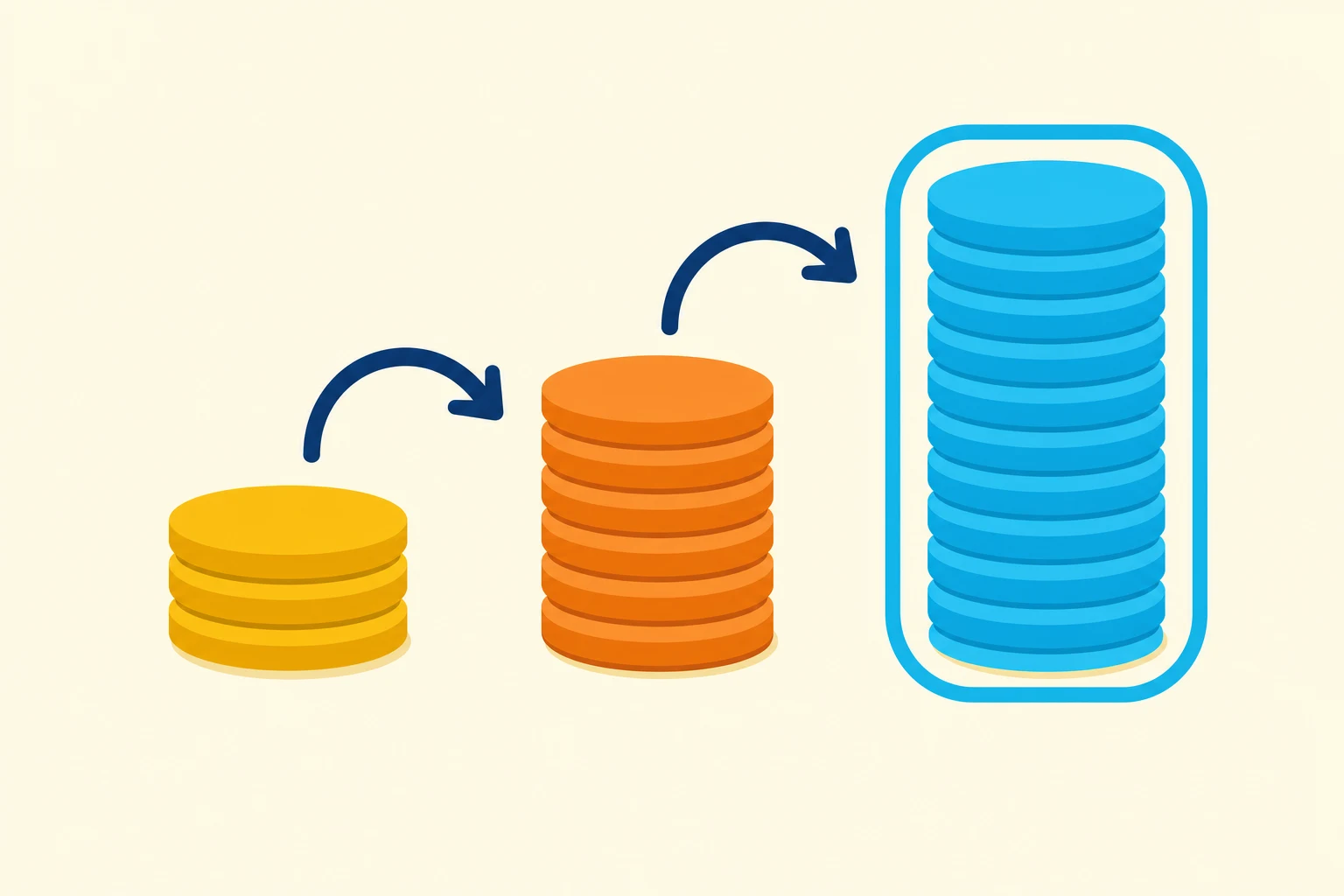
A 3-bet is the re-raise. Someone opens for a raise, and instead of calling you raise them back. That is the whole definition, and the confusing name just counts the wagers in order: the blind is the first bet, the open raise is the second, your re-raise is the third.
As for why everyone seems to be doing it now: calling hands the raiser everything they were hoping for, and re-raising takes it back. Call and the raiser is still driving the hand, the pot stays small enough for them to push you out of it later, and the players behind you come along cheaply. Re-raise and all four of those flip at once, which is the trade the rest of this page unpacks.
3-bet quick answers
| Situation | Default | Why |
|---|---|---|
| Big pair or ace-king, any opener | 3-bet for value | Ahead of the range that keeps playing |
| Loose player opens, you are in position | 3-bet wide for value | Isolate the worse range, keep the field out |
| Tight player opens and you hold a good but not big hand | Fold or call, save the re-raise for the big pairs | Their continuing range is stronger than your good hand |
| You want to bluff and have a suited ace | 3-bet | Blocks their aces, flops the nut flush draw |
| You have a medium pair out of position | Usually call or fold | It cannot stand a 4-bet and does not want a huge pot |
| Somebody 3-bets you | Call, 4-bet or fold on the merits | Flatting a 3-bet is not automatic and neither is folding |
What counts as a 3-bet
Any re-raise over the first raise. If a player opens to three big blinds and you make it nine, you have 3-bet. If someone else then makes it twenty-four, that is a 4-bet, and the counting continues from there. The 3-bet glossary entry keeps the short version if you want the definition on its own.
Counted out at a $1/$2 table, with the big blind as the unit, the ladder looks like this. The pot badge on each rung is the money in the middle once that wager is in, blinds included. The thing that trips everybody up is the first rung: the blind is a bet nobody chose to make, and it still counts.
The forced bet. Nobody decided to make it, and it is still the first bet of the hand, which is why the open raise is the second and not the first.
The second wager. In everyday table talk this is “the raise”, which is exactly why the counting feels off by one.
The third wager, and the subject of this page. About three times the open is the shape you will see most often from a player in position.
The fourth. It beats a range that already re-raised once, so the hands that do it for value are usually just the biggest pairs and ace-king.
The fifth. The counting keeps going from here, but at the 100 big blind stacks most games play, the raise sizes have run out of room and this one is the whole stack.
Preflop and after the flop
Most of the time you hear the word before the flop, because that is where the pattern repeats hand after hand. It applies later too. If a player bets the flop, another raises and a third re-raises, that last raise is a 3-bet as well.
Why re-raise at all
There are four, and a good re-raise usually has two of them working at once.
Value
Sometimes you re-raise because you have a hand that wants a bigger pot. The test is stricter than it looks: your hand has to be ahead of the range that keeps playing after your raise, rather than ahead of the range that opened. Those are different. Someone opening from late position might have a wide range, but the part of it that calls a re-raise is much stronger. That is why a value 3-bet with a hand like ace-jack against a tight opener is often a mistake even though ace-jack beats their opening range.
Isolation
A re-raise clears the table. When you flat-call an open, the players behind you get a cheap look and the blinds get a discount, and now you are in a four-way pot with a hand that wanted one opponent. Making it three times the size takes those players out of the hand. Against a loose player who opens too many hands, isolating them is most of the value: you get them alone, in a bigger pot, with the worse range.
Initiative
The player who raised last is the player everyone expects to bet the flop, and that expectation wins pots on its own. It takes the pot when both players miss, which on most flops is what happens. Calling hands the initiative to the opener. Re-raising takes it.
Fold equity
The last one is the simplest. Sometimes they fold and you win the pot without playing a hand at all. That is not the main reason to re-raise a strong hand, but it is exactly the reason a 3-bet bluff can be profitable with a hand that would have folded otherwise.
Which hands re-raise
The hands split into two groups, and the split is the reason ranges look strange to a new player.
Value hands
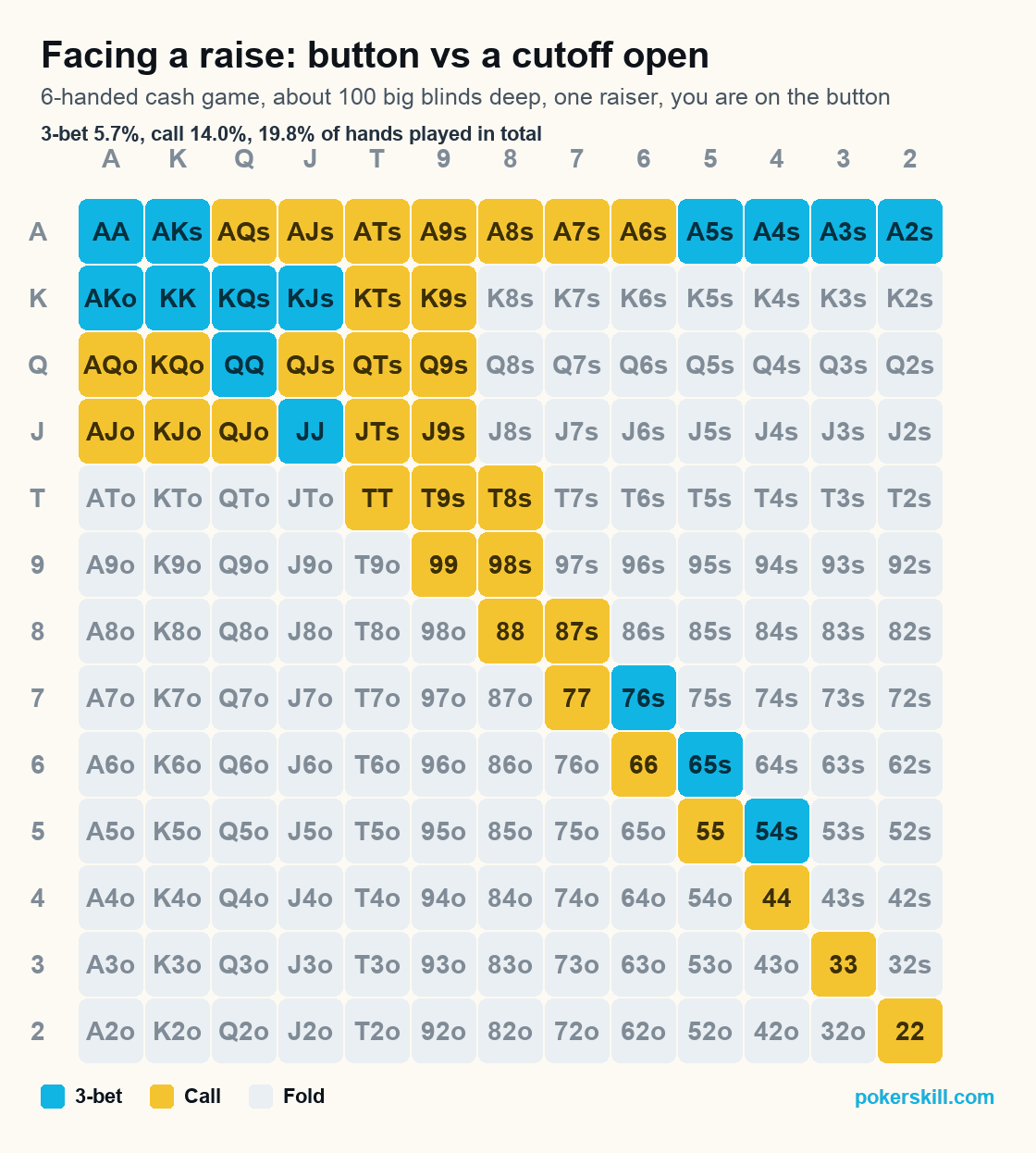
Big pairs and the strong broadway hands. Queens and better plus ace-king is the safe core against most openers, and it widens to jacks and other strong broadways against people who open late and open often. Every one of these wants the pot bigger, and every one of them is ahead of the range that keeps playing after the raise, which is the only comparison that counts. That wider version is what Poker Skill deals in its lesson on the big blind against a button open, where ace-king suited, kings and queens are value 3-bets and so is ace-jack suited, because a button opens so many hands.
Bluff-shaped hands
The second group is the one that confuses people. Suited wheel aces (A5s down to A2s), suited broadways like king-queen suited and king-jack suited, and small suited connectors are the classic re-raising bluffs. They are not random junk. Each one does two jobs: it blocks part of what the opener needs to continue, and it makes real hands often enough to keep playing after the flop. A suited wheel ace holds an ace, which is one fewer strong ace they can have, and it flops nut flush draws and wheel draws.
Linear or polarized
Those two groups are the whole idea behind polarized and linear ranges. The grid above is the polarized shape: two bands with a hole in the middle. A linear range fills that hole instead and drops the bluffs.
| Polarized | Linear | |
|---|---|---|
| What is in it | The best hands, plus bluff-shaped hands | The best hands, plus the solid hands just below them |
| What is missing | The solid middle | The bluffs |
| On the grid | Two bands with a gap | One block from the corner outward |
| Use it against | A player who folds too much to aggression, because that is when the bluffs work | A player who calls everything, because bluffs have nobody to fold out and your solid hands get paid |
Check yourself
The cutoff opens to 2.5 big blinds and you are next, on the button. You hold the ace of clubs and the ten of hearts. 3-bet, call, or fold?
Show the answer
Fold, or call at best, and folding is the honest default. Ace-ten offsuit is not a value 3-bet: it is behind the range that keeps playing after a re-raise. It is not a bluff 3-bet either, because it is not suited, so it makes neither the nut flush draw nor the wheel draw that gives the small suited aces their second job. It is the exact hand the next section is about.
Facing a 3-bet
Somebody re-raises you. The hand you hold decides which of three answers you give.
Call with hands that play well in a bigger pot against a stronger range. Middle pairs, suited broadways and suited aces are the usual candidates, though whether a given one continues depends on your position and how deep the stacks are. Deeper stacks and a seat in position both widen what is worth a call.
4-bet with the top of your range. When the action gets to raise, re-raise, re-re-raise, the honest continuing range is very short: aces and kings are always in, and jacks or better with ace-king is about as wide as it gets against most opponents.
Fold the hands that are dominated, and there will be more of them than you expect. Ace-ten offsuit and king-jack offsuit look strong right up until someone re-raises, and then they are behind the range doing the raising and awkward to play even when they connect. Cold-call or 3-bet works through that decision properly, including the spots where flatting is better than either raising or folding.
Where this fits in your decision
The 3-bet is the first place most players meet the idea that a hand’s strength depends on the range that continues rather than the range that started. Once that lands, the rest of preflop gets easier: which opens to attack, which to leave alone and which hands are worth a bigger pot. Learn the two hand groups first, then worry about how often. The 3-bet range charts have the full grid this page borrows plus the blinds version, free to read or print, and the preflop chart library carries the wider set.
Frequently asked questions
What is a 4-bet?
The next re-raise. Open raise, 3-bet, then 4-bet, and the counting keeps going from there. A 4-bet is a much stronger action than a 3-bet, because it beats a range that already re-raised once, which is why the hands that 4-bet for value are usually just the biggest pairs and ace-king.
Is 3-betting only preflop?
No, though that is where you hear it most. Any third bet on any street can be called a 3-bet: a flop bet, a raise, then a re-raise is a 3-bet on the flop. The preflop version comes up far more often, so the word drifted toward it.
How big should a 3-bet be?
About three times the original raise is the shape you will see most often from a player in position. The exact multiple matters less than the job the size has to do, which is to make calling with a weak hand a real decision instead of a cheap one. Sizes move around with position, stack depth and how the table has been playing, so treat three times as the reference point rather than a rule.