


Color Up
Coloring up means swapping lower-denomination chips for higher ones as the blinds climb, so the table stays countable. The chip race is the procedure that handles the leftovers.
Color up in tournaments
What coloring up is
Coloring up is exchanging lower-denomination chips for higher-denomination ones so the number of chips on the table stays manageable as the blinds climb. Early in a tournament a 25 chip is useful. Ten levels later the small blind is 4,000 and a rack of 25s is just clutter that slows the count. So the room removes the small denomination from play, hands out larger chips at equal value, and the game speeds back up.
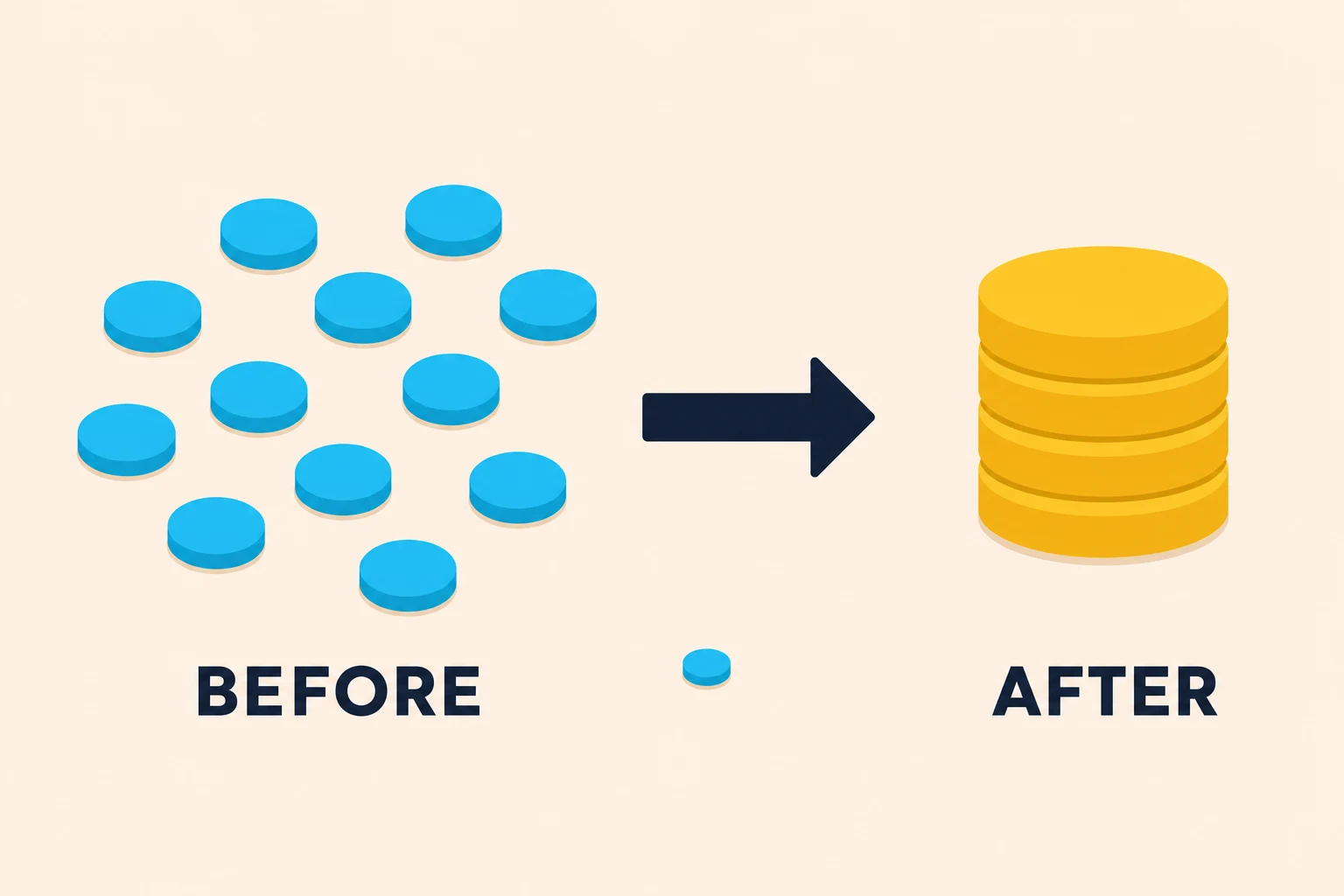
A color-up is an exchange, not a fee, and the rules say so where it matters most. Poker Tournament Directors Association Rule 24 states that chips of a removed denomination still held after the race are exchanged for current denominations only at equal value. What the exchange cannot do is make the arithmetic come out clean for every player, and that leftover is where the chip race comes in.
Related terms
- MTT: the format where scheduled color-ups happen, usually at a break.
- Blinds: the rising cost that makes small denominations obsolete.
- Ante: the other forced bet whose size drives which chips still matter.
- Big blind: the unit worth counting your stack in, before and after a color-up.
- Effective stack: the number a color-up leaves unchanged, give or take one chip.
- Stack depth: what actually governs your strategy, not the chip count.
- Bet sizing: the thing a coarse chip set quietly restricts.
- Min-raise: the floor your sizing options collapse toward when small chips are gone.
Color up versus chip race
The two words get used interchangeably at the table, but they name different steps of the same operation.
| Color up | Chip race | |
|---|---|---|
| What it is | Swapping small chips for larger ones at equal value | The procedure that resolves chips left over after the swap |
| When it happens | Usually at a scheduled break, sometimes at the director’s discretion | Immediately, as part of the same color-up |
| Who it touches | Everyone at the table | Only the players holding odd chips |
| Can it change your stack | No, it is an equal-value exchange | Yes, by at most one chip in either direction |
The Poker Tournament Directors Association rules cover both. Rule 24 handles scheduled color-ups and states that chips are raced off starting in seat 1, with a maximum of one chip awarded to any player. Rule 25 gives the director control over how many chips and which denominations are in play, and allows a discretionary color-up of one or more players at any time, as long as it is announced.
What the rules guarantee you
Three things in the rules answer the anxieties players actually have during a race.
You cannot be raced out of the tournament. Rule 24 states that a player losing their last chip or chips in a race is given one chip of the lowest denomination still in play. Getting unlucky in a chip race can cost you chips. It cannot eliminate you.
One chip is the maximum swing. A maximum of one chip is awarded to any player in the race. Whatever the size of your leftover pile, the race is not going to hand you a windfall or take one from you.
You are entitled to watch. Rule 24 says players must have their chips fully visible and are encouraged to witness the chip race. If you are unsure how the room runs it, stand up and watch. That is the intended behavior, not a complaint.
One thing the rules do not guarantee is value for chips too small to matter. Under Rule 24, chips of a removed denomination that do not total at least the smallest denomination still in play are removed without compensation.
Example: a color-up that changes how you bet
Level 12 of a tournament, blinds 2,000 and 4,000. Green 500 chips come out of play, and the smallest chip left is the 1,000. You had 6,500 in greens, so 6,000 exchanges cleanly for six 1,000 chips and your last 500 goes to the race.
Your stack goes from a sprawl to a tidy column. Your stack depth is essentially unchanged, which is the point: 40 big blinds before, 40 big blinds after, plus or minus a chip.
Poker Skill’s preflop lessons show the same idea: some tables stack 1,000 chips against a 10-chip big blind, others 200 against a 2-chip one, and every stack is still 100 big blinds.
What did change is the menu. With 1,000 as your smallest chip and a 4,000 big blind, your available opening sizes from the button are 8,000, then 9,000, then 10,000. There is no 8,500. The chip set has quietly turned a continuous choice into a stepped one, and every player at the table is now picking from the same handful of steps.
That is a smaller effect than it sounds at 40 big blinds and a larger one when stacks get deep relative to the smallest chip. It is also the reason experienced tournament players pay attention to color-up schedules that strip denominations aggressively: less granularity in the chip set means less granularity in bet sizing, for everyone.
Common mistakes
1) Recounting your stack in chips instead of big blinds
A color-up shrinks your chip count dramatically and leaves your position in the tournament untouched. Players who track “how many chips do I have” feel a loss that did not happen. Count in big blinds instead and the color-up is a non-event.
2) Hiding chips during the race
Rule 24 requires chips to be fully visible during a color-up. Sitting on a stack, covering it with a card protector, or wandering off mid-race is how you end up with an unresolved count and a floor call. Push the odd chips forward and let the dealer work.
3) Assuming a race is negotiable
The race resolves under the room’s procedure and the result stands. Rule 24 already caps the whole event at one chip in either direction, so there is nothing in it worth an argument with the dealer.
4) Burying the large chips you just received
Rule 25 says chips should be kept in countable stacks, recommends clean vertical stacks of 20 same-denomination chips, and requires higher denomination chips to be visible and identifiable at all times. A color-up hands you the biggest chips you have held all tournament, and tucking them behind a wall of smaller ones is the exact situation that rule exists for. Opponents are entitled to a reasonable estimate of what you have.
FAQ
What does it mean to color up in poker?
It means exchanging your lower-denomination chips for higher-denomination ones at equal value, so the table has fewer chips to count as blinds rise. Rooms usually do it at a scheduled break, and the tournament director can also call a discretionary color-up at any time as long as it is announced. Your stack value stays the same across the exchange.
How does a poker chip race work?
After the equal-value exchange, some players hold chips of the removed denomination that do not divide cleanly into the new smallest chip. Those leftovers go to the race, which the Poker Tournament Directors Association rules run starting in seat 1, awarding a maximum of one chip to any single player. A player who would lose their last chips in a race is given one chip of the lowest denomination still in play, so nobody is eliminated by a race.
Can you lose chips in a chip race?
You can lose the odd chips you put into the race, and that is the whole exposure. The maximum any player gains is one chip. Chips of a removed denomination that do not total at least the smallest remaining denomination are removed without compensation, which is why players sometimes see a small pile disappear and nothing come back.
Does a color-up change my strategy?
Your stack depth in big blinds is what drives strategy, and a color-up leaves that alone. The one real effect is on sizing: when the smallest chip in play is large relative to the blind, your available bet and raise sizes become a short list of steps rather than a continuous range. That constrains everyone equally, and it matters more the deeper the stacks are.