
Push/fold arrives before most players think, somewhere around 15 big blinds, because that is where the middle options start losing money quietly. Raise to two and a half out of twelve, watch somebody move in behind you, and you are choosing between folding a fifth of your stack and calling off with a hand you never wanted.
One book draws the line at 12: at that depth and below, it says, you are in push all-in or fold mode. That is a simplification rather than a law, and it is a good one to learn first.
The reason is not that you are about to blind out. That framing gets people shoving too early, and books warn about it directly. The reason is arithmetic, and it is drawn two sections below. Everything here assumes what the push/fold charts assume: the pot is unopened when the action reaches you, the table is nine-handed, and the numbers count chips rather than prize money.
Why shoving beats raising when you are short
Fold equity is the engine
An all-in wins the pot immediately every time everyone folds, and at 12 big blinds the blinds and antes you collect are a real fraction of your stack. Those uncontested pots are not a consolation prize, they are most of what the strategy earns. The books’ framing is worth keeping: you are risking fewer chips to win the same reward, so the shorter you get, the more hands clear that bar.
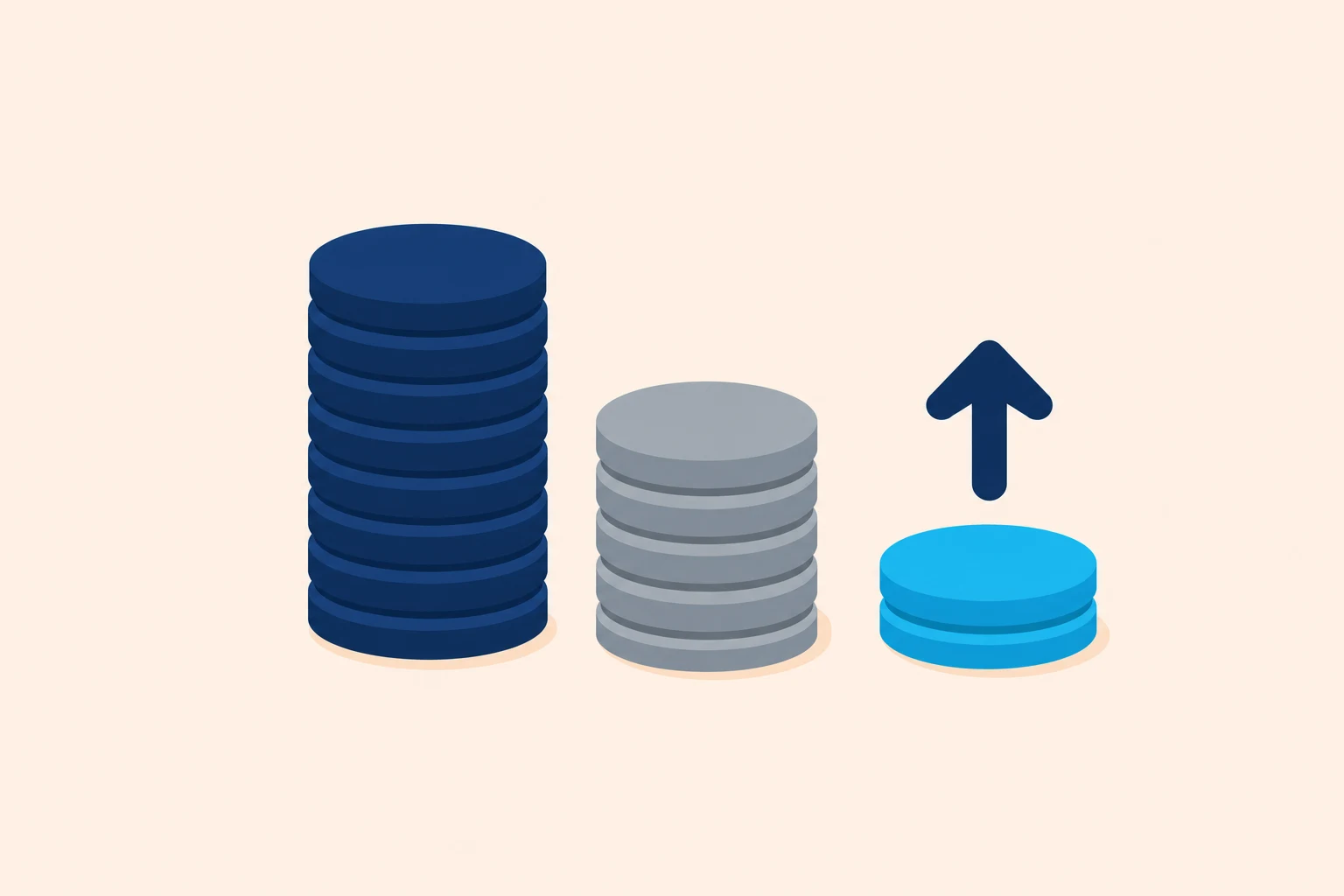
That last sentence is the whole strategy, and it is easier to see than to read. The reward never changes: the small blind and the big blind sitting in the middle, 1.5 big blinds before anyone posts an ante. What changes is how much of your stack that reward is worth.
Antes push every one of those bars further right, because they add dead money to the reward without changing what you risk.
Raise-folding bleeds the stack you need
Raising small with a short stack invites the worst outcome available: you put chips in and then let go of them. Books build small-blind strategies around exactly that problem, keeping the raising range for hands that can call a jam and moving the rest elsewhere. Deliberate raise-folding does exist at these depths, in the hands of players who planned the whole sequence. Raising because a shove felt too big is not that plan, and it is the version that empties short stacks.
You do not want a postflop pot at this depth
Open-shove 8 big blinds and the hand becomes one decision followed by a showdown. Put a third of it in and see a flop instead, and you are playing the same money across three streets with more ways to get it wrong, out of position most of the time. A jam removes the streets you are least equipped to play at that depth.
Where push/fold starts
There is no single line, and books name several depths for good reasons. Everything below assumes the simplest case, the one the charts assume too: the pot is unopened when the action reaches you, the table is full, and you are counting chips rather than prize money.
| Stack | What the simplification looks like |
|---|---|
| Above 20 big blinds | Normal raising, tighter when the players behind can jam over you |
| 15 to 20 | Shoves enter the picture, and the small blind starts mixing pushes with limps |
| 12 to 15 | Mixed: some shoves, some limps, plenty of folds, and raises still exist from late seats |
| Under 12 | One book’s cutoff for push all-in or fold, which is where the charts do their work |
| Under 6 | Ranges get very wide, and position moves them more than at any other depth |
Read that table as a ladder of defaults rather than a set of switches. Real short-stack play still contains small raises from the button and limps from the small blind at depths where the chart says shove, which the chart page says in its own words, and satellites break the top row entirely by making survival worth more than chips.
The preflop charts cover what raising looks like at the depths above this table, which is where you want to be playing whenever you can.
What changes what you shove
| What moves it | Which way | Why |
|---|---|---|
| Position | Later is much wider | From the button two hands are left to get through. From an early seat at a full table there are several, and every one of them can wake up |
| Antes | Wider | More dead money in the middle makes the uncontested pot bigger, so the bar for a profitable shove drops. Ante levels are where short-stack ranges open up |
| Who is behind you | Tighter, if they never fold | A big blind who calls everything removes the fold equity your shove was built on |
| The bubble | Both ways at once | Chips stop being worth the same to everybody. A big stack can pressure the players who cannot afford to call, while the stack that would bust by calling folds hands it would otherwise play |
Two reasons send you wider on the button when a hand is folded to you in Poker Skill’s preflop lessons, played with deep stacks: you have position, and only the blinds are left to act. A shove keeps the second reason and drops the first, since nobody bets again once the all-in is called.
Read the stacks behind you carefully, not just the seat count: a player who would be all in by calling is sometimes the tightest seat at the table and sometimes the loosest, depending on what the price and the payouts are doing to them. The bubble correction has a name, ICM, and the chart page gives it a section of its own. It is the one adjustment worth deferring to a chart rather than eyeballing.
Use the chart, learn the shape
Charts are for memorising, and the memory that survives is a shape rather than a grid. Here are the two depths this page keeps naming, drawn. Both come from the free push/fold charts, which publish all five charts with their assumptions stated.
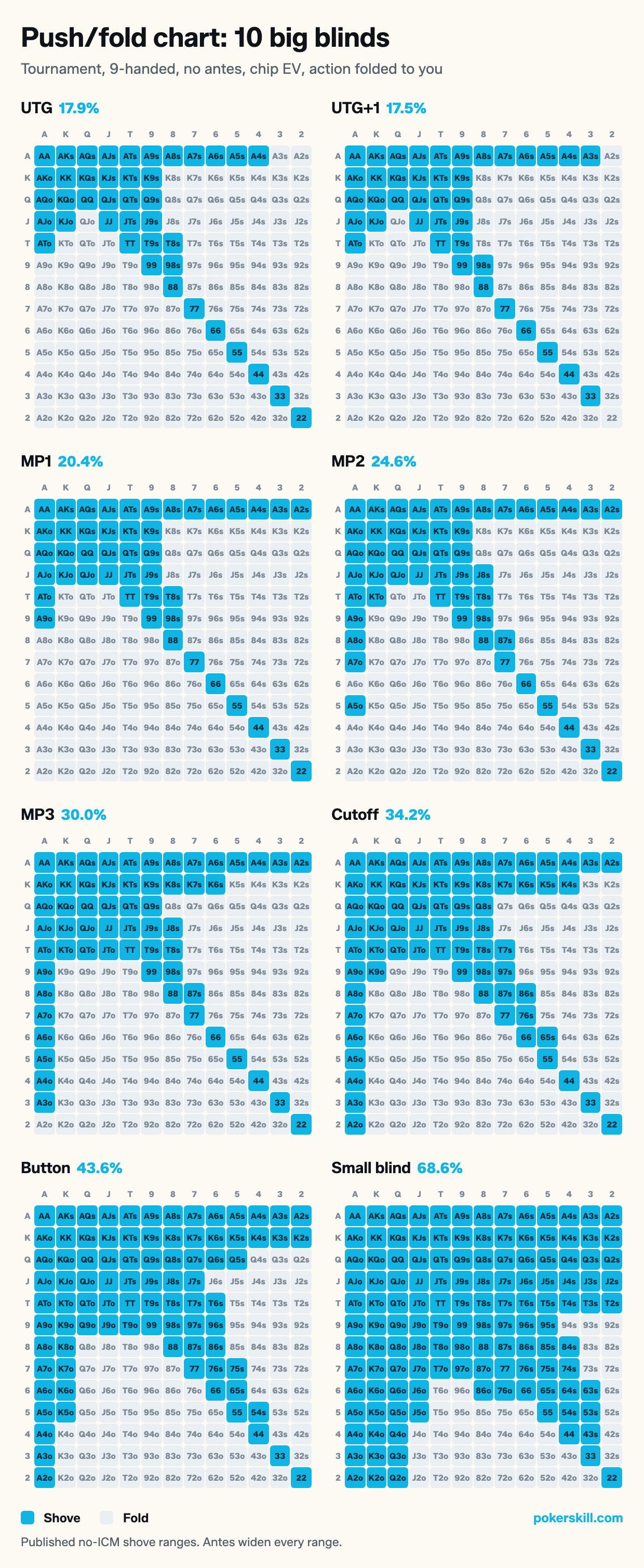
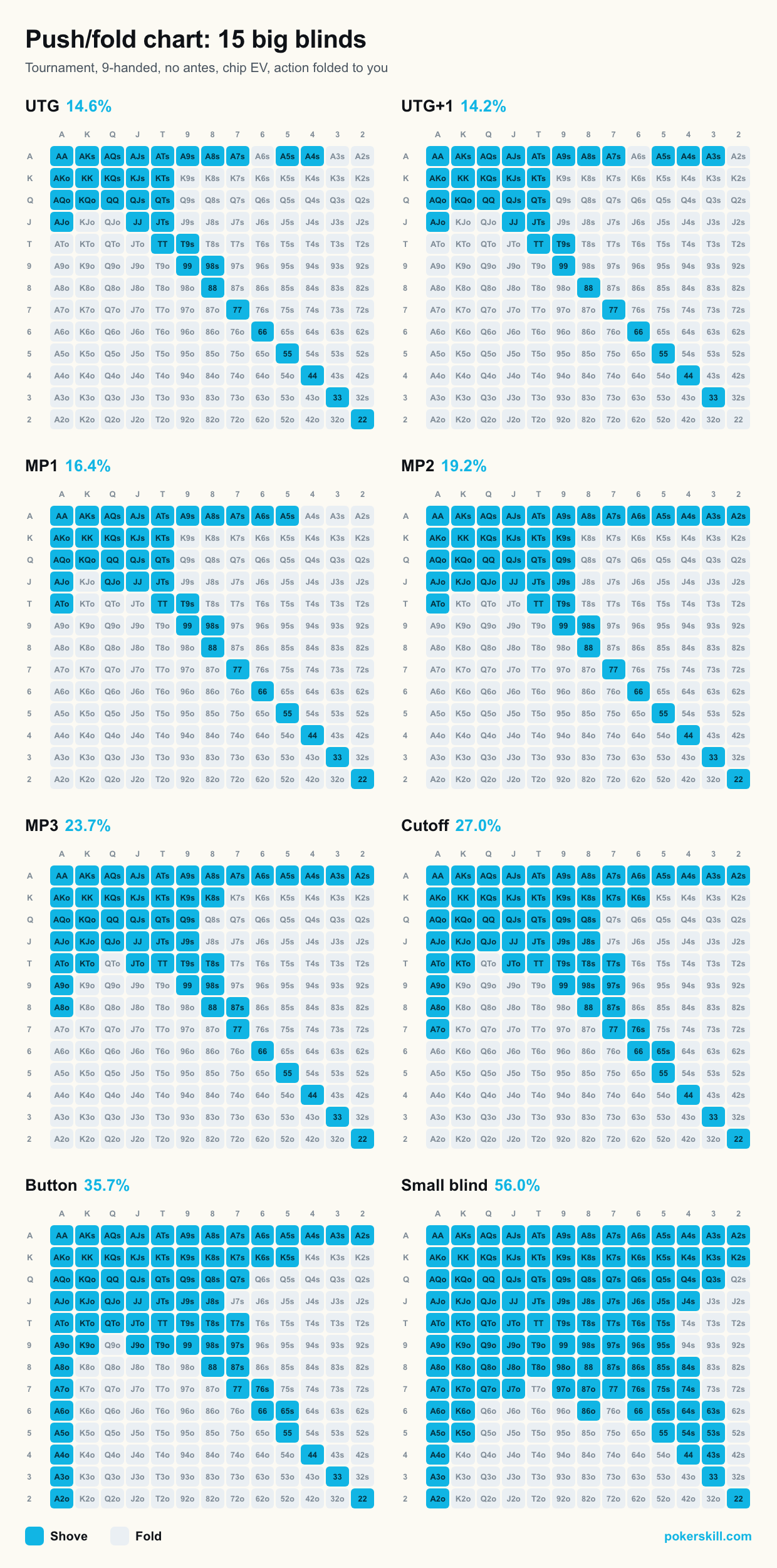
Three things worth carrying from those grids without memorising a cell:
- Pairs are the backbone. On both grids nearly every seat shoves every pocket pair, down to deuces. The smallest pairs are among the first hands to go as the stack gets deeper: on the 20 big blind chart the two earliest seats start at fives. Even at 10 big blinds the tightest early-position ranges start a little above deuces.
- Aces come in early, and suited beats offsuit at the margin. Ace-rag suited is a shove from seats where its offsuit twin is a fold, which is not the same as saying the kicker stops mattering.
- Broadway hands widen with position. King-jack from the button and king-jack from an early seat are different hands.
Check yourself
Eight big blinds, nine-handed, no antes, folded to you on the button. You hold the king of spades and the seven of hearts. Shove or fold?
Show the answer
Shove. Eight big blinds sits between the published 5 and 10 big blind charts, and the button’s range at both depths already contains it: the published 10 big blind button range runs to K5o and better, and the 5 big blind range is wider still. The button is shoving about 44% of all hands at 10 and about 54% at 5, so a king-high offsuit hand is nowhere near the edge. Folding it is the leak the next section is about.
The mistakes that leak chips
Limping into a pot you cannot defend
Off the small blind, limping short gives everyone behind a cheap look at a flop you cannot play. The exception is the small-blind mixed strategy above, and it is an exception with a plan attached, not a habit.
Min-raising when you are already committed
A raise that leaves you three big blinds behind has already committed you, and it asks your opponent to risk less to find out. If the chips are going in either way, put them in while the size of the bet still pressures somebody.
Calling off with a hand that only looks strong
Shoving ranges and calling ranges are not the same list. Ace-eight can be a shove from late position and a poor call against an early-position shove, because the range coming at you from up front beats it. Read the two lists separately.
Waiting for a premium until you have four big blinds
The most expensive mistake on the list. One book tells short stacks to fight rather than ante away while waiting for a premium, and another says to start moving all in once a normal raise would cost a quarter of your stack or more. At four big blinds the fold equity you were saving up is already shrinking, and by two or three big blinds the big blind’s calling range widens sharply. Shoving a mediocre hand at 12 usually beats shoving a good one at 4.
Frequently asked questions
What stack size is push or fold?
There is no single line, and books name several. Around 20 big blinds you are still raising normally, just more carefully. Around 15 you are in mixed territory, where some hands shove, some limp from the small blind and the rest fold. At 12 and below, one book calls it plainly: you are in push all-in or fold mode. Under about 6 big blinds the ranges get very wide and the seat you are in moves them a long way. Treat 15 as the depth where the idea starts mattering and 12 as the depth where it takes over, for an unopened pot at a full table with chips rather than prize money on the line. Change those conditions and the depth moves.
Should you ever limp with 10 big blinds?
From the small blind, yes, and books describe exactly that: a mixed strategy in the 10 to 15 big blind range where some hands push, some limp and the rest fold. It is the hardest short-stack line to run properly, because you need a plan for what happens when the big blind raises. Everywhere else at that depth, shoving or folding is the strategy that costs you least.
Do push/fold ranges change on the bubble?
Yes, and not always in the same direction. Busting costs real prize money near the money, so the stack that would be eliminated by calling plays tighter, while a stack that covers the table can shove wider precisely because the players behind cannot afford to call. That adjustment has a name, ICM, and the push/fold chart page gives it a section: at a final table with big pay jumps, small pairs, weak suited connectors and weak offsuit aces are the hands that lose value. Use it near the money instead of guessing at the correction.