


In the heads-up match of the 2003 WSOP Main Event, Chris Moneymaker moved all in on the river with king-high after missing a flush draw and a straight draw. Sammy Farha folded a pair of nines, the better hand, rather than risk his last 2.9 million chips on a call.
Moneymaker held K♠ 7♥ and Farha Q♠ 9♥ on a 9♠ 2♦ 6♠ 8♠ 3♥ board. Moneymaker went on to win the title and $2.5 million.
Below, you face the river the way Farha did, with Moneymaker’s cards hidden, before the video and the full hand. If you want the general skill instead, how to bluff in poker covers which hands make good bluffs.
Would you call? The spot Farha faced
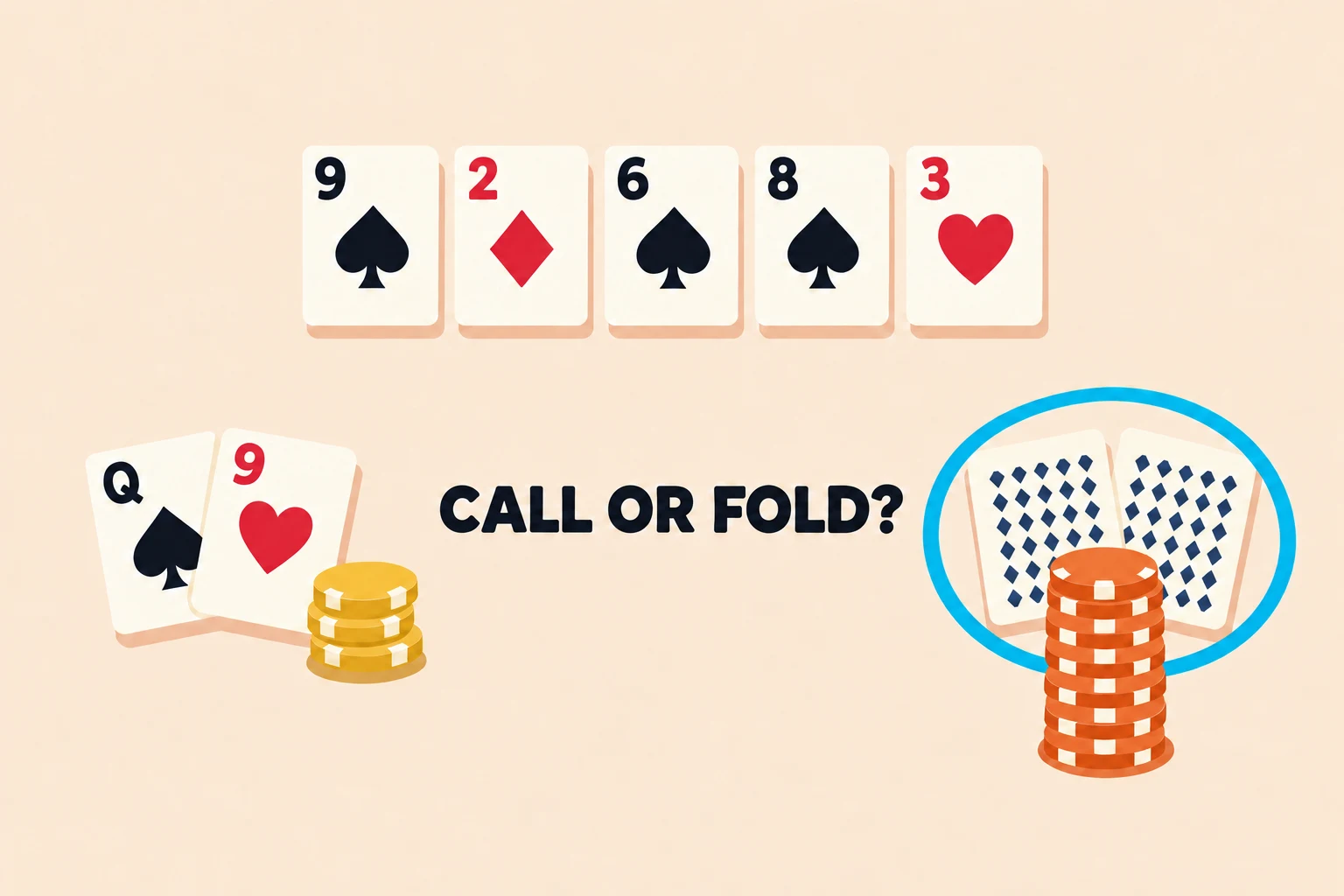
It is heads-up for the world title at Binion’s Horseshoe in Las Vegas. Farha has the queen of spades and nine of hearts. The board has run out 9♠ 2♦ 6♠ 8♠ 3♥, so he has a pair of nines with a queen kicker, and three spades sit on the board. He checks the river. Moneymaker moves all in and has him covered, so a call risks Farha’s whole stack.
The pot before the shove is about 1.8 million. Farha has about 2.9 million left, so that is what a call costs. Call and the pot grows to about 7.5 million, and his 2.9 million would be about 38% of it. So a call has to win 38% of the time to break even in chips. Pot odds give you that number for any all-in.
Then Farha talks. “You must have missed your flush, huh?” he asks. Moneymaker keeps his hand over his mouth and says nothing. Before you open the answer, make the call from Farha’s chair, knowing only what he knew.
Show what Moneymaker had
Farha folded, and Moneymaker had king-high. He held the king of spades and seven of hearts. Both his draws had missed, and Farha’s pair of nines was ahead when he let it go.
Watch the hand
The video plays the hand from Farha’s side of the table, gives you four seconds to make your own call, then shows the fold and puts both men’s later accounts next to the footage.
The 2003 Main Event bluff in 4 minutes 21 seconds, from the first raise to Moneymaker’s title.
How the hand was played, street by street
Moneymaker started the hand with about 4.62 million chips and Farha with about 3.77 million. Here is every action, with Moneymaker’s cards shown.
Moneymaker raises to 100,000. Farha calls with Q♠ 9♥.
Farha flops top pair and checks. Moneymaker checks behind with two spades on the board and his king of spades.
The eight of spades gives Moneymaker a flush draw and an open-ended straight draw. Farha bets 300,000. Moneymaker raises to 800,000, and Farha calls the extra 500,000.
The three of hearts misses both draws. Farha checks and Moneymaker moves all in. Farha folds.
What Moneymaker had on the turn
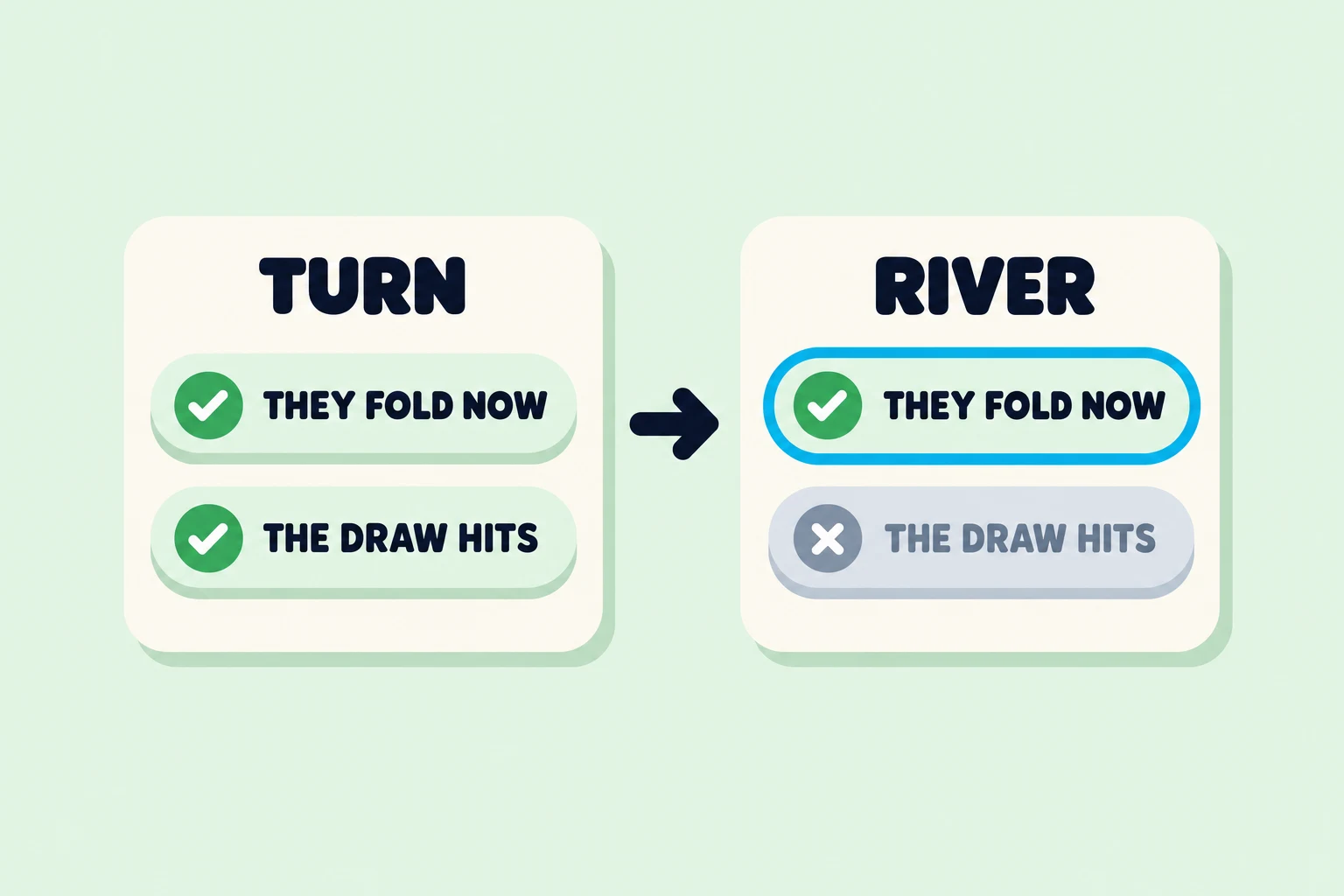
The turn raise was a semi-bluff. On 9♠ 2♦ 6♠ 8♠, the king of spades gave Moneymaker four spades, a flush draw. The seven of hearts gave him 6-7-8-9, an open-ended straight draw that a five or a ten would complete. Holding both at once is a combo draw: from his seat, 9 spades and 6 more fives and tens were live, 15 outs in all.
Against Farha’s actual hand, the count changes a little. Farha’s queen of spades took one of Moneymaker’s flush cards away, but a king would now win too, as a bigger pair. That makes 8 spades, 6 fives and tens and 3 kings: 17 of the 44 river cards.
The river was the three of hearts, one of the 27. Moneymaker was left with king-high and one way to win the pot.
Why Farha folded, in his words
Farha explained the fold to Michael Kaplan of Card Player in a January 2007 interview. He said he had put Moneymaker on a draw: “I set him up to do exactly what he did. I was not going to put him all in. He had been lucky throughout the World Series, he was on a straight or flush draw, and I knew he would go all in if he missed.”
He folded anyway, for two reasons. “My problem was that I was so tired, I was practically in a coma,” he said. He thought he could win with the chips he had left: “I figured, why gamble? I knew I could catch him in a different situation. But, still, I knew I had him, and it bothered me that I laid it down.”
Why Moneymaker shoved and kept quiet
Moneymaker told Dan Cypra of Poker News Daily in December 2008 that he expected the turn raise to end it: “When he bet and I raised, I really thought that he was going to fold.” When Farha called, he already knew what he would do on the river: “My intention was to move all in on any river card that wasn’t a spade.”
Then Farha asked about the flush. “It was a little bit harder to breathe and it was a bit tough to swallow, but I tried not to move and tried not to give anything away,” Moneymaker said. He kept quiet because of something he had watched hours earlier: “About seven or eight hours earlier, Sammy said something to Amir Vahedi. Sammy instantly called him when he was bluffing because Vahedi said something back. I just tried not to say anything to give him any information.”
You can see that stretch in the video: Farha asks about the flush and Moneymaker keeps his hand over his mouth. Any answer could have been a tell.
What happened next
The bluff did not end the match. Moneymaker still had to win the final hand, 5♦ 4♠ against Farha’s J♥ 10♦, and when he did he became world champion and took $2.5 million. Farha, already a WSOP bracelet winner from 1996, took $1.3 million for second.
The champion was an accountant from Tennessee who had qualified online, and the Main Event was his first live poker tournament. That is the champion ESPN viewers met when the broadcast aired. The 2003 Main Event drew 839 entries at $10,000 each. In 2004 it drew 2,576. Moneymaker’s win helped set off the poker boom.
Where this fits in your decision
You can face Farha’s spot at any stakes: a pair on a board where a draw just missed, a big bet into you and an opponent who will not talk. Heads-up poker explains why hands get this wide with two players, and how to play flush draws covers Moneymaker’s side of the turn. To check a price like Farha’s yourself, use how to calculate pot odds. For what a silent opponent might be telling you, read poker tells.
Frequently asked questions
What cards did Chris Moneymaker have against Sammy Farha?
King of spades, seven of hearts. On the 9♠ 2♦ 6♠ 8♠ 3♥ board that left him with king-high and nothing else: his flush draw and his straight draw both missed on the river. Farha held queen of spades, nine of hearts, a pair of nines.
Did Sammy Farha fold the better hand?
Yes. Farha's pair of nines beat Moneymaker's king-high, and he folded it to the river all-in. In a 2007 interview he said he had expected the all-in and had meant to call.
How much did Chris Moneymaker win at the 2003 WSOP?
$2.5 million for first place in the $10,000 Main Event, which drew 839 entries. Sammy Farha took $1.3 million for second.
How did Chris Moneymaker get into the 2003 Main Event?
He qualified online. He was an accountant from Tennessee, and the Main Event was his first live poker tournament.
What was the last hand of the 2003 Main Event?
A later hand, not the bluff. Moneymaker held 5♦ 4♠ and Farha J♥ 10♦, and Moneymaker won it to take the title.