
Bluff the hands that lose at showdown but can win the pot two ways, folds now or a better hand later, and leave your medium-strength hands alone. Did the hand you bet with block the calls you were afraid of, could it still improve if someone called and were you attacking a player who actually folds?
Miss all three and you were betting into a wall. Hit two of them and you had a real bluff, even on the hands where you got looked up and lost the pot.
No, that bluff was not bad because it lost. It was bad or good before the cards came. So run the hand back through those three questions instead of through the result. If you bet a flush draw at a player who folds too much, you had a bluff whether it got there or not. If you bet second pair at someone who calls with any pair, you had a bad bluff that happened to work the one time he folded. How often you should be bluffing is a separate math question with its own home: optimal bluffing frequency has that one.
Bluff candidates and never-bluff hands
One more line belongs on the right-hand column and does not need a board: any of these hands against a calling station, on any board. The fold is not coming.
Which hands make good bluffs
The hands that bluff well are the ones that are losing right now and have a reason to keep betting. That reason is either equity, a blocked call, or a story the board already told for you.
Draws first: the semi-bluff
A draw is the cheapest bluff in poker because it wins two ways. Your opponent folds and you take the pot now, or your opponent calls and you still have live cards to make the best hand. That two-way property is what makes the semi-bluff the first bluff most players should learn. A bluff with no outs depends on everyone folding, and when it gets called there is no way back.
Flush draws, open-ended straight draws and combination draws with two overcards are the classic candidates. In Poker Skill’s lesson on bluffs and semi-bluffs, the open-ender J♠ 4♥ on 3♦ 5♠ 6♥ bets and the four-out gutshot 7♠ 10♣ on 4♦ 8♠ J♣ checks.
You have not made anything yet, but a bet here has the whole package: the nut flush draw, two overcards and the ability to keep firing on a club or a broadway card. Position sharpens it further, because acting after the original bettor tells you whether the pressure is landing.
Hands that block the calls
A blocker is a card in your hand that removes a hand from your opponent’s range, and the ones that matter are the cards in their calling range, not the cards in their folding range. Aces and kings do the most work, and queens and jacks start to matter when the opponent is defending wide.
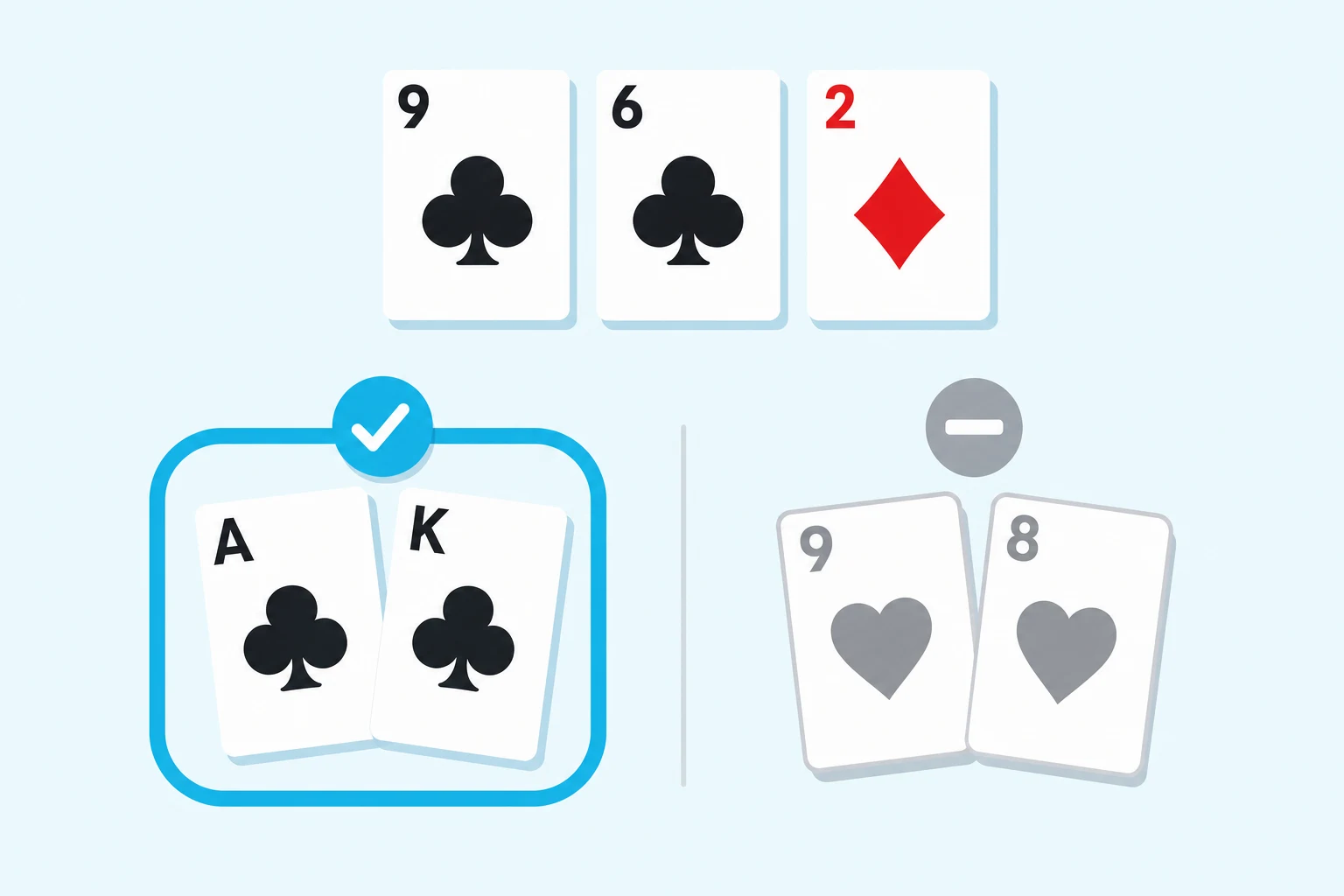
That hand makes no pair at all, and it still takes combinations out of both straights that beat you: the king removes some of the K-T combos, the eight removes some of the T-8 combos. Those are the hands most likely to call a big river bet, and you hold a piece of each. Bet. When two candidate hands look equally worthless, take the one that blocks the call. That is what the bluff-to-value ratio conversation is really about once you get past the arithmetic: which specific hands you pick to fill the bluff side.
Self-check: which of these two is the bluff?
Same board, two worthless hands. Pick the one you fire, then open the answer.
Show answer
Hand A, the king-eight of diamonds. Hold the six-five of hearts on the same board and you block nothing your opponent cares about, so the bet is just money. Both hands are worthless at showdown; only one of them removes the calls you are afraid of.
No showdown value, but a barrel that makes sense
Some hands have no equity and no blocker and are still the right bluff, because the board handed you a story. A turned ace on a low flop, a third card of a suit, a card that completes the obvious straight: those cards weaken the range that called your flop bet more than they help it, and the hand you happen to be holding matters less than the card that just landed. The 4-bet bluff preflop is the same idea moved earlier: the action itself is the story, and the specific two cards are chosen for what they block.
Which hands should never bluff
Your bluff-catchers are not bluffs. A weak pair, a middle pair, an ace high with no draw: these already have a way to win the pot, which is that your opponent’s bluff loses to them at showdown. Turning them into bets throws away that job. A hand with showdown value is usually worth more when it can still reach showdown.
Betting turns your eights into a bluff, and the only hands folding are the hands you already beat. Every ace calls. Check, and your eights still win at showdown against the king-high and the busted draw. The middle of your range is the part you protect, not the part you fire with.
Where bluffs actually profit
Hand selection gets you a candidate. Spot selection decides whether it wins.
The opponent, first
The most reliable filter is the person across the table. A calling station calls with anything that might win. Do not bluff them, value bet them instead. A tight, cautious player who folds when the board scares them is the reason bluffing works at all. Before you pick the hand, pick the opponent who is capable of folding.
The board tells the story
Board texture changes both what you can represent and what will fold. On wet, connected boards, people continue more often, so pure bluffs land less and draws become the better bet because they still have equity when called. Take a low coordinated board and a broadway turn card:
The king of clubs is a better bluffing card than a small card, because it beats the middle pairs and weak draws that called your flop bet.
Spots people under-bluff
There are places where almost nobody bluffs, and those are the places where a bluff gets the most respect. The river check-raise is the clearest one: it reads as the nuts to almost every player, which is exactly why it works when the story supports it. The river bet after a scare card that kills the hands your opponent called the turn with is another. The pattern behind both is the same: a bluff is under-used precisely where it is hardest to believe someone would try it.
Before you fire, check three things
Miss all three and the bet is money. Hit two and it is a real bluff, whatever the river brings.
The mistakes that burn chips
Bluffing the player who cannot fold
This is the biggest one and it is not close. You can pick a perfect blocker hand on a perfect board, and if the person facing the bet calls with any pair, none of it matters. Fold equity is a property of the opponent, not of your cards.
Bluffing into three people
Each extra player is another chance that someone has enough to call. Heads up you have to move one person. Three ways you have to move two, and one of them usually finds a reason. Bluff less when the pot is multiway, and give the pure bluffs up entirely.
Doubling down on a dead story
The second and third barrel need to make sense as the same hand. If the turn and river do not help the story you started on the flop, a bigger bet does not fix it, it just costs more. When the runout stops supporting the hand you were representing, check and keep the chips.
Where this fits in your decision
Hand selection is one of three questions a bluff has to answer. Which hand, which spot and how often. This page covers the first two. The third is arithmetic and it lives on the bluffing frequency page, where the ratio between your value bets and your bluffs gets worked out properly. Learn the hand classes first. The math is easier to apply when you already know which hands you are choosing between.
Frequently asked questions
What hands should you bluff with?
Hands that are losing now but win two ways: flush draws, open-ended straight draws and combination draws first, then hands that block the cards your opponent needs to call, then hands with no showdown value on a board that just changed in your favor. Leave weak pairs and other bluff-catchers out of it, because they already beat the hands you would be folding out.
How often should you bluff?
Often enough that your value bets get paid, and that ratio is a real calculation rather than a feel. It has its own page: optimal bluffing frequency works through where the number comes from and how to use it at the table.
Is bluffing profitable at low stakes?
Selectively. Low-stakes games have more players who call too much, so the pure bluffs that work in a tough game get paid off in a soft one. Semi-bluffs still work everywhere, because they win when the fold comes and they win again when the draw hits. The adjustment is not to stop bluffing, it is to stop bluffing the people who never fold.