
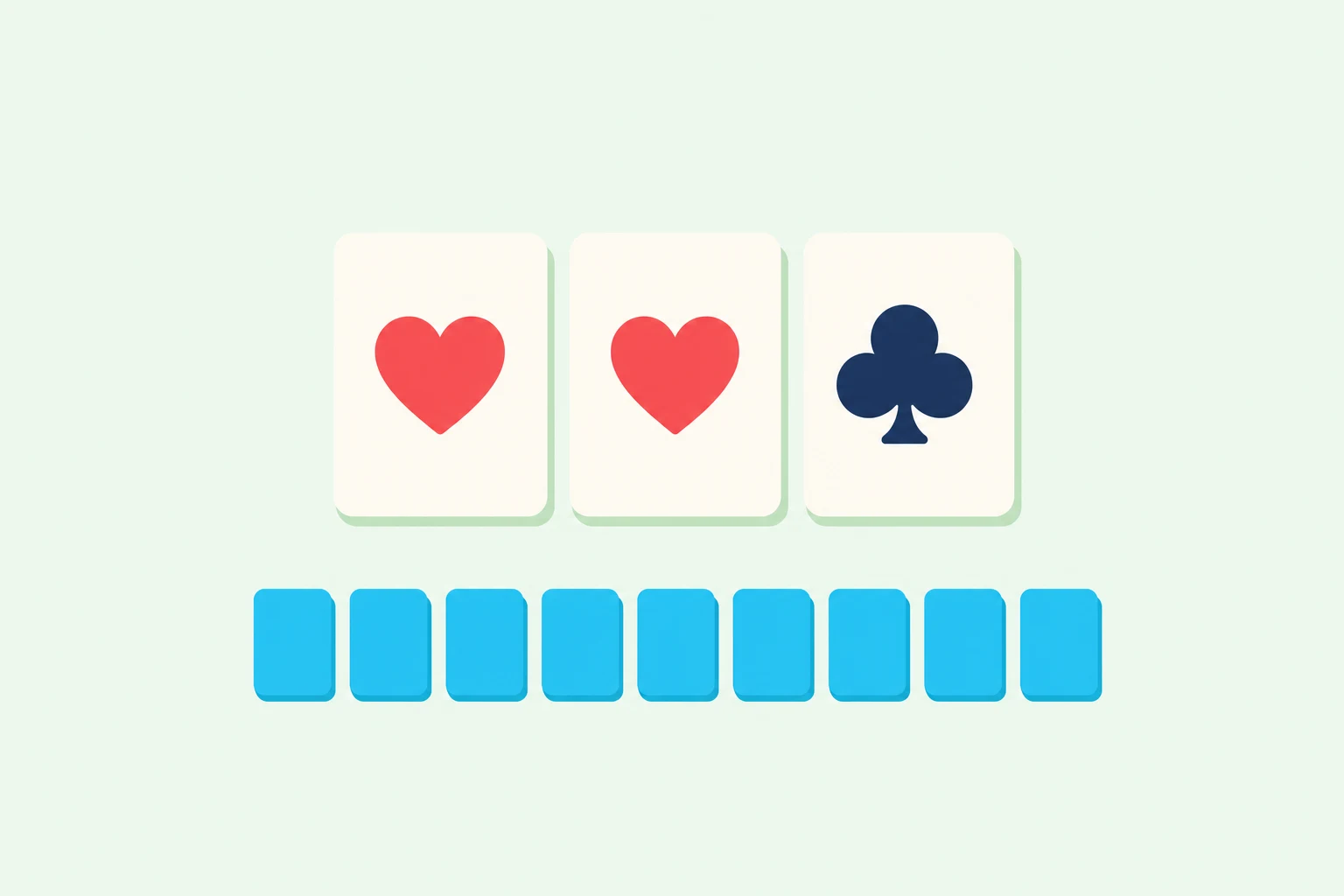
A flush draw is strong enough to get money in with and weak enough to fold, and which one it is comes down to two things you can check every time: the price you are being offered, and whether betting could make anyone fold. With a good price and real fold equity, raising is usually right. With neither, you have a pretty hand that is losing right now.
Nine outs come in about 19% of the time on the next card, and about 35% of the time by the river if both cards are dealt with no more betting.
Flush draw decisions at a glance
| Street | Situation | Default | Why |
|---|---|---|---|
| Flop | One opponent bets, they can fold, you have position | Raise | About 35% if it all goes in, plus the pot when they fold |
| Flop | Multiway, or an opponent who never folds | Call if the price and the later streets justify it | Fold equity is gone, so you are paying for cards |
| Flop | Low draw, big action, several players | Fold | Some outs make you second best, so the real equity is under the price |
| Turn | You raised the flop and the board is unchanged | Bet again, expecting fewer folds | The story holds, but their range is stronger now |
| Turn | You called the flop and they bet big | Fold unless the price is unusually good | One card is about 19.6% |
| River | Draw came in, board unpaired, no bigger flush likely | Bet for value | Two pair and sets pay this off |
| River | Draw missed | Usually check | The busted flush is a poor bluffing hand |
Every row assumes one street at a time and a price you have actually worked out. None of them survives a bad price. A pair behind the draw changes the turn rows. Poker Skill deals A♣ 7♣ on 7♦ 3♣ T♣ in its turn lessons, and when a bet comes on the K♦ turn, the right answer is a call: sevens plus the nut flush draw give it real ways to win.
Take the all-in first, because that is the spot people replay afterwards. Straight draws work the same way with fewer outs, an open-ender at eight and a gutshot at four, and they get their own section below. Nut-flush hands also have decisions of their own, and the nut flush playbook owns those. Here we are playing the draw itself, whatever its top card.
The two numbers you need before any decision
A flush draw has nine outs.
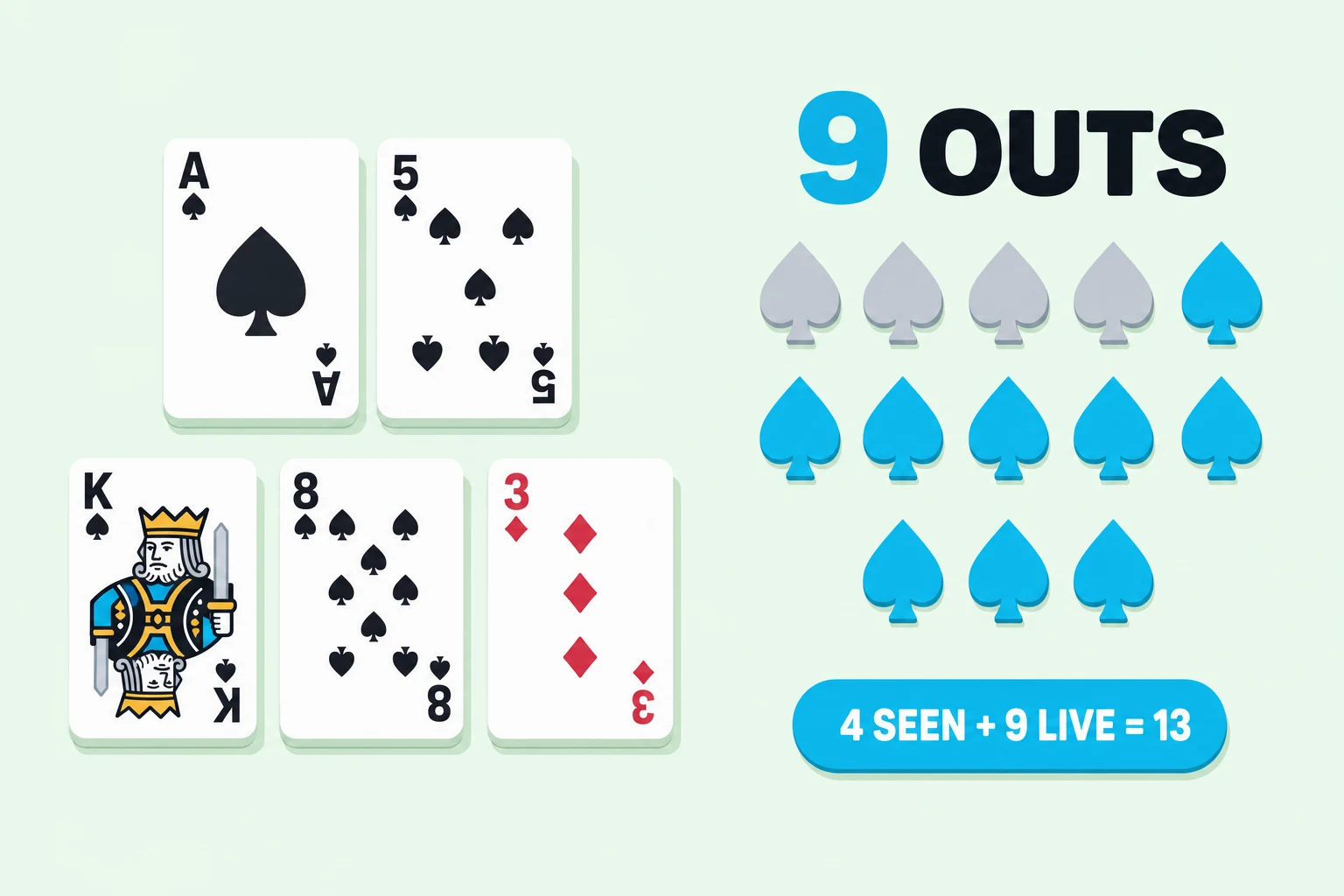
Which of the two percentages applies is decided by the action, not by the street: 35% is an all-in number, 19% is what a single card is worth.
The two numbers are 19.1% for the next card and 35.0% by the river, the nine-out row on Poker Skill’s outs-to-odds chart, and its lessons round them to about 19% and about 35%.
The other half is the price. Divide what you must call by the total pot after your call, and you get the percentage you need to break even.
Pot odds has the method, and counting outs has the part where you check whether all nine outs are really yours. Backdoor chances, the runner-runner shape, add a little equity, and they are not outs.
On the flop: your best street
Two cards can still come, and nobody has narrowed their range yet. This is the street where the draw is worth the most and where aggression pays.
Raise when folding is a live option
Raise. Your draw wins about 35% if you both get it all in, an ace can win unimproved, and the raise makes hands like pocket sixes and queen-nine give up now rather than after they have seen two more cards. Books rate drawing hands highly as semi-bluffs in no-limit for that reason: a small bet now can win a much larger pot in two different ways.
Fold equity has to be real, though. A semi-bluff raise into three opponents on a board that connects with all of them is not pressure. It just builds a pot you will have to give up.
Call when the price and the position are right
You need 25% and one card gives you 19%. The call is not made by the direct price. It is made by what you expect to win on the later streets when the heart lands, and by the fact that raising here folds out the worse hands and keeps in the kings and sets you are behind. Take the card and keep the pot small.
Fold when the outs are not clean and the pot is not yours
You are being asked for 100 to win 300, so you need 25% and both cards are coming, which sounds like a call. It is not. Two opponents are in with hands that liked this board, and at least one diamond bigger than yours is very likely to be among them, so some of your nine outs make you the second-best flush. Discounted outs turn a 35% draw into something well under the price.
On the turn: one card left
Miss the flop card and you are down from about 35% to about 19.6%, so the same bet size that was worth calling with two cards to come can be a clear fold now.
Self-check: call, raise, or fold?
You called the flop with the heart draw. The turn is a blank, and the tight player bets 100 into a pot of 200. Pick your action, then open the answer.
Show answer
Fold. Calling 100 means putting in 100 to win 400, so you need 25 percent. One card is about 19.6 percent, you have no pair, and you have no fold equity because you are the caller. Books are direct about this: with one card to come and an opponent showing aggression, folding the draw is usually correct rather than weak. Raising is the other live option, and it needs a player who can fold, which a tight opponent betting big into a board that missed you is not.
Two lines cover most turn spots. If you raised the flop and the board has not changed, betting again is often right, though the caller’s range is stronger than it was on the flop, so expect fewer folds than you got the first time. If you called the flop and the turn brings a real bet, calling again needs a real price.
On the river: the draw is over
When it hits, bet it, unless the board has paired or a bigger flush is obvious in the way the hand played out. A completed flush on an unpaired three-suit board still gets paid by two pair and sets more often than people expect. Against heavy action on a paired board, remember that a full house does not care about your flush.
When it misses, be careful about turning it into a bluff automatically. Books make a specific point here that runs against the reflex: a missed flush draw is a weaker bluffing hand than a missed straight draw. Your suited cards block the busted flush draws that would have folded, while a missed straight draw tends to block the top pairs that call. If you fire, do it because the board and their line say they gave up, not because your cards are worthless. Bluffing by the numbers covers which hands make good bluffs.
Straight draws: the same logic, one card weaker
Open-ended and gutshot draws
An open-ended straight draw has eight outs, a gutshot four. Everything above still applies, with less equity behind it: fewer outs mean you need a better price, and you need more fold equity to justify a raise.
| Draw | Outs | Next card alone | Both cards, money in |
|---|---|---|---|
| Flush draw | 9 | 19.1% | 35.0% |
| Open-ended straight draw | 8 | 17.0% | 31.5% |
| Gutshot | 4 | 8.5% | 16.5% |
Those are the same rows as the outs-to-odds chart, computed from the 47 unseen cards after the flop.
OESD vs gutshot counts them properly, and OESD probability has the by-street percentages.
Combo draws
A flush draw with an open-ender, or a flush draw alongside a pair, has far more equity than a bare draw, because two or three different cards win the pot. Books treat these as the strongest hands to continue with, and they are the spot where even a low flush draw is worth raising, since you are not relying on the flush alone.
Where this fits in your decision
Every default above is a starting point that a worked-out price can overrule. Pot odds is the arithmetic, counting outs is the part where you check the outs are really yours, and the nut flush playbook takes over once your draw is the best one available.
Frequently asked questions
Should you ever fold a flush draw?
Often, and the two spots are worth learning by name. The first is a bad price: heavy action into you with one card to come, when the pot is not laying you the roughly 19% that one card is worth. The second is a low draw against several opponents in a big pot, where getting there can still leave you second best to a higher flush. A flush draw is a good hand. It is not a reason to put money in at any price.
Is a flush draw a semi-bluff?
It is the standard one. A semi-bluff is a bet or raise with a hand that is probably behind now but can improve to the best hand later, which describes a flush draw exactly. Books like drawing hands as semi-bluffs in no-limit specifically, because a small bet now can win a large pot in two ways: everyone folds, or you get called and hit.
What are the odds of hitting a flush draw?
Nine outs, about 19% on the next card and about 35% by the river when both cards are dealt with no more betting. The two-card number only applies when the money is already all in, which is the distinction that decides most flush-draw calls. Counting outs owns the method for getting there at the table, including the outs that are worth less than they look.