
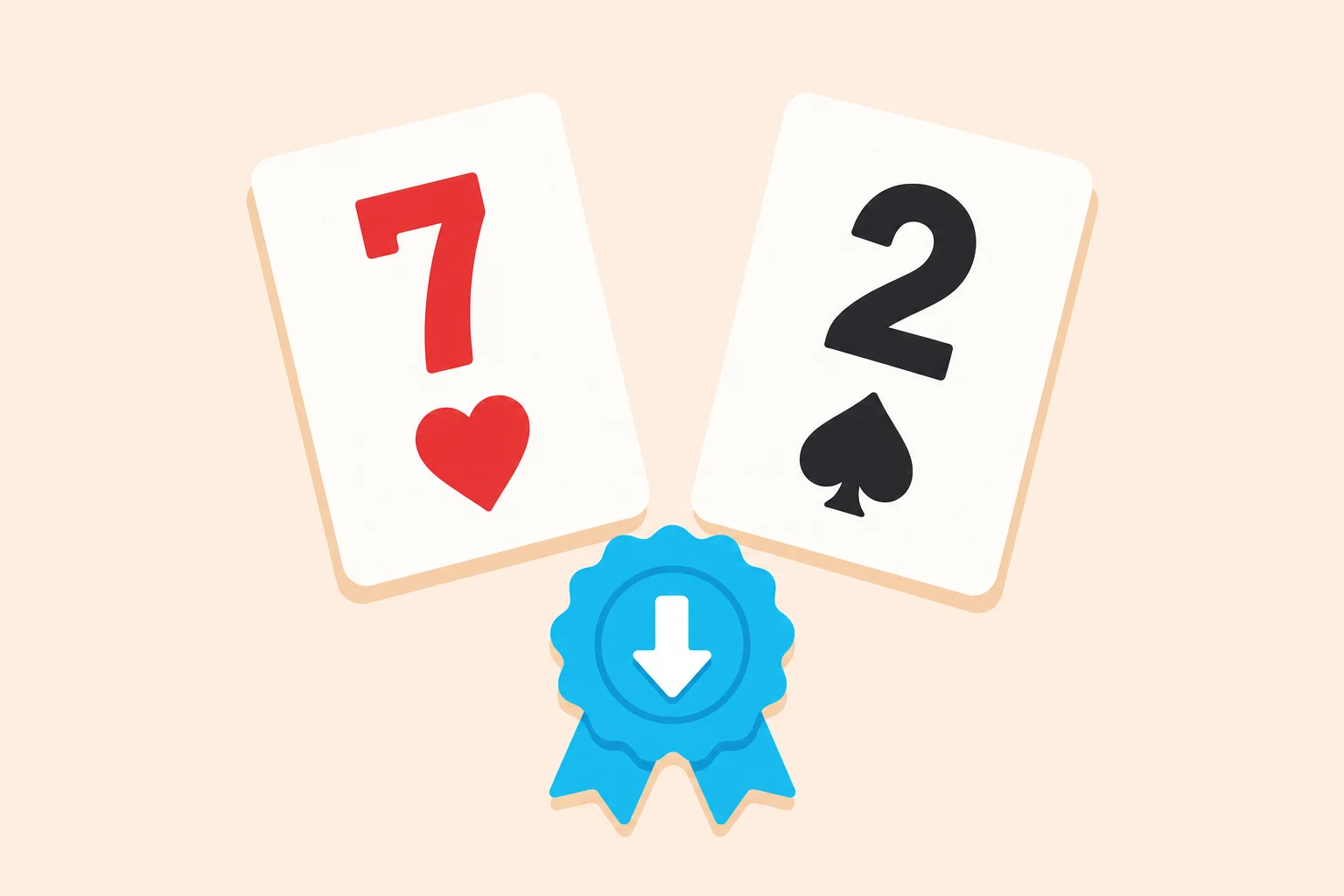
Seven-deuce offsuit (written 7-2o or 72o) is the worst starting hand in Texas hold’em because it fails at everything a starting hand can be good at. No five-card straight uses both a seven and a two. Different suits mean no flush help. And a seven-high is beaten by nearly anything else that reaches showdown unimproved.
Plenty of hands are bad. What makes 7-2 the champion of bad is that most trash has at least one redeeming feature: 3-2 connects for straights, J-2 has a face card, 9-8 flows into a dozen boards. Seven-deuce offsuit has nothing, and understanding exactly why turns the game’s most famous joke hand into a genuinely useful teaching tool. Worst starting hand and worst made hand are two different questions: 7-2 is the worst two cards to be dealt, while the worst hand at a showdown is whatever sits lowest on the standard poker hand rankings.
The three defects, one at a time
First, the straight problem. A straight is five ranks in a row, and seven and two are five gaps apart: any run that includes the seven has climbed past the two before it finishes. So the two cards can never cooperate in a straight. At best one of them participates while the other is dead weight, which means you are effectively playing one card in a two-card game.
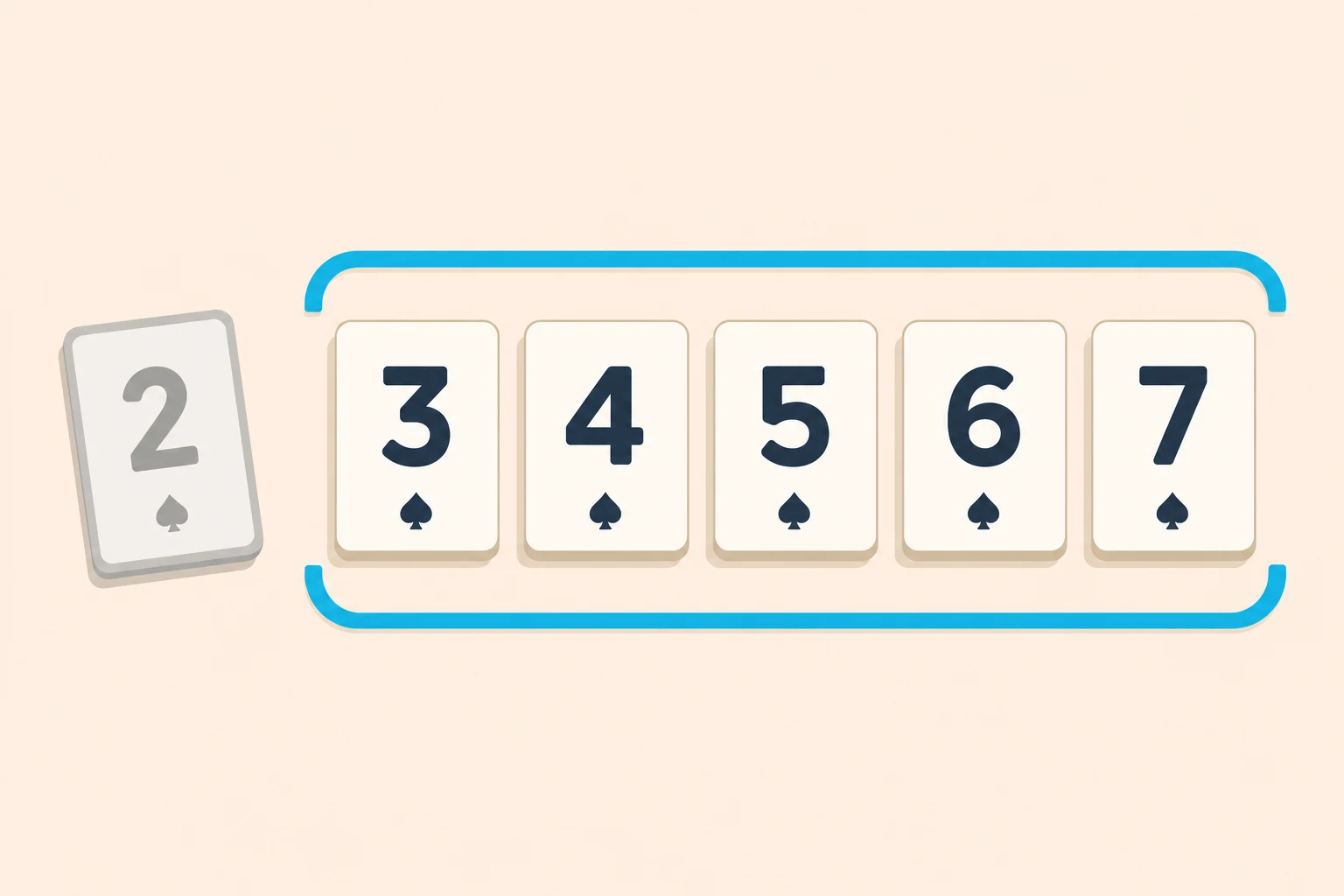
Second, the suit problem. Offsuit cards need the board to supply four of a suit before either can make a flush, and even then the flush is usually weak. Suited 7-2 would at least add a low flush draw to the picture, which is why 7-2 suited, still terrible, is measurably less terrible.
Third, the height problem. When nobody improves, the highest cards win. A seven as your best card loses the high-card war to almost every hand your opponents can hold. Pair the seven and you have a weak pair with a two kicker; pair the deuce and you have the lowest pair in the game. Even winning scenarios are losing scenarios waiting for a better hand to show up.
Stack the defects and every route to victory is broken at once: no straight synergy, no flush synergy, no showdown strength, and pairs that beg to be outkicked. Other bad hands break one or two of those routes. Seven-deuce breaks them all.
The honest numbers
Heads-up against one random hand, 7-2 offsuit still wins about a third of the time. That surprises people, and it is worth sitting with, because it explains something important: no hold’em hand is hopeless in a vacuum. Two live cards plus five community cards produce plenty of accidents.
Against real hands the picture darkens fast. Facing pocket aces, seven-deuce wins roughly one time in eight. Facing ordinary raising hands, it is a clear underdog everywhere, and its wins come mostly from boards that scare the better hand into folding, not from making the best hand.
Multiway, the story gets bleaker still: every extra opponent is another chance someone connected with a board you barely touch, and trash hands bleed hardest in exactly the limped family pots where they look cheapest to play.
So why fold a hand that wins a third of its all-in confrontations? Because poker is not an all-in confrontation. You pay to see flops, and 7-2’s flops almost never cooperate: when you miss you have seven-high, and when you hit you usually have a pair that cannot stand pressure. The money you invest to find out is money equity math never gives back. Poker Skill deals one of those misses in a big-blind defense drill that starts on the flop: 7♣ 2♦ faces a big bet on 9♦ 10♣ K♥, and folding leaves behind everything the hand paid to see it. Winning a third of showdowns is very different from winning a third of the money, and the gap between those two sentences is most of preflop strategy.
What the worst hand teaches about every other hand
Here is the practical value of 7-2: it makes hand selection concrete. Every player agrees seven-deuce is a fold. The useful question is what else shares its defects, because hands like J-3 offsuit and 9-2 offsuit fail the same three tests, just slightly less loudly. If a hand cannot make a straight with both cards, has no suit help, and cannot win a high-card war, it belongs in the same bin no matter how much prettier it looks.
The second lesson is position. Marginal hands gain value when you act last and lose value when you act first, but broken hands gain nothing anywhere: no seat at the table turns 7-2 into a hand. Learning to sort “marginal, playable somewhere” from “broken, playable nowhere” is the entire skill of preflop discipline, and 7-2 is the clearest possible example of the second category.
Fold it whenever playing it costs chips, and notice how the fold feels: like nothing. That is the feeling of a correct decision made instantly, and collecting a few thousand of those instant correct decisions is worth more to a new player’s win rate than any fancy postflop move.
A worked hand: the trap when you actually hit
Suppose you ignore all of this, limp 7♦ 2♣ from late position, and the flop arrives 7♠ K♥ 4♦. You hit. Top pair it is not, but a pair of sevens is real, and this is exactly where the hand does its damage, because now you have something, and something is what calls bets.
Count what beats you already: every king, every pocket pair above sevens, and 7-x with any kicker bigger than your deuce, which is all of them. Your pair of sevens loses the kicker war to 7-8 whenever the kickers play, and pairing your deuce only makes sevens and deuces, the lowest two pair you can make. Meanwhile every draw that gets there beats you, and no strong hand ever folds to your pressure, because pressure from this hand represents nothing believable.
Play the same flop with 7-8 suited instead and the picture changes: same pair, a kicker that wins some of the wars, backdoor straight and flush possibilities, and honest reasons to continue. That contrast is the real lesson. The cost of a trash hand is rarely the preflop chips; it is the profitable-looking quicksand on the flops you hit. Good hands hit flops and make money. Bad hands hit flops and make second-best hands, and second-best is the most expensive finishing position in poker.
The deuce-seven game
Poker culture salutes the worst hand with a standing prop bet: in many home games, winning a pot while holding 7-2 pays a bounty from every other player. The game exists precisely because the hand is so bad that winning with it requires either a miracle board or a shameless bluff, and both are entertaining.
It is also quietly educational. Watch someone try to win the seven-deuce bounty and you see, in exaggerated form, what bluffing actually is: winning with cards that cannot win by themselves, using position, pressure, and a believable story. Just remember the bounty is paying for the show. Without it, the play is a donation.
Do good players ever play it?
Almost never for value, occasionally as theater. You will see professionals turn 7-2 into a bluff at high stakes, sometimes as a prop-game obligation and sometimes precisely because the hand is so weak it makes an honest bluffing candidate: it blocks nothing an opponent wants to fold. Those moments make highlight reels because they are rare, difficult, and played by people with reads and stakes that have nothing to do with a normal game. Poker Skill’s preflop charts stop seven-high suited hands at 7-5 even on the button, their widest range, so 7-2 misses every chart, suited or offsuit. The takeaway for the rest of us is unchanged: the correct long-run play with 7-2 offsuit, from every seat where playing costs chips, is the muck, and the hand rankings it might chase were never really available to it.
Is 7-2 offsuit really the worst hand in poker?
By raw all-in equity against a random hand, 3-2 offsuit polls about as badly, but 3-2 can at least use both cards in two different straights. Seven-deuce cannot use both cards in any straight, and playability, not just raw equity, is what the “worst hand” title measures. Most players and most textbooks give the crown to 7-2 offsuit.
Can 7-2 ever win?
Constantly, in absolute terms: about a third of random heads-up confrontations, plus every pot where a bluff gets through. The point of folding it is not that it never wins; it is that the price of finding out reliably exceeds what those wins pay back.
Should you ever play it?
In a normal game, no. In a game with a deuce-seven bounty, the bounty changes the math and half the fun. If you do play it, know that you are paying for entertainment, and keep the price of the ticket small.