
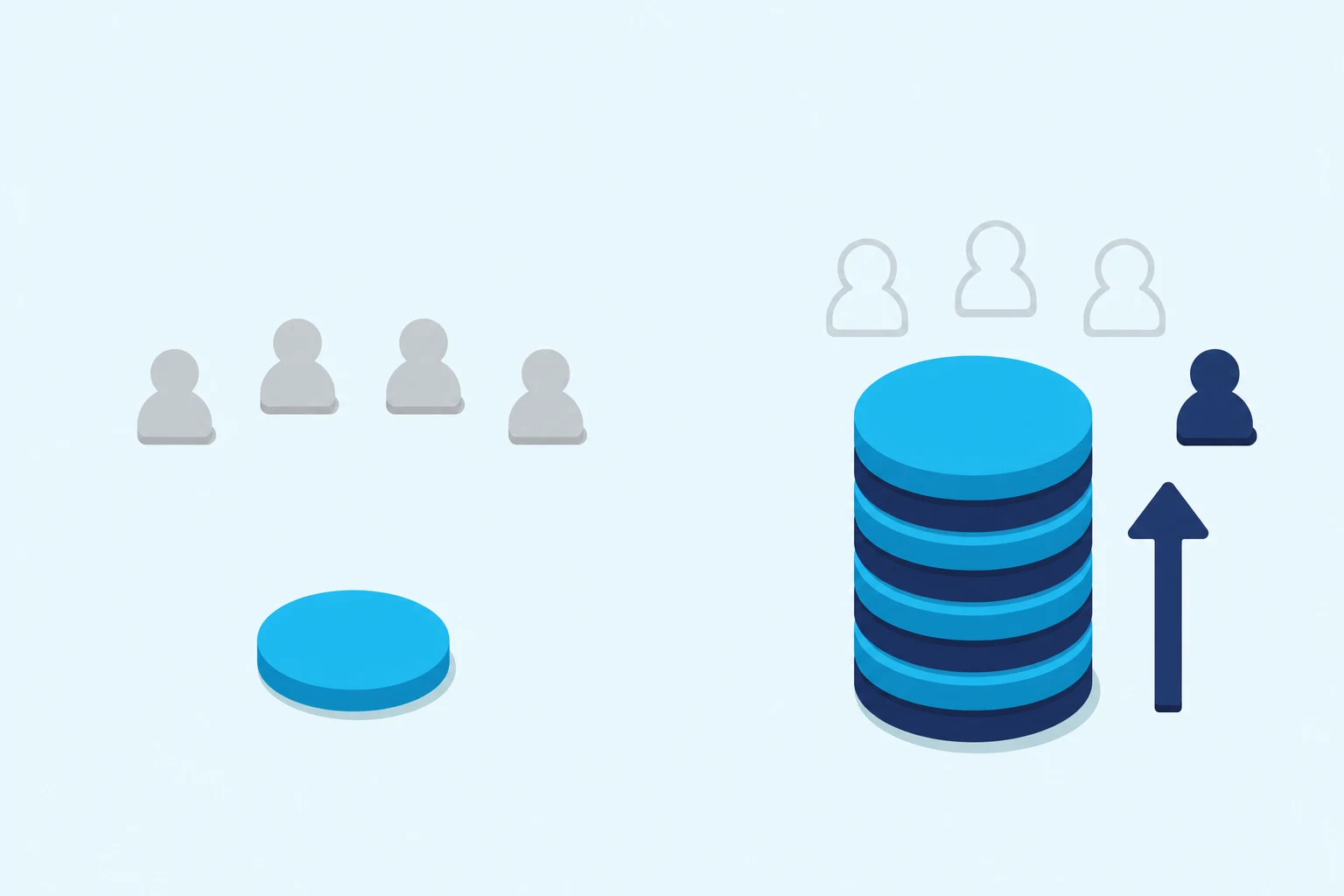
A limp is entering the pot by calling the big blind instead of raising, and in an unopened pot it is almost always the worse of the two. Raising builds the pot while you have the best of it, narrows the field to one or two opponents, and hands you the lead going into the flop. Limping buys a cheap flop and gives all three of those away.
Limping behind other limpers, and completing the small blind, are different actions with different answers.
Limp against raise, same two hands
The suited connector is the row worth sitting with. Limping it feels harmless, because the hand is cheap and it plays well multiway. The cost is hidden: you enter with the weakest hand in the pot, you invite a raise you then have to answer with no plan, and you hand the lead to somebody in a pot you chose to enter.
Raising with a hand like ace-king is not a bluff, and it is not about looking strong. It is about money. When you raise, the hands that would have come along for one big blind now have to pay several times that to keep playing, and most of them are hands you are ahead of. The pot grows while you have the best of it, and it grows with their chips.
What a raise buys you
Value from hands that are worse than yours
Your raise is not trying to make everyone fold. It is trying to get called by ace-nine, king-jack, queen-ten, hands you are ahead of that will keep paying you after the flop. A limp gets called by the same hands for a fraction of the price, which is the same customers at a smaller bill. Note the shape of the list: hands your ace-king dominates, not every hand that calls. A caller holding pocket fives is a small favourite over ace-king before the flop, and no preflop raise changes that.
Fewer opponents, so your hand keeps its value
Unpaired hands like ace-king fall faster than pairs as opponents pile in, because more players means more ways for somebody to flop two pair, a set, or a draw that gets there by the river. Big hands want a small field. The raise is how you get one, and position decides how wide you can push it: the opening ranges by position get looser as you get closer to the button, for exactly this reason.
The lead going into the flop
After a raise, everyone at the table treats you as the player with the strong range, so on flops that helped nobody you are the one who can bet and take the pot. The limper does not get that. They have to work out whether their ace-high is still good, and the usual way to find out is by calling. Position decides who acts first; the raise decides who gets believed.
Dead money when everybody folds
Sometimes nobody calls and you collect the blinds. That is not a failed raise. From late position it is a stated reason to make one: with nobody in the pot ahead of you, taking the blinds uncontested is enough to make the raise worthwhile with hands that would fold to real resistance.
What limping costs you
Everyone behind you gets a cheap decision. The reason poker writing says to almost never open-limp is not aesthetics. A limp lets the players behind you see a flop for one big blind, which is a small enough investment that most of their hands can play on without being wrong. Raising is what puts a price on those hands. Poker Skill’s First In: Don’t Limp lesson is built on that rule: twelve hands from the hijack, a limp on the menu every time and every right answer a raise or a fold.
The multiway trap
You limp pocket kings from the hijack in a 6-max game, hoping somebody raises behind you. Nobody does. The button, the small blind and the big blind all come along, and the flop arrives in a four-way pot.
You act before the button on every street with the second-best pair on the board, against three ranges full of queens, jacks, ten-eight and spades. Kings are still probably the best hand. They are also a hand you can no longer bet with confidence or fold with a straight face, which is what a limp bought you.
A capped range. Once your strong hands are raising and your weak hands are limping, your limp says what it holds. Observant players attack the limp with raises, take the pot away on flops you missed, and you spend the hand defending with the worse half of your hands.
Self-check: limp or raise?
Six-handed game, loose table. Everyone folds to you in the cutoff. Pick your action, then open the answer.
Show answer
Raise. The pot is unopened, so this is the one spot where the rule has no exceptions worth learning yet. Raising gets called by the ace-nines and king-jacks you are ahead of, cuts the field to one or two players so your 65 percent against one hand does not turn into a coin flip against four, and gives you the lead on every flop that missed everybody. The limp buys a cheap flop and sells all three.
When limping is defensible
The players arguing that limping is fine in principle have a real case, and it is narrower than the argument it usually turns into. Here is the version that survives.
| The exception | The condition you must be able to name | Why it holds |
|---|---|---|
| Limping behind, in a loose game | Limpers are already in the pot | The field is already wide, and a raise may chase off the callers your small pairs and suited connectors need |
| Completing the small blind | You have already posted half the price | Genuinely a mixed decision, not a default, because you act first for the whole hand |
| The limp-raise | One specific opponent who attacks every limp | It gets more chips in with a big hand than an open that folds everyone out |
Limping behind, in a loose game. When three players have already limped, the pot is multiway whether you like it or not. Books describe playing most of your marginal hands there without raising, and marginal here means the hands that want company: small pairs, suited connectors, suited aces. Each of them wins a big pot when it connects. This is limping behind, and it is a different decision from opening the pot with a limp.
Completing the small blind. The books do not give a universal rule here, and they treat small-blind limping as a genuine decision with mixed answers rather than a default. A workable beginner simplification: complete with suited hands, connected hands and pairs, fold the offsuit junk, and stop looking for a rule that does not exist.
The limp-raise, with a target. Books call it a strong, deceptive line, and the case they make for it is specific: against a player who attacks every limp automatically. The glossary entry has the mechanics. What matters here is the condition. Remove that one opponent and you are left with an ordinary limp holding a very good hand, which is the outcome the rest of this page is about avoiding.
All three depend on a condition you can name before you act: limpers already in the pot, a blind you already posted, a specific opponent sitting behind you. If you cannot name the condition, you are not taking an exception. You are limping.
Frequently asked questions
Is limping always bad in poker?
No, but open-limping is, and that is the version of the rule worth carrying. Poker writing is blunt about being first into the pot: you should almost never open-limp there, because the limp lets the players behind you continue for one big blind. Limping behind other limpers is a different action with a different answer, and completing the small blind is different again. Raise or fold when the pot is unopened, and treat the other two spots on their own terms.
What is a limp-raise?
It is the one aggressive way to use a limp, and the limp-raise entry covers how it works. The part that belongs here is when it is worth doing: only against an opponent who raises limpers automatically. Against a table that just calls along, the same line builds a big multiway pot with the hand that least wanted one.
Should beginners ever open-limp?
No, and the reason is practical rather than theoretical. Raise or fold from an unopened pot gives you one decision to get right instead of three, keeps you out of the multiway pots that punish inexperience hardest, and means the pots you do play are ones where you had the lead. Learn the exceptions later, from spots you actually watched go wrong.