
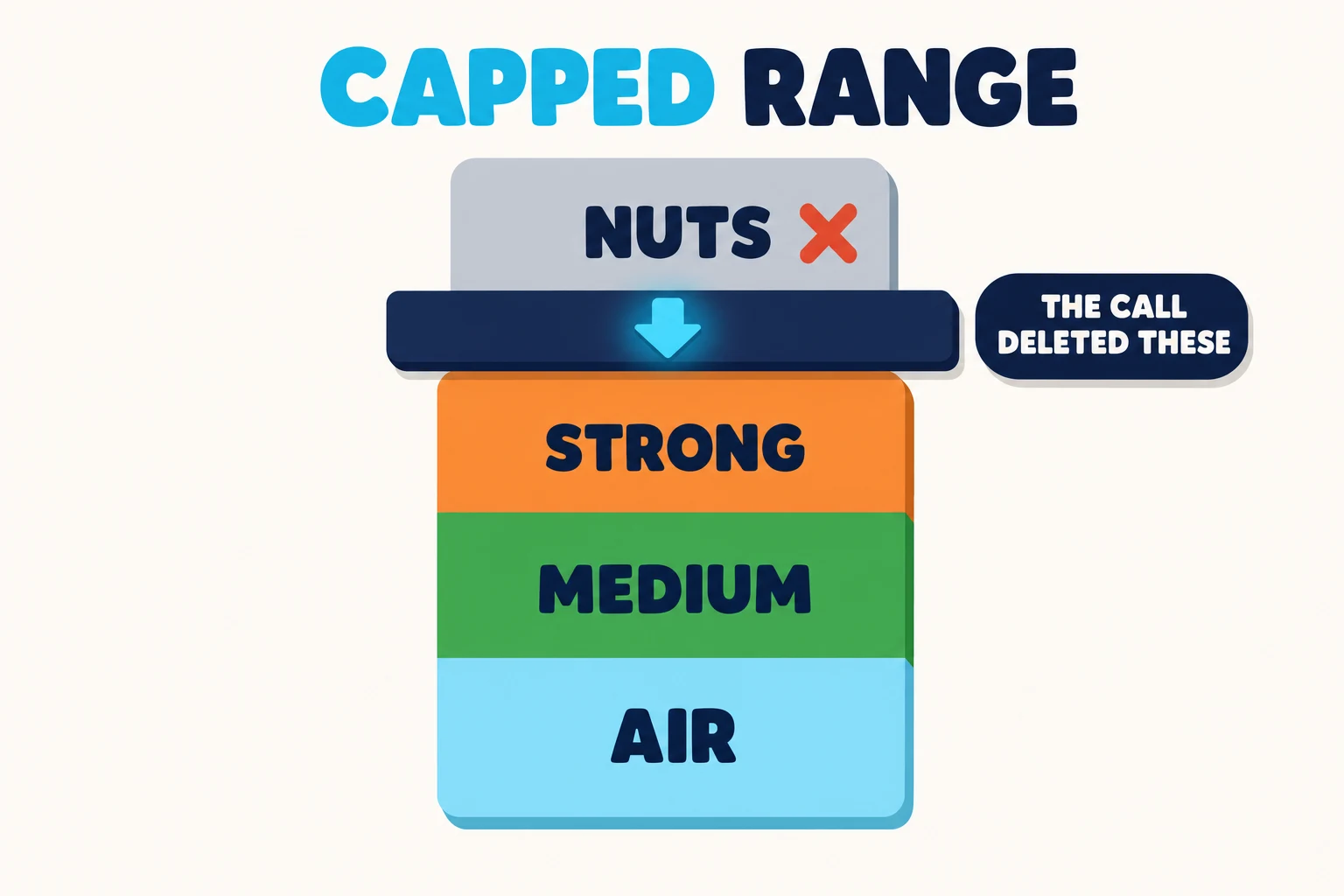
A capped range is one whose own actions have deleted its strongest hands. A player who just calls your raise almost never holds the hands that would have re-raised, so their range has a ceiling: plenty of medium, none of the nuts. Learn to spot the moment a ceiling appears and you inherit poker’s most reliable green light for pressure.
How actions cap a range
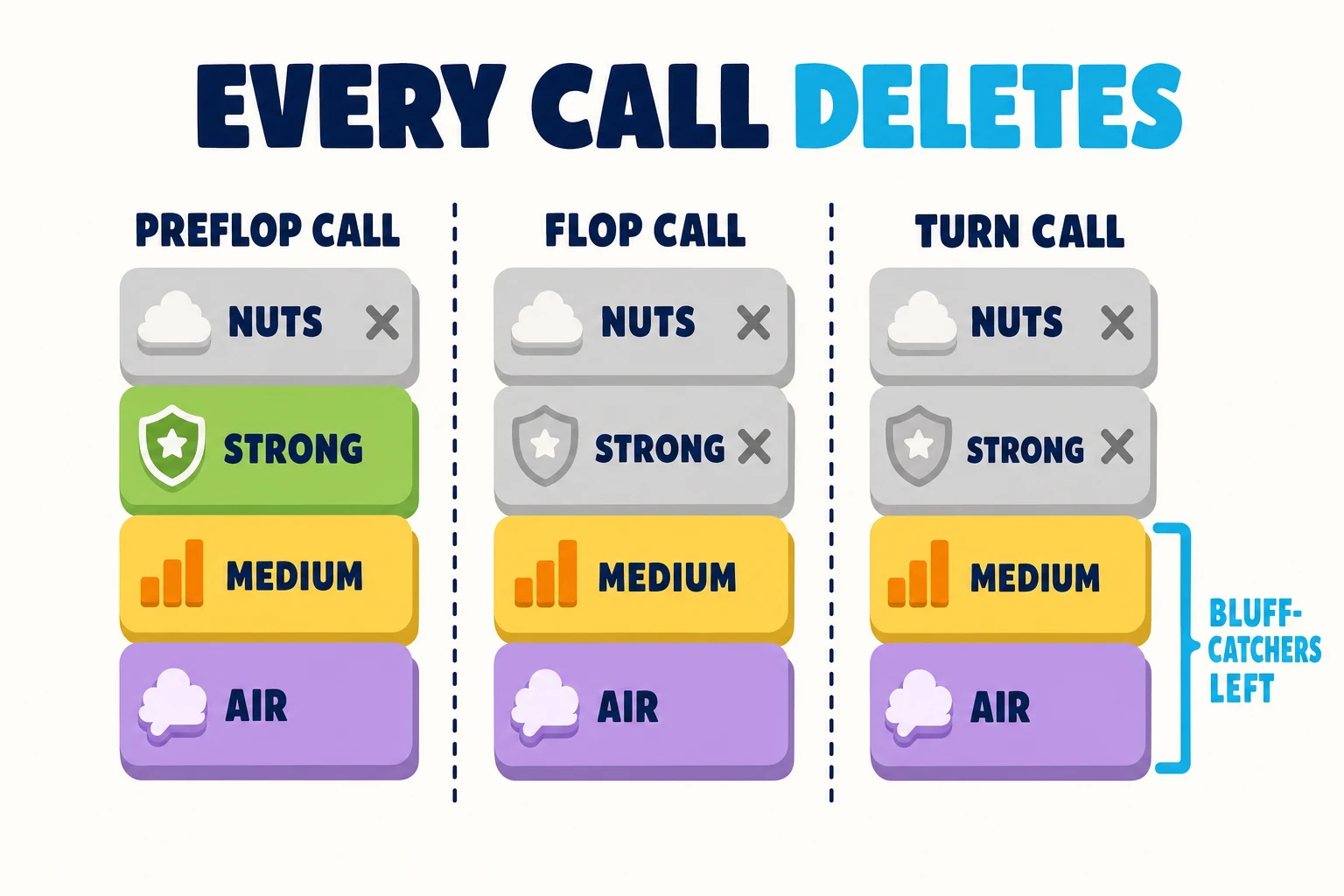
Every passive action is a small confession. Calling preflop caps, because aces, kings, and usually queens and ace-king would have 3-bet; the flat call keeps everything else. Calling a flop bet caps, because sets and two pair often raise wet boards to charge draws. Checking back the flop as the raiser caps, because strong hands mostly bet; when that player later faces a big turn bet, their range arrives without most of its monsters. None of these deletions is absolute, and that is the right way to hold the idea: each passive action makes the top of the range scarcer, and by the third one, scarce has usually become empty.
The opposite side of the coin: a range that still contains its raises is uncapped. The uncapped side can credibly hold anything; the capped side has to defend a known ceiling. That asymmetry, not any particular hand, is what the pressure below exploits.
What each action deletes
| Action | What it deletes | What remains |
|---|---|---|
| Preflop flat of a raise | AA-QQ, AK (mostly) | Pairs, suited broadways, connectors |
| Flop call on a wet board | Most sets, two pair | Draws, one pair, floats |
| Flop check-back by the raiser | Strong top pairs, overpairs (mostly) | Showdown value, air, some traps |
| Turn call after flop call | Slow-played monsters that would raise by now | Bluff-catchers, live draws |
| Passive line arriving at the river | Nearly everything that beats value bets, deleted street by street | Bluff-catchers at best |
The right-hand column is the read; the middle column is why the read holds.
A worked capping read
The big blind calls your button open, calls your c-bet on K♠7♦2♣, and calls again on the 5♥ turn. Walk the deletions. Preflop: the flat removed the big pairs and ace-king. Flop: a raise-worthy hand on a dry board is rarer, but sets of sevens and twos mostly raise the turn at the latest, and none has yet. Turn: the second call removed the slow-plays that were ever going to reveal themselves, with one honest exception: the 5♥ itself promoted a few hands, pocket fives into a set, five-seven suited into two pair, and those check-calls look identical to the bluff-catchers. What arrives at the river is king-x with a modest kicker, sevens with backup, pocket pairs between the board cards, stubborn ace-highs, and that thin slice of turned monsters. Almost nothing there beats a confident triple barrel for value, and its owner knows it. Two river disciplines keep the read honest: a river that completes the turn’s new straight draws (a 3, 4, 6, or 8) un-caps them further and cools the bluffing plan, and the rare check-raise from this line is the turned-monster slice announcing itself. On the blank rivers, your decision is no longer about your cards; it is about whether their bluff-catchers call the size you choose, which is exactly the decision you want to be making.
The pressure playbook
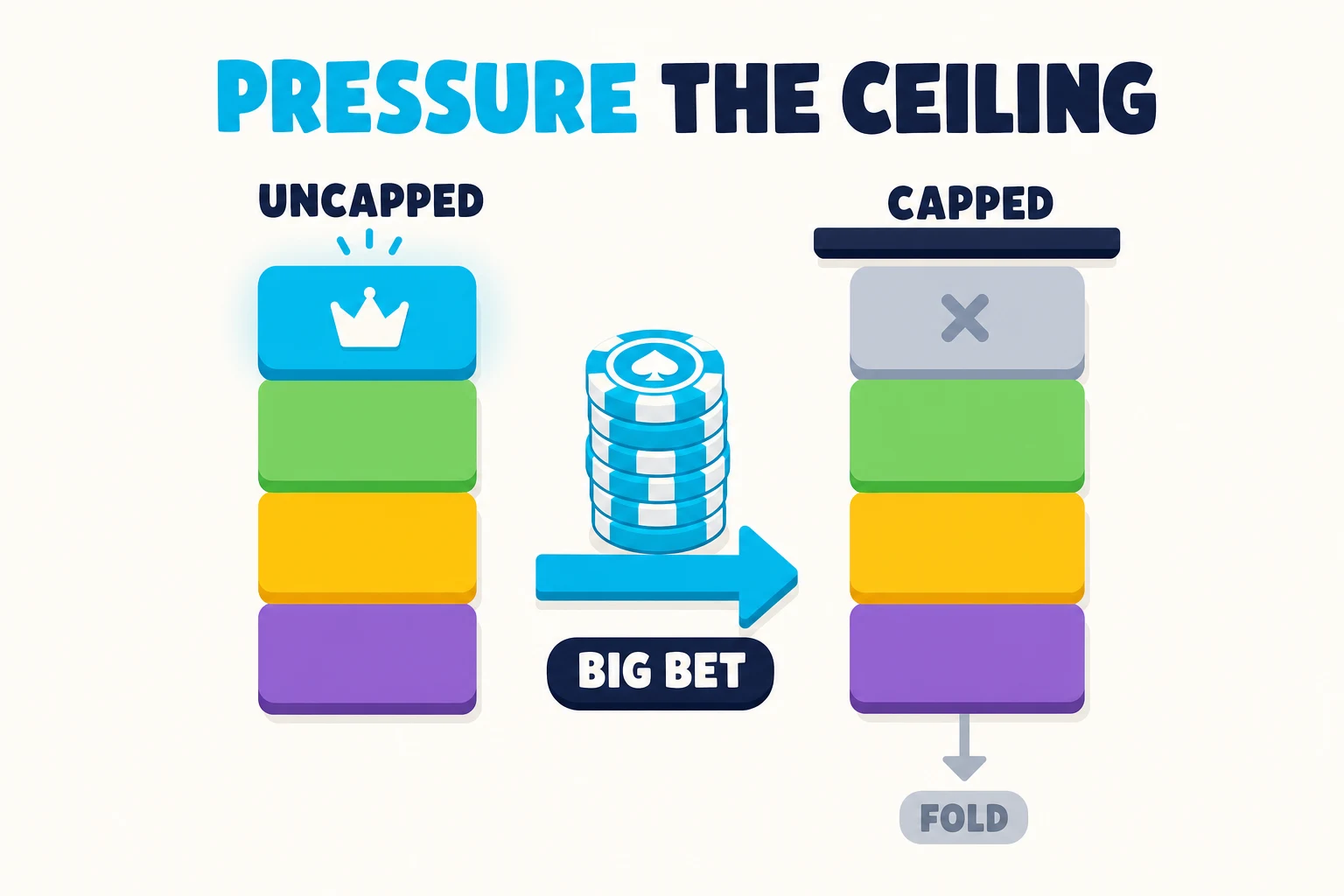
Against a ceiling, big sizings do the work. The capped side holds almost no raising hands, so your bets overwhelmingly face two responses, call or fold, and the check-raise that punishes thin aggression comes rarely enough that its arrival is itself a read. That safety is why overbets exist: when your range contains the nuts and theirs cannot, a bet larger than the pot forces their entire range of bluff-catchers to pay a premium price or surrender, and no holding they own can fight back. The sizing logic scales with the asymmetry: modest ceilings deserve normal pressure; a range that is provably all one-pair by the river deserves the biggest number the stacks allow, with your value hands and your bluffs both using it. The one discipline the playbook demands is that the pressure comes from range logic, not from bravado: you are betting because their line deleted their strong hands, and the moment the board or the action stops supporting that story, the green light goes out.
Staying uncapped yourself
Everything above is symmetrical, and observant opponents run the same audit on you. This is why balanced players do inconvenient-looking things: check back a set on a dry flop occasionally, flat a big pair preflop now and then, check-raise a turn with a monster instead of always betting it. Each of those keeps strong hands alive inside lines that would otherwise cap, so the opponent who wants to overbet your checking range has to price in the trap you sometimes carry. You do not need much: a few slow-plays per session keeps the ceiling off every line you take. What you cannot afford is a game where every strong hand announces itself immediately, because then every passive line you ever take is an honest confession, and the pressure playbook runs against you on autopilot. Poker Skill’s lesson on leads and donk bets drills this from the big blind: aces, a flopped straight and bottom set all check to the raiser, so the strong hands stay inside the range that checks.
When this lies to you
Three caveats keep the concept honest. Stations do not read ceilings: pressure only profits when the capped side folds its bluff-catchers, and a player who calls everything makes your overbet bluffs a donation; against them, use the same range logic for value sizing instead. Some players flat monsters by temperament, arriving at rivers with boats their line said they could not have; the first time someone shows you a slow-played set after calling three streets, update their personal deletion table, not the concept. And boards un-cap ranges: the caller who could not have two pair on the flop can absolutely have it when the turn and river pair their calling cards, so re-run the read on every street instead of freezing it on the flop.
A live-play pattern
At every raise-or-call moment, yours and theirs, ask one question: what did that action just delete? Say the missing hands to yourself as concretely as you can: “no aces or kings anymore,” “the sets would have raised by now.” By the river, the two deletion lists are the hand: one side’s list still contains monsters and the other’s does not, and the side holding the fuller list should be applying the pressure. Most players track what their opponent might have; the capping habit tracks what they cannot, and cannot is the stronger read.
Where this fits
Capped-versus-uncapped is the range-level version of the initiative battle that starts with the c-bet: the raiser’s range stays uncapped, the caller’s caps, and most postflop pressure flows downhill along that gradient. The related shape worth knowing next is the condensed range, capped at both ends, and the broader positional version lives in range advantage.
Frequently asked questions
What is the difference between capped and uncapped ranges? A capped range has lost its strongest hands to its own passive actions; an uncapped range still contains them. The uncapped side can represent the nuts credibly, the capped side cannot, and that difference drives who gets to apply pressure.
Can a capped range still win the pot? All the time; capped means no monsters, not no winners. Bluff-catchers win every time the uncapped side is bluffing. What a capped range cannot do is raise for value or threaten stacks, which is why it plays defense.
What beats a capped range? Sustained pressure with big sizings, up to overbets, from the side whose range still contains the nuts. The capped side must either fold its medium hands or pay premium prices to catch bluffs, and both outcomes profit the aggressor over time.
Does any of this matter at low stakes? The reads work at every stake; the exploits need opponents who fold. At stakes where nobody folds a bluff-catcher, use capping to size your value bets bigger instead of to bluff more, and it prints just as reliably from the other direction.