


RTA (real-time assistance)
RTA is real-time assistance: using a solver, chart, app, or another person's advice to decide how to play while the hand is still live. Tournament rules and online sites both ban it.
RTA in poker
What RTA is
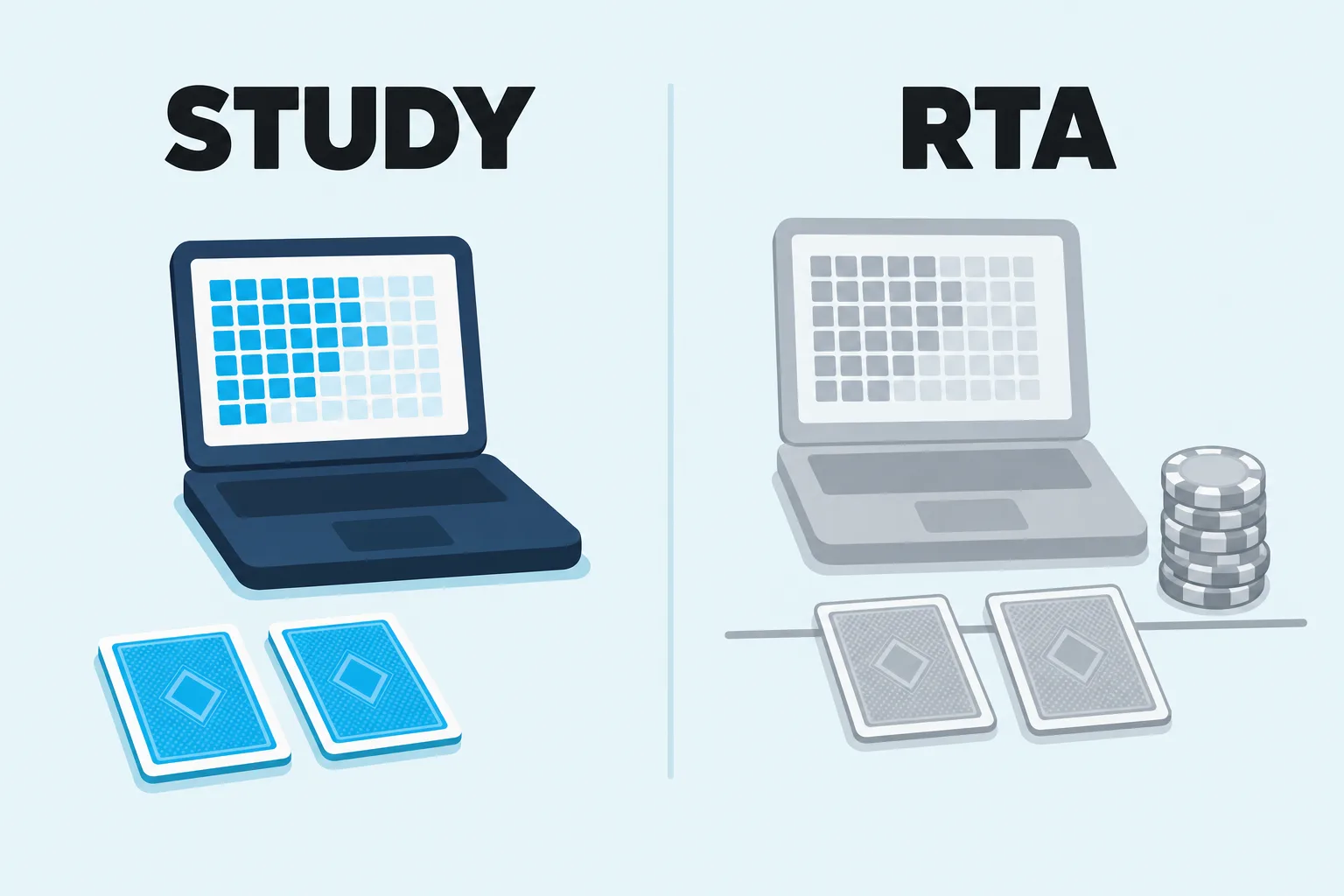
RTA stands for real-time assistance: getting outside strategy help on a hand while that hand is still live. The name came from software that feeds a player advice mid-hand, and the rules that ban it reach wider than software, naming betting apps, charts, and strategy data from another person or source. The whole meaning of the term sits in the timing. Working through a solved spot on Tuesday and remembering it on Friday is study. Opening that same tool in a second window while you are facing a river bet is RTA, and both rulebooks below treat the two differently.
RTA software works in one of two ways. Some tools read the cards and bet sizes off your screen and run a solver on the spot, and modern solvers can finish a custom spot in seconds. Others look up the closest match in a library of spots solved in advance. Either way the answer rests on ranges and bet sizes the tool assumes, so it can be wrong when your real spot sits outside them.
Related terms
- Solver: the study tool RTA repackages for use during play.
- GTO: the equilibrium strategy solvers approximate and RTA tools serve up as answers.
- HUD: the other piece of table software, legal on most online sites and worth checking against the room’s own policy.
- Mixed strategy: the split frequencies a solver returns, where one hand takes more than one line at some rate.
- Frequency: how often a line should be taken, which is the shape of a real solver answer.
- Range: the set of hands the tool needs assumed before it can return anything.
- Exploitative deviation: the read-based adjustment RTA output cannot make for you.
RTA versus solver study
The line is not “solvers are bad.” Running your own solves is the best way to get deep into a spot. The line is the moment you look at one. Reviewing a game after it ends is study, and Poker Skill’s analysis of each Practice vs AI game is that kind of review, with Coach Max grading your decisions once the hands are over.
| What you are doing | When | Where it stands |
|---|---|---|
| Running a spot in a solver and working out why the answer is what it is | Away from the table | Study. Encouraged. |
| Reviewing a hand history after the session | After the hand is over | Study. Encouraged. |
| Reading a preflop chart you memorized last month, from memory | During the hand | Fine. The rule names tools used at the table, not what you remember. |
| Opening a chart, app, or solver output during a live hand | During the hand | RTA. Banned. |
| Asking a friend or a spectator how to play the hand you are in | During the hand | RTA. Banned. |
| Running a tool for a friend who is currently in a hand | During their hand | RTA. Banned, and the WSOP rules name the spectator side directly. |
The last two rows catch people out. The clause quoted in the next section bans strategy data received from another person or source, so a person whispering the answer and a laptop supplying it land in the same rule.
What the rules actually say
For rules and procedures, live tournaments point at the rulebook published by the Poker Tournament Directors Association, and its 2026 version puts this in Rule 5, on electronic devices and communication. Two clauses do the work. Rule 5C says players with live hands may not interact with or operate an electronic or communication device, and adds that the definition of such devices may include new technologies as updated by the tournament director. Rule 5D is the direct one: betting apps, charts, and other poker strategy tools may not be used at the table, and players may not receive or use poker strategy data from another person or source.
That second clause is why the smart-glasses question has a boring answer. Rule 5D is written around the help, not the hardware. A pair of glasses that can answer a strategy question is a poker strategy tool being used at the table, and it was covered by the rule before the product existed.
The World Series of Poker publishes its own rules on top of that, and its 2025 set is more explicit about artificial intelligence. Rule 64 permits approved devices such as music players and noise-reduction headsets until a tournament reaches its final three tables, but only so long as they do not contain or use artificial intelligence or any other type of electronic assistance that could give a participant an advantage. The same rule bans charts, apps and artificial intelligence anywhere in the tournament room, players and spectators alike, and specifically prohibits spectators from providing live real-time assistance or coaching to an active player.
Online there is no floor to call. The site does the enforcing: it monitors play and can suspend or bar an account. Read its policy on which software it allows before you install anything.
Example: where the line actually falls
You open ace-queen offsuit from the cutoff at a 200 big blind table, the big blind three-bets, and you are not sure whether this is a call or a four-bet. Three versions of the next thirty seconds:
Version one. You think it through, decide the three-bettor has been passive all night, and call. Whatever happens next, that was your decision.
Version two. You worked this exact spot through at home last week, remember what you concluded, and play it. Also fine. Memory is yours.
Version three. You alt-tab, type the spot into a solver interface, and play what it hands back. That is RTA, and the fact that all three versions can end in the same action does not change it. What changed is who made the decision.
Version three also has a practical problem that gets less attention than the ethical one. The tool answered a spot defined by assumed ranges at a canonical stack depth, and your table has a passive big blind at 200 big blinds. The output ignored the read that was actually the most valuable thing you knew.
Common misunderstandings
”It is only RTA if it is software”
Rule 5D covers strategy data from another person or source. A railbird texting you the answer is doing the same job as a solver window, and the WSOP rules spell out the spectator case directly. The medium is not the offense.
”Charts are fine, solvers are not”
Both are named. Preflop charts, betting apps, and other strategy tools sit in the same clause. A chart you memorized is knowledge. A chart you are reading is a tool at the table. Knowledge like that is what Poker Skill’s UTG: Raise or Fold lesson builds, with 9♠ 9♥ opening under the gun and A♠ 9♥ folding.
”The solver is calculating my exact hand”
Only within the tool’s assumptions. A tool that solves on the spot works from ranges and bet sizes it assumes for both players, and one that looks up a library returns the nearest spot solved in advance. Neither can tell how far your real opponent sits from those assumptions.
”A GTO answer would have won the hand”
Equilibrium strategies are built to be unexploitable, not to maximize against a specific opponent. Against a player with an obvious leak, the highest-value line is often the deliberate deviation from equilibrium, and no lookup tool knows your table.
FAQ
What does RTA stand for in poker?
Real-time assistance. It covers any strategy tool or outside advice consulted during a hand that is still in progress. The tournament rules name betting apps, charts, other poker strategy tools, and strategy data from another person or source. The name describes the timing, not the technology.
Is using a solver cheating in poker?
Not away from the table. Running spots in a solver is standard study practice. It becomes cheating the moment the tool informs a decision in a hand you are currently playing. The Poker Tournament Directors Association rules put this in Rule 5, which bans betting apps, charts, and other poker strategy tools at the table and bans receiving strategy data from another person or source.
Are smart glasses allowed at a poker table?
Not unless the tournament director allows them. The 2026 Poker TDA rules name them in Rule 5A, which prohibits “wearable devices (e.g. smart glasses, hidden cameras) and other technology capable of covert recording, communication or external assistance (including AI agents)” at the table unless specifically authorized by the TD. Poker TDA Rule 5C covers interacting with an electronic device while holding a live hand, and Rule 5D covers the strategy help itself. The 2025 World Series of Poker rules go further and bar approved devices that contain or use artificial intelligence. Individual rooms post their own house rules on top of that, so ask rather than guessing.
What happens if you get caught using RTA in a tournament?
Under the Poker Tournament Directors Association rules, a Rule 5 violation may be subject to the penalties set out in Rule 74, which is the general penalty rule tournament directors work from. The specific penalty is the director’s call and scales with what happened. Online, there is no floor to call and the consequence is set by the site’s own terms of service, so read the prohibited-software policy for the room you actually play in.