
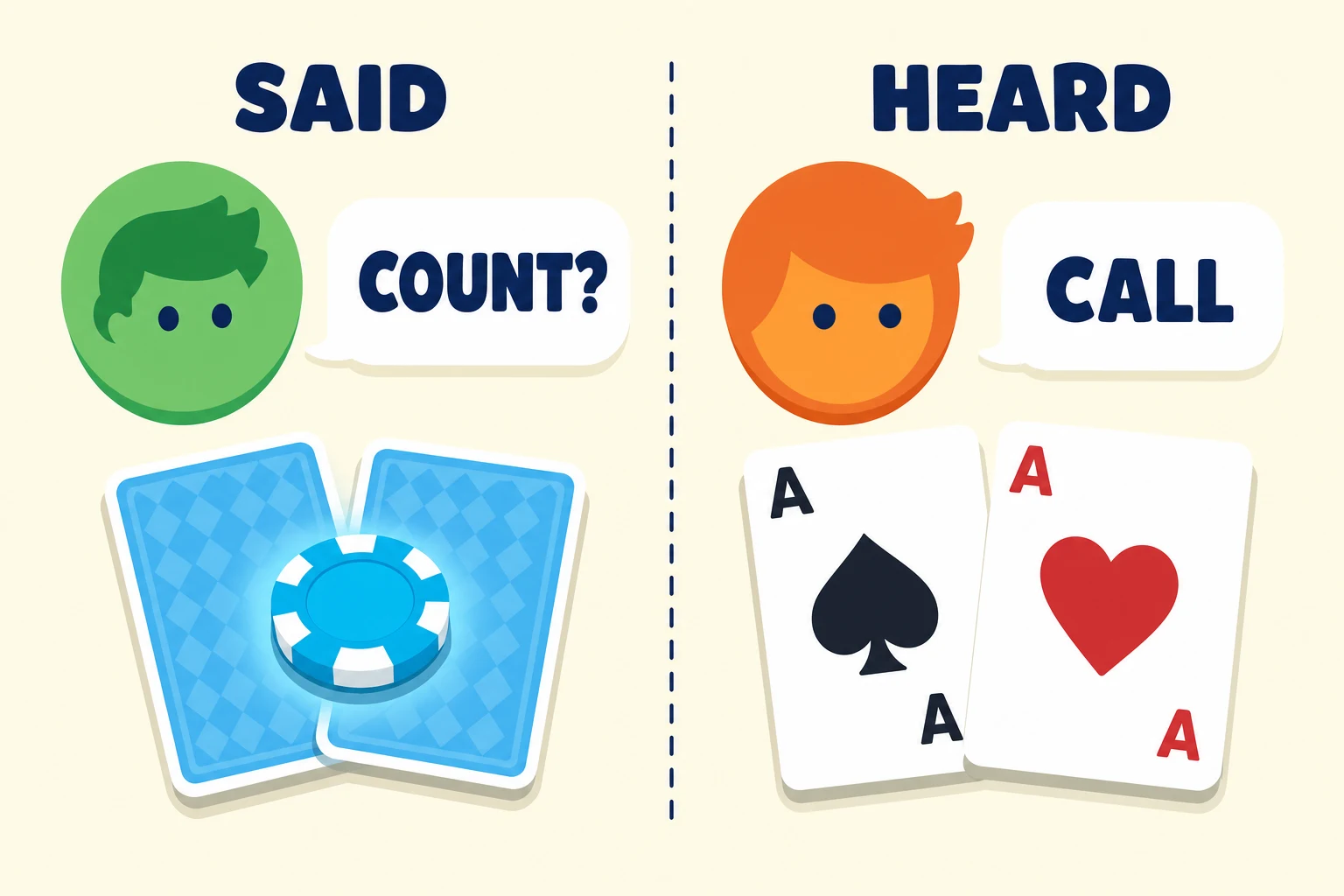
At this year’s World Series of Poker Main Event, one player moved all in with pocket aces. His opponent, holding kings, asked for a stack count. The player with the aces heard “call,” turned them face up, and just like that a pot worth a run at the world championship changed shape. The floor ruled the hand live with no penalty, she folded her kings face up, and poker spent the next week arguing about it. Angle shooting in poker means using moves that are technically legal to gain an edge the rules never intended, and that hand shows exactly the seam anglers live in: the gap between what you meant and what the table heard.
Nobody cheated in that hand. Every angle in this article works exactly the way that mishearing did, except on purpose.
What counts as angle shooting
Poker has three zones. Sharp play is everything the game invites: bluffing, bet sizing that tells a story, staying quiet about your hand. Cheating breaks the rules outright: marked cards, or a partner across the table. Angle shooting sits in between. An angle follows the letter of a rule while working against its purpose, usually to pull information out of you or to win a pot the cards didn’t earn.
The test is simple. Ask what the move gained and how. A player who bluffs gains chips through a legal bet you were free to call. An angler gains chips or information through a mechanic: a binding word, a dead hand, an action you took out of turn. If the profit comes from the machinery of the game rather than from the poker, it’s an angle.
Theatrics like slowrolling sit in a fourth, sadder category. They break etiquette and win nothing. An angle is colder than that. It has a payoff.
The classic angles
Six moves cover most of what you’ll actually see at a live table. Learn the shape of each and they stop working on you.
| The angle | What it looks like | What it exploits | Your defense |
|---|---|---|---|
| The mumble | Words at the table that sound like “call” but weren’t quite | Verbal declarations are binding | One clear word at your turn, nothing extra |
| The pump fake | Chips pushed toward the pot, then pulled back after reading your face | Your reaction to incomplete action | Stay still until the dealer confirms a bet |
| The false claim | ”Flush” announced at showdown with no flush in hand | Mucked cards are dead cards | Never release your hand until you see theirs |
| Acting out of turn | A fold or call made early, on purpose, to steer players still to act | Information moving in the wrong order | Play at your own pace; the dealer owns the order |
| The buried stack | Big chips hidden behind small ones so the shove looks cheap | Your read of what a call costs | Ask for a count every time it matters |
| The fake fold | Cards lifted toward the muck to coax a fold behind, then kept | Your assumption that a motion is an action | A fold isn’t real until the cards are dead |
Every row follows the same logic. The angler makes something ambiguous, you resolve the ambiguity in their favor, and the rules hold you to it.
Why angles work
Three features of live poker do the heavy lifting. First, actions bind. Say “call” and you’ve called. Push chips in one motion and they stay. The game can’t function any other way, so the rules refuse to litigate intent. Second, information can’t be unseen. Once your cards flash or your reaction leaks, no ruling puts it back. Third, the floor rules on what happened, not on what anyone meant, because what happened is the only thing a ruling can verify.
Anglers weaponize all three. They manufacture a moment where the binding action, the leaked information, or the unverifiable intent lands in their favor, and then they let the rules do the collecting.
The Main Event hand, replayed slowly
Walk back through the aces against kings hand with those three features in mind. The all-in goes in. The player with kings wants to know what the shove costs her, which is exactly the right instinct, so she asks for a count. The room is loud. The word travels four feet and arrives as “call.” The player with aces tables his hand immediately, which is what you’re supposed to do when you believe the action is complete. Nobody has broken a rule yet, and the damage is already total: she now knows she’s holding the second-best starting hand in poker.
The floor ruled the hand live and gave no penalty for the exposed cards. She folded kings face up. Under the three features above, the ruling is close to forced. The exposure punished the player who exposed, intent can’t be verified either way, and the action never actually completed.
A deliberate angler studies moments exactly like this one. If a misheard syllable can move a pot that size by accident, it can move one on purpose. That’s why your protection routine can’t depend on everyone else’s good faith.
When suspicion lies to you
Most weird behavior at a poker table is not an angle. New players act out of turn constantly because tracking the action order is a skill nobody teaches. Tired players mumble. Casual players wave cards around because nobody told them not to. If you treat every oddity as an attack, you’ll spend your session as the table cop, playing worse and making enemies who were never out to get you.
The line to hold is procedural, not personal. When something ambiguous happens, you don’t need to decide whether it was innocent. Ask the dealer to clarify, or call the floor for a ruling. A ruling names what happened. An accusation names a villain. You need the first one, and you almost never have the evidence for the second.
How to protect your action
Five habits close off nearly every angle in the table above. They cost you nothing once they’re automatic.
- Use one clear word, once, at your turn. “Call.” “Raise to sixty.” If you want information instead, make it unmistakable: “Just a count, please,” with your hands flat and away from your chips.
- Announce your raise before your chips move, or move them in one motion. String bets get ruled down to a call, and the ambiguity invites everyone to read you mid-action.
- Keep a chip on your cards, always. An unprotected hand that touches the muck is dead, and you should expect no ruling to recover it. The chip is a two-cent insurance policy on your whole stack.
- React to the dealer, not the player. A check, a bet, a fold: none of it is real until the dealer confirms it. The pump fake and the fake fold both die against a player who waits one beat.
- Call the floor before the next card, not after. Rulings can only fix what hasn’t moved on. The moment something feels off, stop the action politely and ask. Every serious player at the table will respect it.
Notice what the routine doesn’t require: reading souls or confronting anyone. It just removes the ambiguity anglers need to operate.
Where this fits
Angles prey hardest on players who are still unsure of the mechanics, because uncertainty is the raw material every angle is built from. The fix is the same as it is for any other part of your game: make the fundamentals automatic so your attention is free for decisions that matter. If the mechanics still take up headspace, start with the rules of Texas hold’em and the broader guide to how to play poker, then let repetition do its work. Poker Skill’s first lessons supply that repetition, from picking the winner at showdown to telling a bet from a raise. A player who knows exactly what happens at showdown is a hard player to angle.
FAQ
Is angle shooting cheating? Not by the letter of the rules, which is the whole point of an angle. But cardrooms are not helpless against it. Floors have wide discretion, repeat anglers get warnings and penalties, and a room that knows a player shoots angles will start ruling gray areas against them. The reputation cost is real and it follows you.
Is slowrolling an angle shoot? No. A slowroll, taking a long dramatic pause before showing the winning hand, breaks etiquette rather than exploiting a rule, and it gains nothing. It will earn you the table’s contempt, just not a ruling.
What should I do if I think I’ve been angled? Stop the action and call the floor right away, before cards are mucked or the next street is dealt. Describe what happened in plain terms and let them rule. Skip the accusation. Even when the ruling goes against you, you’ve put the table on notice, and anglers hate attention.
Can you get angle shot online? Mostly no. The software enforces turn order, bet sizes, and showdown automatically, so the classic angles have nothing to grab. The online cousins are different animals: disconnect abuse and deception in the chat box. The defense is the same spirit, though. Trust the interface, not the story.