
Thin Value Trap
What a thin value trap is
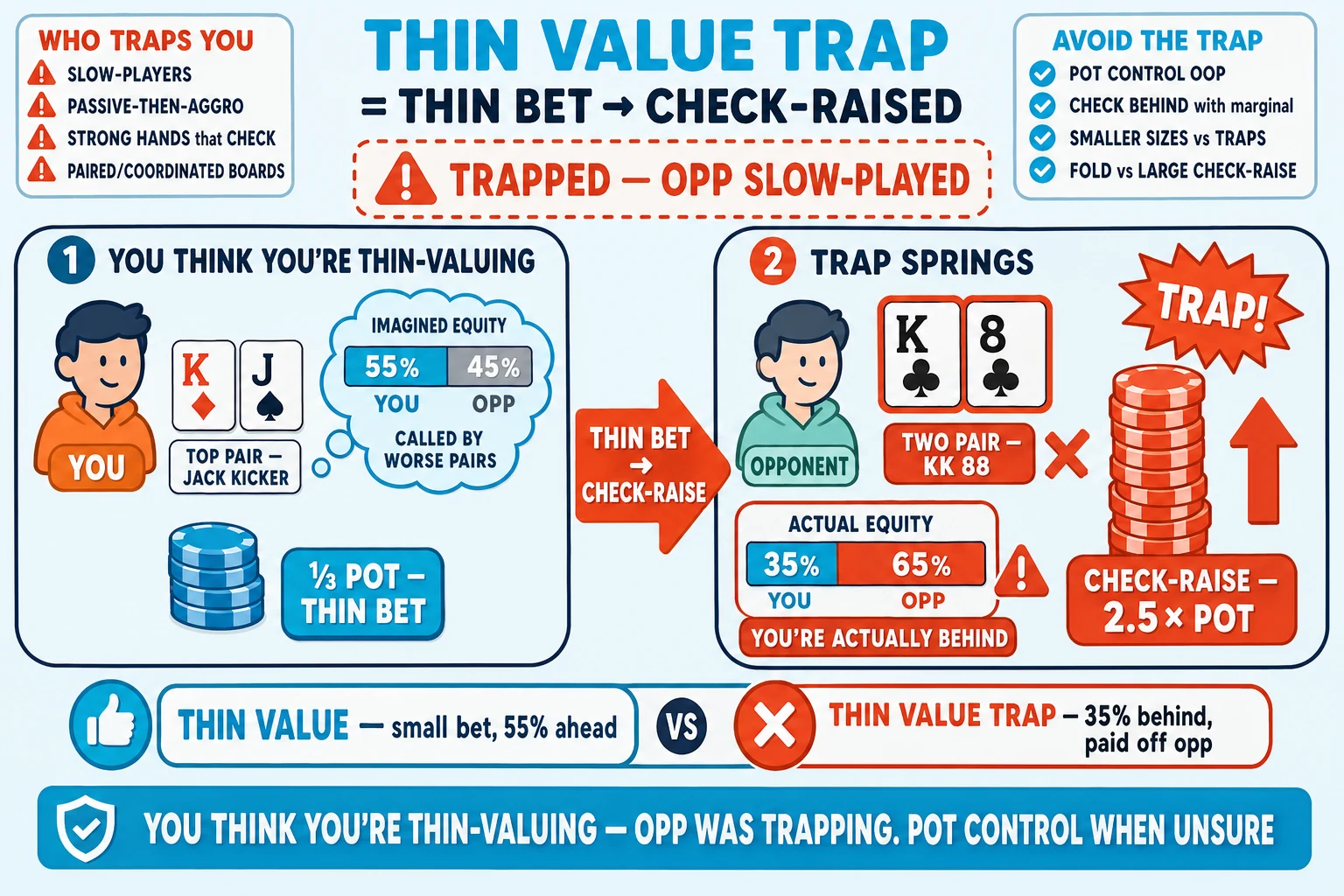
A thin value bet is a wager with a marginal or moderate-strength hand meant to be called by worse hands. (“Thin” means your hand is only slightly ahead of many likely callers.) A thin value trap occurs when an opponent with a stronger hand slow-plays or check-raises after you bet for thin value. The core risk: you extract value only from worse hands and get punished by a better holding.
Typical spots and mechanics
Rivers are the most common spot because ranges narrow and marginal-best hands appear. On the river you get the last chance to be called, so thin value bets and traps concentrate there.
Bet sizing changes your vulnerability: larger thin bets invite stronger reactions like decisive check-raises or big calls. Out-of-position situations and deep stacks increase the threat, since opponents can comfortably check-raise or shove to extract more. Mechanically, traps form when a line appears weak on the flop or turn but actually hides strong hands that become aggressive on the river.
Signals an opponent may be setting a trap
Watch these tendencies and cues:
- Players who frequently slow-play big hands or rarely fold to river bets pose high trap risk.
- Passive flop/turn lines followed by sudden river aggression often signal a check-raise trap.
- A player who called small bets earlier and then checks the river may be disguising strength.
- Board texture matters: paired, coordinated, or draw-heavy boards increase the chance opponents hold strong hands that can check to induce.
Brief jargon: slow-play = hiding a strong hand by checking or calling; check-raise = checking to induce a bet, then raising; pot control = keeping the pot smaller by checking or using small bets.
How to avoid or mitigate thin value traps
- Pot control: check behind or use small bets with marginal hands to avoid inflating a pot you might be dominated in.
- Range reading: decide whether your opponent’s range contains many weak callers or many strong slow-plays. Bet only when weak callers are common.
- Opponent-adjusted sizing: versus trapping players, prefer smaller thin bets or check. Smaller bets still extract value but limit losses if raised.
- Position awareness: out of position, be more conservative with thin value bets because you are easier to exploit.
River decision framework with a short example
Example setup: you river second pair and your opponent has been mostly passive but can trap. Ask whether worse hands will call often enough to justify a thin value bet.
Decision flow:
- Assess opponent tendency: do they slow-play or reraise the river often? If yes, treat as high trap risk.
- Evaluate range composition: does the board leave many weak callers, or does it favor disguised strong hands? If many weak callers -> safer to bet; if many slow-plays -> risky.
- Choose action: If opponent likely traps or your range is dominated: check for pot control. If opponent calls wide and has few slow-plays: make a thin value bet, size small. If unsure and out of position: default to checking or a minimum bet to minimize downside.
If you face a check-raise after betting and suspect a trap, prioritize pot-size when deciding whether to call. Folding can be correct if the raise makes pot odds and range logic unfavorable.
Checklist
- Review opponent tendencies for slow-play and check-raise frequency.
- Ask whether worse hands will call often enough to cover the risk of better hands.
- Prefer pot control or smaller sizing when in doubt or out of position.
- Use a river-range assessment to decide between thin value and checking.