
The best way to learn GTO poker without a solver depends on how you study, but every good route teaches solver-derived strategy and has you practice it. We make Poker Skill, a free app that explains every answer plainly. PokerCoaching and Upswing Poker teach GTO in courses and Modern Poker Theory in a book, while GTO Wizard shows solved spots.
The best way to learn GTO poker without a solver, by how you study
The list runs from decisions explained in plain words to solver output you read on your own.
- Poker Skill. Short lessons that run from preflop ranges to turn barrels, the Daily Puzzle and hands against AI opponents in Practice vs AI. Pick this if you want the ideas behind GTO as decisions you make yourself.
- PokerCoaching. Video courses, interactive hand quizzes and free GTO preflop charts. Pick this if you learn from courses and want quizzes to test what stuck.
- Upswing Poker. The Lab’s game theory video modules and practice quizzes, with a members’ community. Pick this if you want one structured course path.
- Modern Poker Theory. Michael Acevedo’s book on what GTO means and how to use it at the table. Pick this if you’d rather read the theory in depth.
- GTO Wizard. A library of solved spots from preflop to the river, with a trainer, in the browser. Pick this if you want to read solver output without running a solver.
Whether to buy a solver at all is covered in trainer vs solver, and our GTO poker charts page has a GTO preflop chart to start from.
Ways to learn GTO without a solver at a glance
| Option | How you learn | What an answer looks like | Price | Runs on |
|---|---|---|---|---|
| Poker Skill | Lessons, the Daily Puzzle and hands against AI | Your choice first, then the reason for the best play | Free forever. | iPhone, iPad, Android |
| PokerCoaching | Video courses and interactive hand quizzes | A coach’s explanation, and quiz results | $147 a month or $999 a year | Web, iPhone, iPad, Android |
| Upswing Poker | Video modules and practice quizzes in the Lab | A coach’s explanation, plus quiz feedback | $99 a month or $699 a year | Web browser |
| Modern Poker Theory | A book | Worked examples from solver study | $39.95 paperback, $29.95 ebook | Paperback, ebook |
| GTO Wizard | Solved spots and a trainer | How often each hand takes each action | Free plan; cash plans from $39 a month, billed yearly | Web browser |
Prices and features checked September 2026.
The five options in detail
Poker Skill
Lessons, puzzles and practice hands
Free forever.
Best for Players who want the ideas behind GTO, such as ranges, board texture and bet sizing, learned as decisions they make themselves.
Skip if You need exact frequencies for your own spots.
Free version Every lesson, the Daily Puzzle and one Practice vs AI game a day. Poker Skill Plus is an optional subscription.
Where it runs iPhone and iPad (iOS 17 or later) and Android
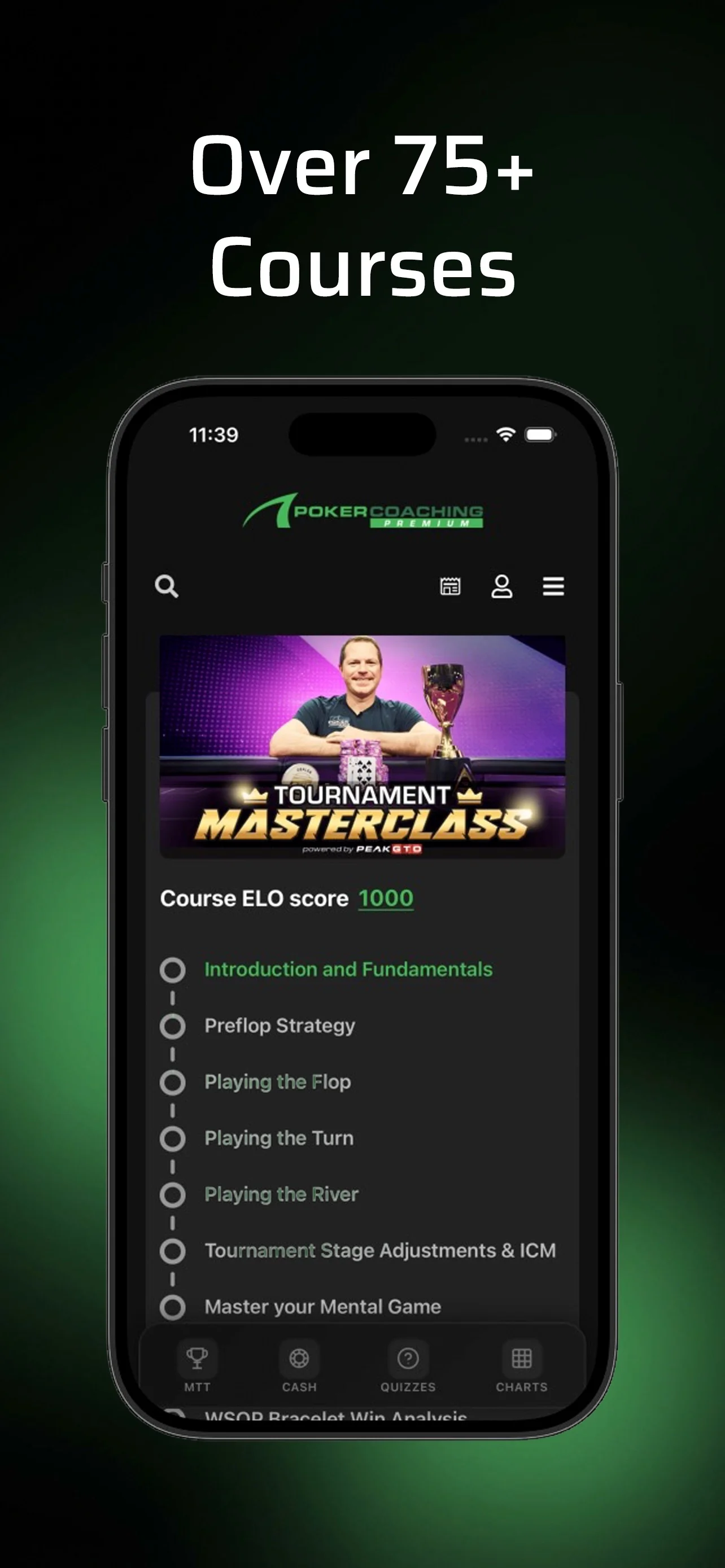
After its preflop track, Poker Skill's postflop lessons cover when to continuation bet and how much, polarized bets, check-raises and which turn cards to keep betting. In Practice vs AI you play full hands against AI opponents that run on Showdown AI. Coach Max, Poker Skill's AI poker coach, advises you during the hand and grades your decisions in the game's analysis. The app is built for Texas Hold'em.
PokerCoaching
Video courses, hand quizzes and GTO charts
$147 a month
Best for Players who learn from structured video courses and want quizzes to test what they learned.
Skip if You want the courses for free: they come with Premium, as do the 1,500+ interactive hand quizzes.
Free version Free GTO and exploitative preflop charts, ebooks and cheat sheets on the site. Premium has no free trial but comes with a 30-day money-back guarantee.
Where it runs Web, iPhone, iPad and Android
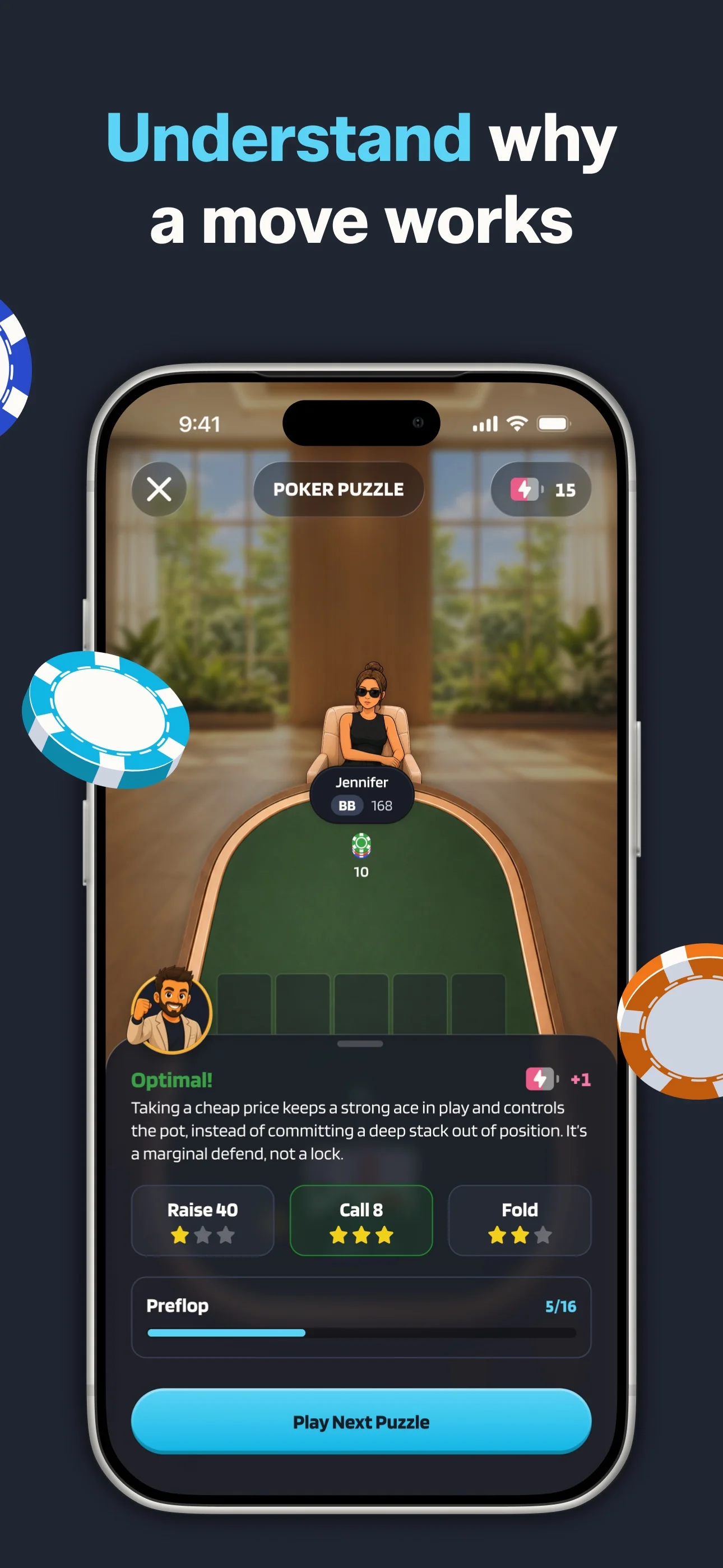
PokerCoaching is Jonathan Little's training site. Premium holds structured courses and 1,500+ interactive hand quizzes, plus 600+ video classes and webinars, and its app puts the GTO charts, quizzes and video lessons on your phone. It costs $147 a month or $999 a year. The company also sells PeakGTO, a GTO trainer on the web and on iPhone whose free plan includes the full preflop library and trainer. PeakGTO's paid plan costs $79 a month or $599 a year, or $169 a month or $1,299 a year together with Premium.
Compared with Poker Skill: PokerCoaching is the better pick if you learn from video courses and want hand quizzes to test what stuck, while Poker Skill teaches the ideas behind GTO in short lessons, from preflop ranges to continuation bets.
Upswing Poker
The Lab: video courses with game theory modules
$99 a month
Best for Players who want one structured course path, from the basics to game theory modules, with a quiz that places them at the right level.
Skip if You want to try it before paying, because the Lab has no free trial.
Free version Eight free preflop charts and a free strategy blog. The Lab offers first-time members a 30-day guarantee instead of a trial.
Where it runs A web browser; the only store app is an Android chart viewer for Lab members
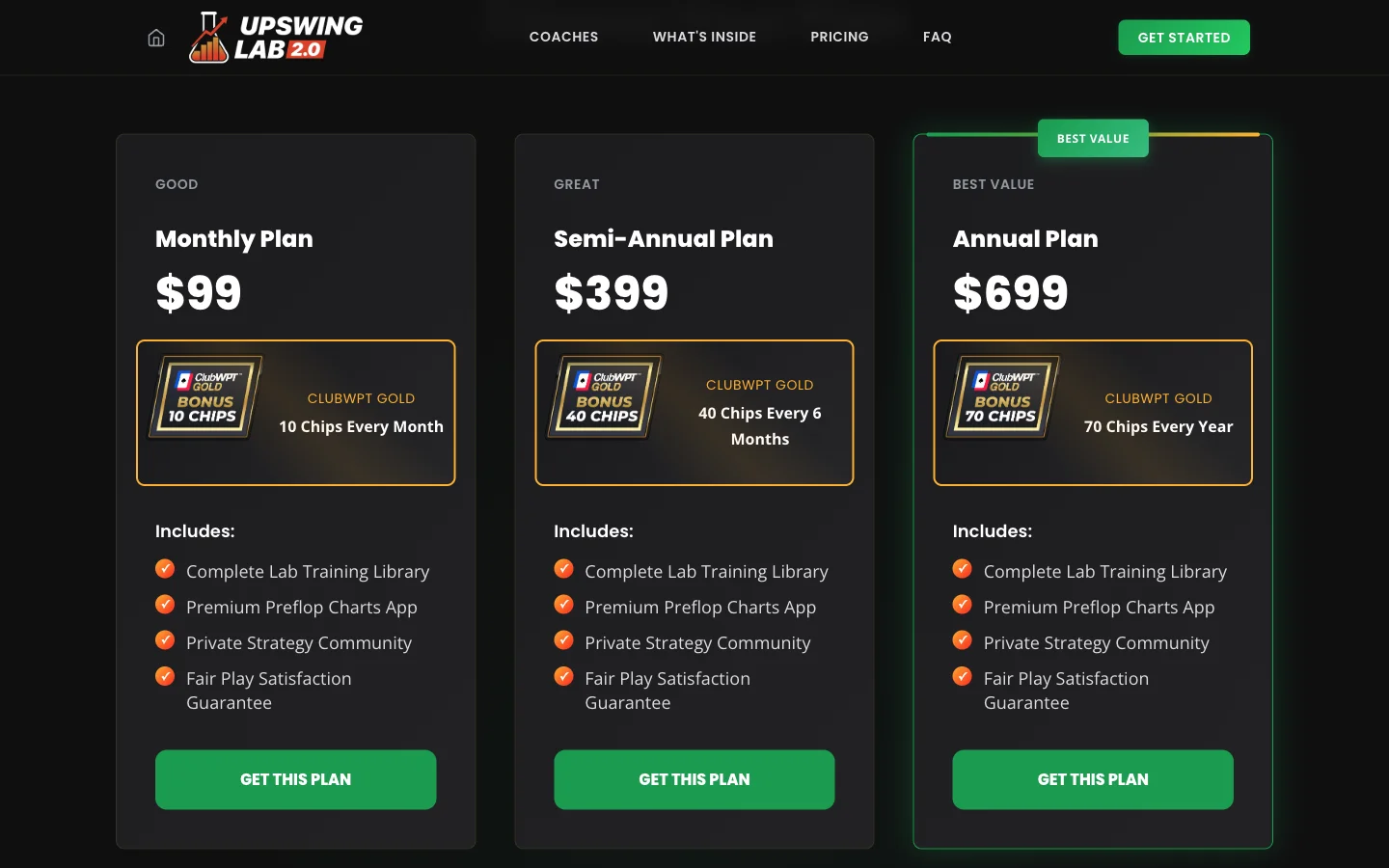
Upswing Poker's Lab 2.0 was rebuilt under coach Uri Peleg. Its Game Theory Training runs 10 cash-game levels and 8 tournament levels on topics such as bet sizing, river strategy and check-raised pots. An Intro to Solvers module covers solver basics. The lessons are videos, with practice quizzes that give instant feedback, and a placement quiz sets your starting level. Membership costs $99 a month, $399 every six months or $699 a year, and it includes a preflop charts app and a private strategy community.
Compared with Poker Skill: Upswing Poker's Lab is the better pick for one structured course through game theory, with levels for cash games and tournaments, while Poker Skill has you practice one decision at a time.
Modern Poker Theory
A book on GTO by Michael Acevedo
$39.95 paperback; $29.95 ebook
Best for Players who learn best by reading and want GTO explained in depth, with examples from solver study.
Skip if You want feedback on your own decisions, since a book can't check your answers.
Free version None. The publisher sells the paperback, the ebook and a bundle with two video packs.
Where it runs Paperback, or an ebook from the publisher
Modern Poker Theory, from the poker publisher D&B, examines what game theory optimal play means in No-Limit Hold'em and how to apply it at the table. Michael Acevedo built it from thousands of hours of research with advanced poker software, so you read what the solvers found without running one. The paperback costs $39.95 and the ebook $29.95, and a bundle of the ebook with two video packs costs $219.95.
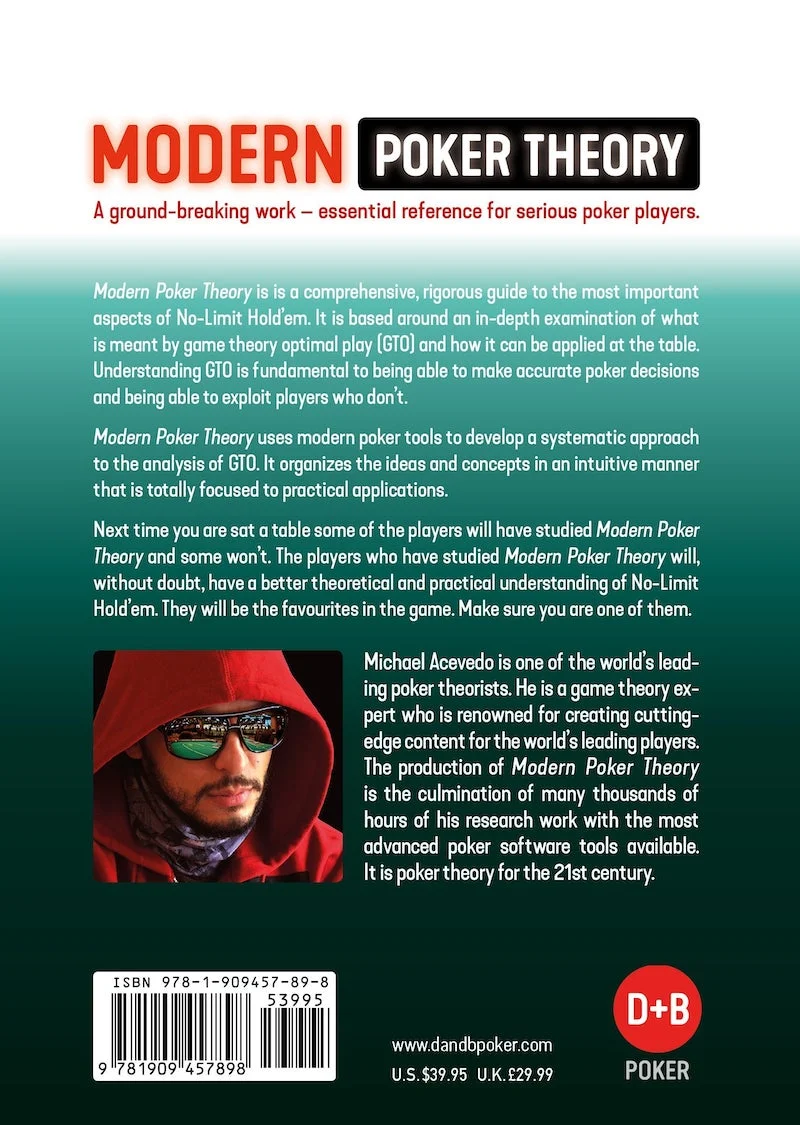
Compared with Poker Skill: Modern Poker Theory explains GTO in depth for players who learn by reading, while Poker Skill's Daily Puzzle grades your own answer on a new spot each day.
GTO Wizard
Solved spots and a trainer in the browser
Free plan
Best for Players who already think in ranges and want to study solver output for common spots.
Skip if You want a guided path through the ideas first, because its solutions answer in frequencies across a whole range.
Free version 100 preflop solutions, 1 postflop solution and 10 trainer hands a day, with no end date, plus free strategy articles.
Where it runs A web browser, on a computer or a phone; no study app in the App Store or Google Play
GTO Wizard keeps a library of solved spots for cash games and tournaments, from preflop to the river. Open one and you see how often each hand in a range takes each action, and its trainer gives instant GTO feedback on your own decisions. For cash games, Starter costs $39 a month billed yearly ($468) or $49 month to month. A spot you set up yourself needs its AI solver, which starts on the Elite plan at $139 a month billed yearly.
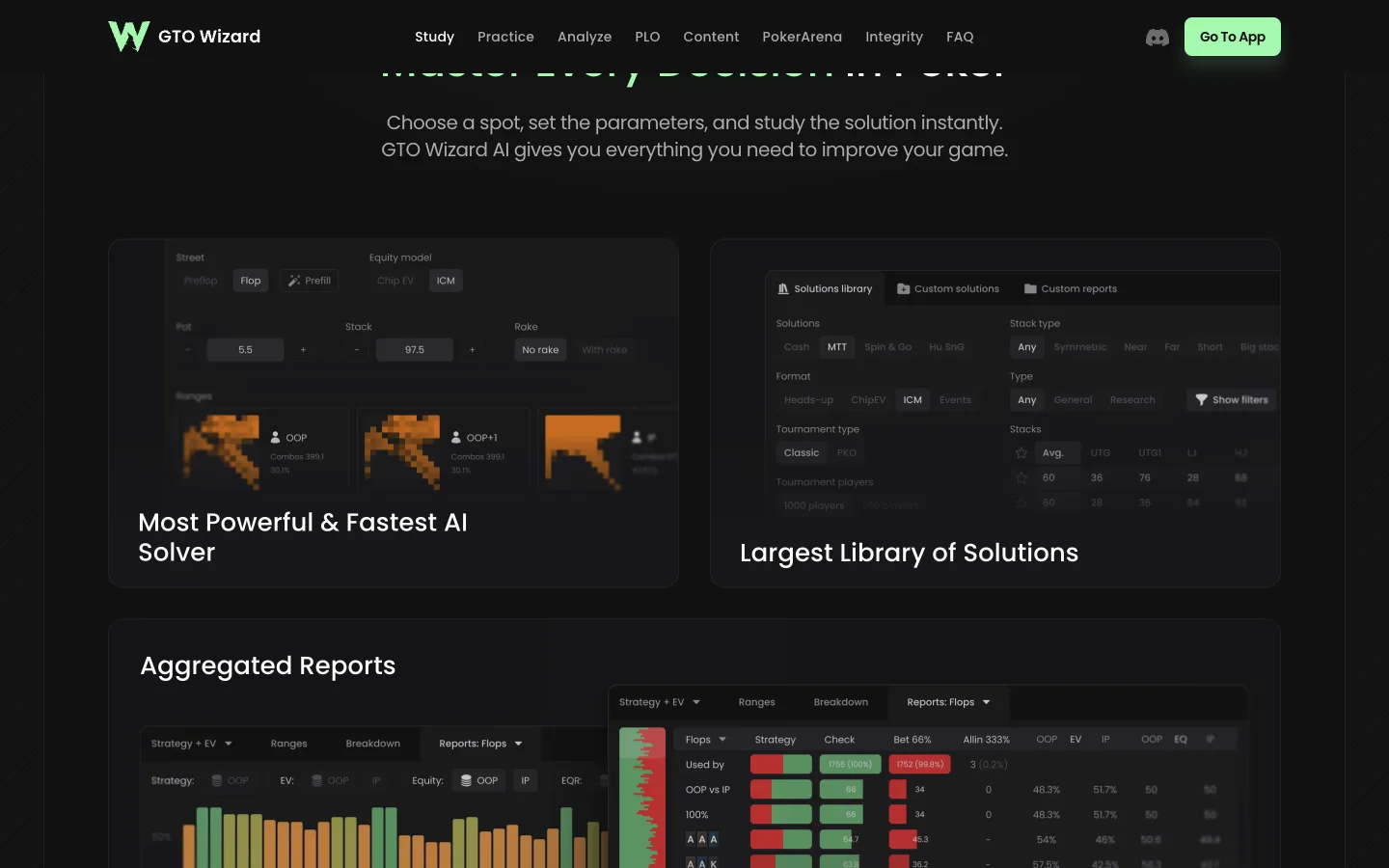
Compared with Poker Skill: GTO Wizard shows solver frequencies in a browser for players who already think in ranges, while Poker Skill explains the reasoning behind each play in plain words on iPhone and Android.
What to learn first, and how to study GTO without a solver
A GTO strategy is built to resist exploitation: in a heads-up spot, an opponent can’t do better by changing their play to attack it. A solver works it out for a spot you define, from the ranges, stacks and bet sizes you give it, and reports how often to take each action. Its answer can be a mixed strategy, with the same hand taking more than one action. Against a player whose leak you can name, an exploitative adjustment can earn more, so GTO serves as the baseline you adjust from. Without a solver of your own, you learn from strategies that were already solved, and each one answers only the spots it covers, at the stack depths and bet sizes it was solved for.
Think in ranges. Start each hand from a preflop range suited to your game, then narrow the hands each player can hold as the betting goes on, rather than weighing only your own two cards. Solver output gives the action frequencies for each hand in each player’s range, so reading it starts with this habit.
Board texture changes how often a light continuation bet gets folds. A dry flop connects with fewer hands in the caller’s range, so it offers more fold equity, while a wet flop connects with more of that range and calls for more care and more equity behind the bet. Poker Skill teaches the continuation bet from the same idea: before you bet the flop, ask whether the big blind’s range connected with it.
Bet size sets how many bluffs a balanced range can hold. Bet the size of the pot on a heads-up river and the caller risks one pot to win two, so a hand that only beats bluffs needs to win one time in three. A range with one bluff for every two value bets leaves that caller no better off calling than folding, and that balance is the bluff-to-value ratio for a pot-sized bet. Try the same sum for a half-pot bet before you open the answer.
Show the half-pot answer
A half-pot bet asks the caller to risk half a pot to win one and a half, so a hand that only beats bluffs needs to win one time in four. The balanced range holds one bluff for every three value bets.
Blockers help pick which hands to bluff with. A card that removes some of your opponent’s strongest calling hands makes a bluff more attractive, such as the ace of the suit when three cards of one suit are on the board. A blocker matters most when the decision is close, and bluffing just because you hold one leads to too many bluffs.
A study session without a solver
Who should skip Poker Skill
Skip Poker Skill if you need exact frequencies for your own spots. GTO Wizard’s library shows them for the spots it has already solved, and its AI solver, from the Elite plan up, answers a spot you set up yourself.
How we compared
We judged each option on how it teaches, what its answers look like, what it costs and where it runs. Poker Skill’s facts come from its store listings, its shipped lessons and the Poker Skill training app page. The other four were read on their own sites, store listings and the publisher’s page in September 2026, and which reader each one fits is our judgment. Other trainers sell solved spots too, and GTO Wizard stands for that way of studying here.
Frequently asked questions
Can you study GTO for free?
Yes, up to a point. Poker Skill opens every lesson, the Daily Puzzle and one Practice vs AI game a day to every player, and GTO Wizard's free plan opens 100 preflop solutions, 1 postflop solution and 10 trainer hands a day. PokerCoaching and Upswing Poker give away preflop charts, and GTO Wizard and Upswing publish free strategy articles. The video courses, the full solution library and Modern Poker Theory are paid.
Should you learn GTO as a beginner?
Yes, gradually, while most of your time still goes to playing. Solver output lists how often each hand in a range takes each action, and making sense of it takes poker knowledge and practice. When you do study a solved spot, ask why the strategy works instead of copying it, and pick one built on the ranges and bet sizes of the games you play.
Is reviewing your own hands enough to learn GTO?
No. Reviewing your hands is useful, but you also need a benchmark to compare your play with, such as a solved spot, a course or a book. Note your decision and your reason on each street before you look, then check how a solved spot plays your whole range there. A hand's result on its own says little about whether the decision was right.