
The grid is not sorted by how good the cards look. It ranks what the hand can turn into, so every cell is there for a reason you can say out loud, and once you can say the reason the grid collapses into about five rules and a seating order.
Learn the widest seat first, subtract a band of hands for every seat you move earlier, and drill only the hands on the edge.
The five rules that compress the grid
Five classes. One rule each. Learn these and you can reconstruct most of any seat’s range without looking.
| Class | The rule | Where it enters |
|---|---|---|
| Pocket pairs | Always playable, the only question is how early | Big pairs from any seat, medium pairs almost as wide, small pairs get more selective the earlier you sit |
| Suited aces | The strongest ones are early hands, the small ones are position hands | Ace-king through ace-ten suited early, the small suited aces later and in the blinds |
| Suited broadways | Two high cards of one suit are always worth something | Playable from any seat in the right spot, most comfortable from the middle and late seats |
| Offsuit broadways | Only the top of the class travels | King-queen and ace-jack can open early in a good spot, king-jack and queen-jack and jack-ten are button and blind hands |
| Suited connectors | The clearest late-position class in the game | Button and the blinds, not early or middle |
Read the right-hand column top to bottom and you have the subtraction order. The classes that enter latest are the classes that leave first. Keep the free preflop charts open while you work through the rest of this page, because the chart is the reference you are trying to make unnecessary.
Where those classes sit on the grid
The rules are what to learn. The grid is where to find them: four blocks, the same four in every chart.
| Block | Where it sits on the grid |
|---|---|
| The pairs | Down the diagonal, AA top left to 22 bottom right |
| The suited aces | Along the top row, right of AA |
| The suited broadways | The top left corner block |
| The suited connectors | A stripe running parallel to the diagonal |
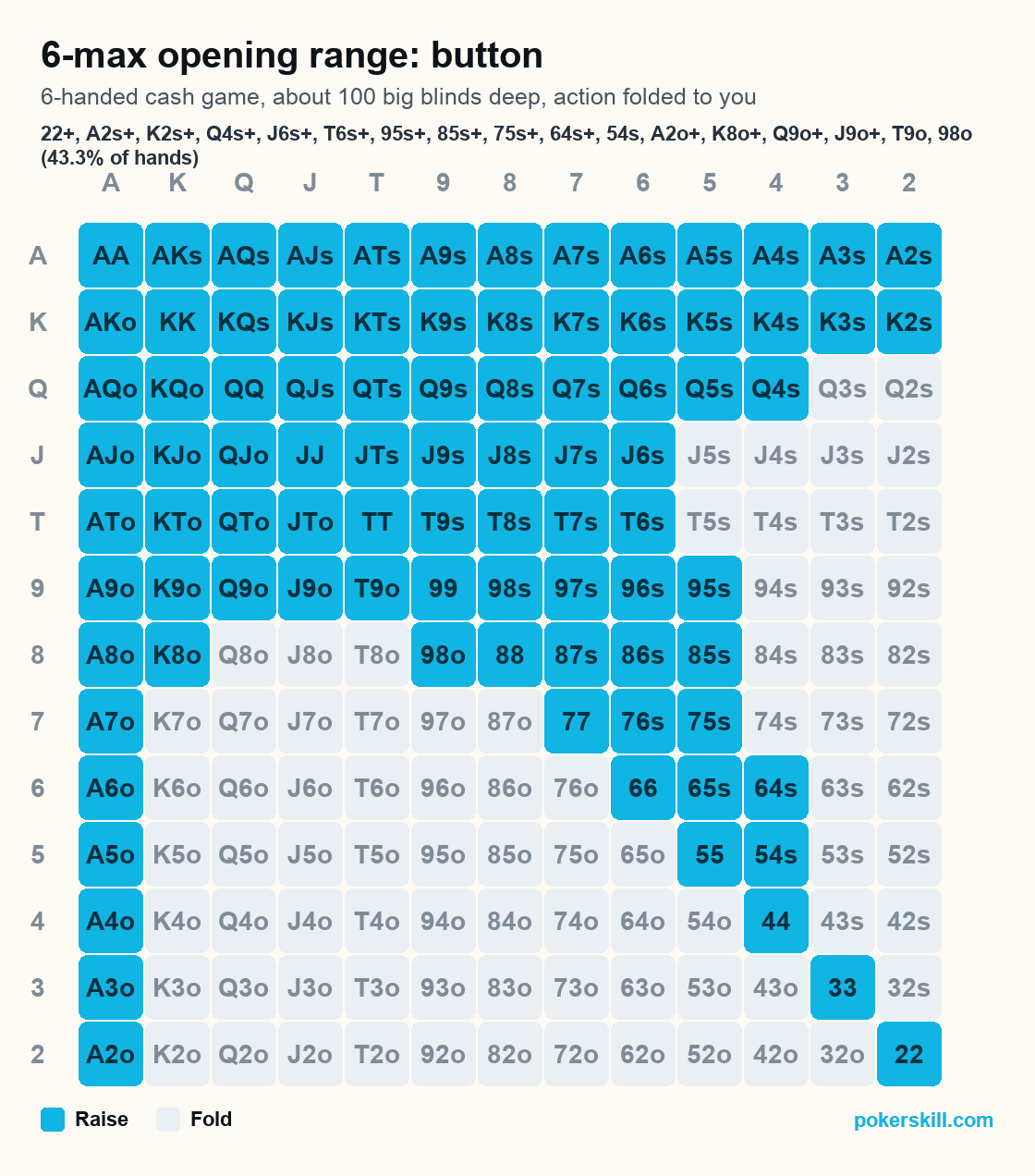
Each seat you move later, those blocks extend and the offsuit region under the diagonal starts filling in. Learn where your seat’s edges sit, then drill the boundary hands, because the middle of the range is never the part you get wrong: K9s and A9o are where the money is.
Position first: learn the button, then subtract
The whole grid is one range plus a shrinking rule.
Start at the widest seat
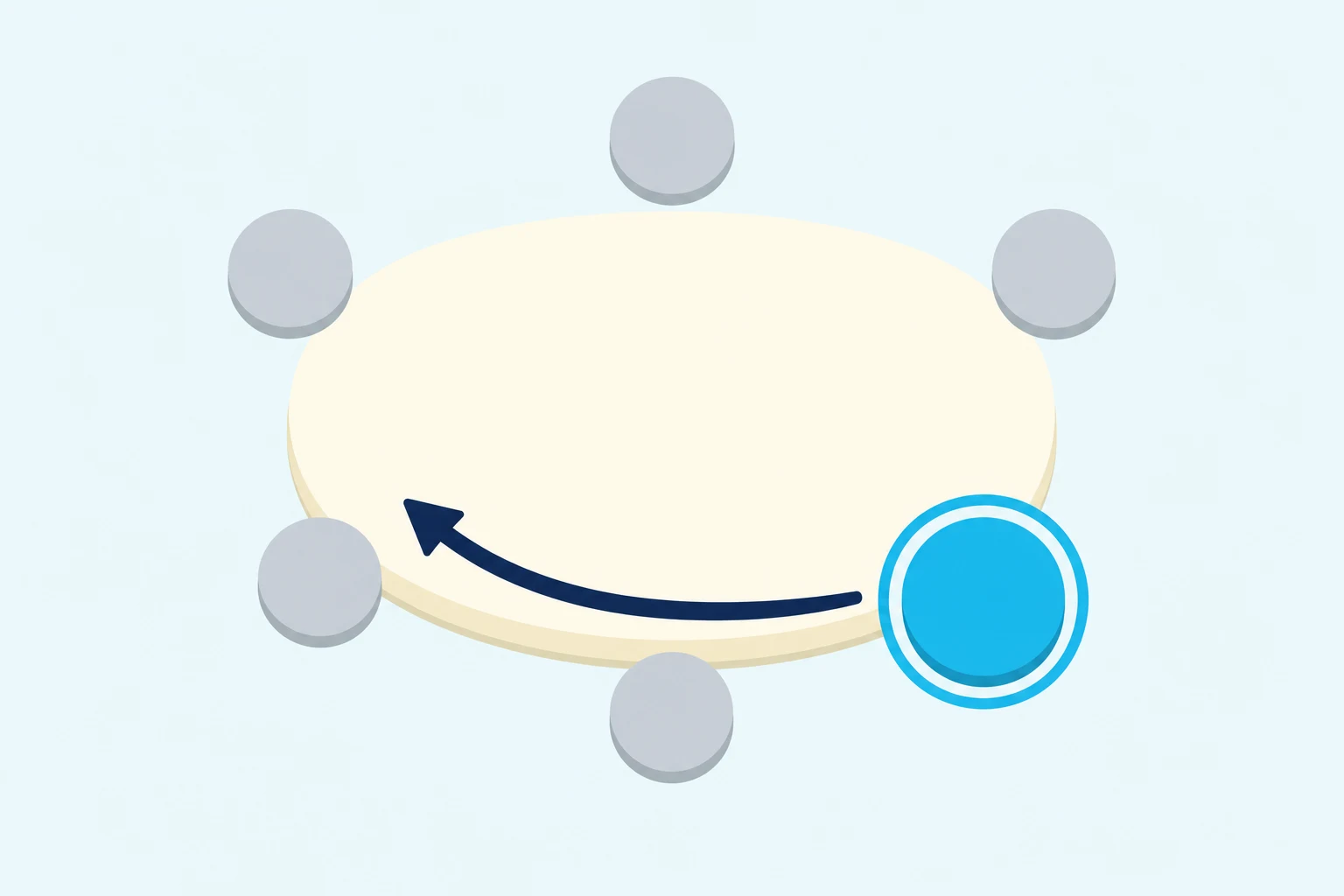
The button is the widest opening seat, because it is the only seat that acts last for the rest of the hand, and because two blinds are sitting there waiting to be attacked. Learn that range first. It is the largest one, and every other seat is a subset of it. That is the part nobody tells you: you are not learning six ranges, you are learning one range and five subtractions.
Each earlier seat is the last one minus a band
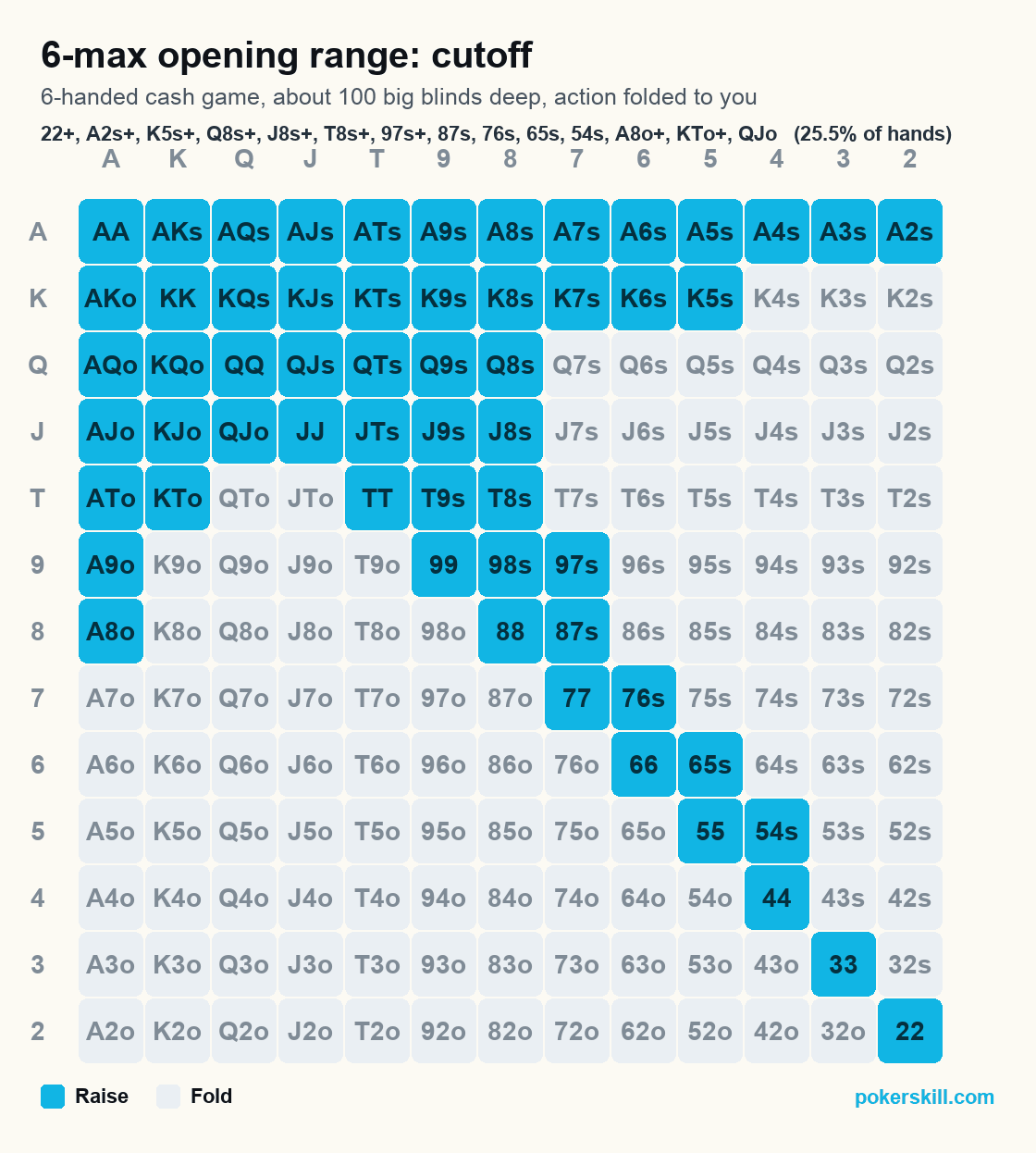
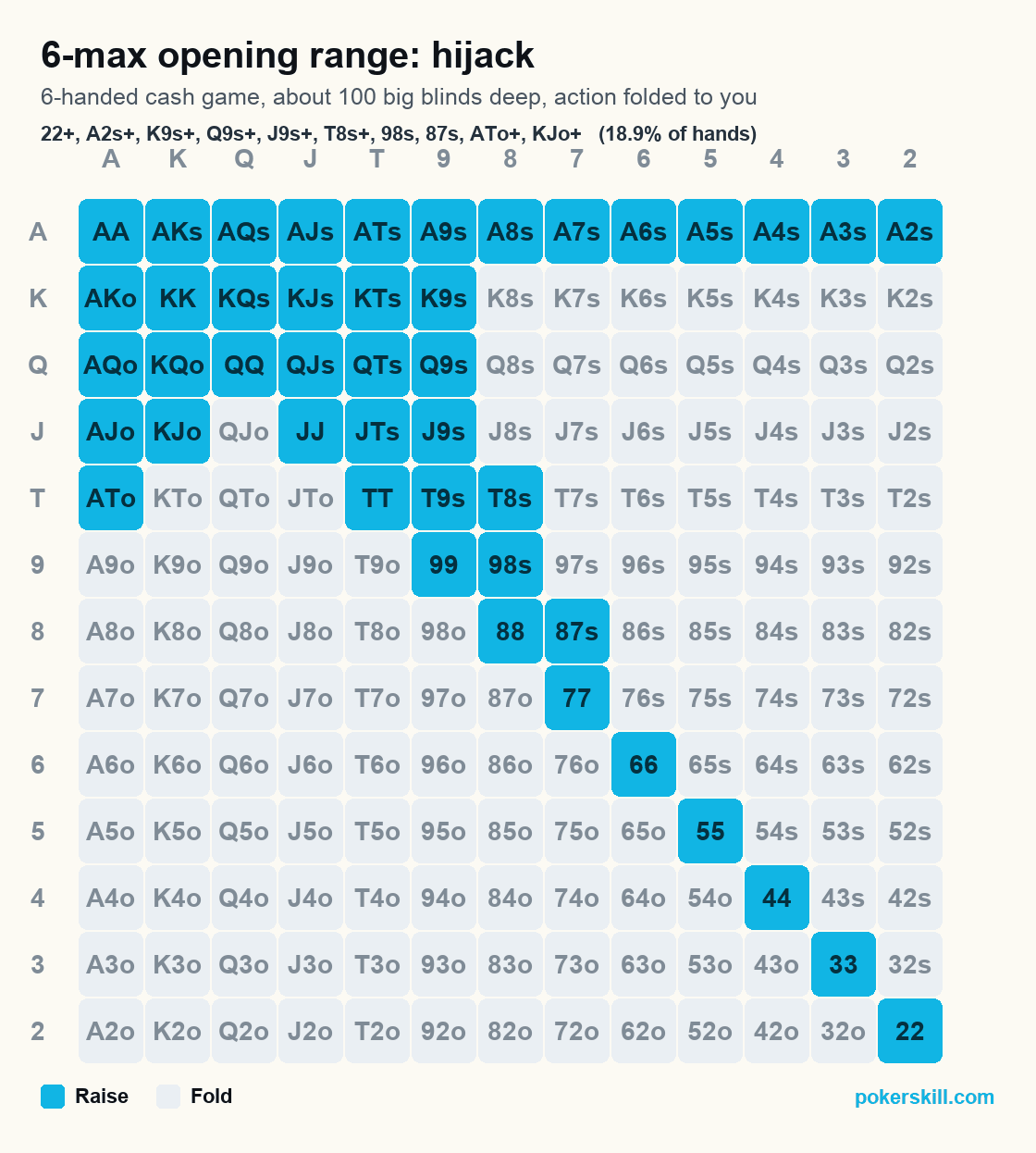
Move one seat earlier and you have more players left to act, so more chances someone wakes up with a real hand. That is the entire mechanism, and it means the range shrinks in a predictable order. The hands that leave first are the ones that need position or a lot of players folding to be worth playing: the weak offsuit broadways, then the suited connectors, then the small suited aces and on down from there. Under the gun is where that subtraction stops.
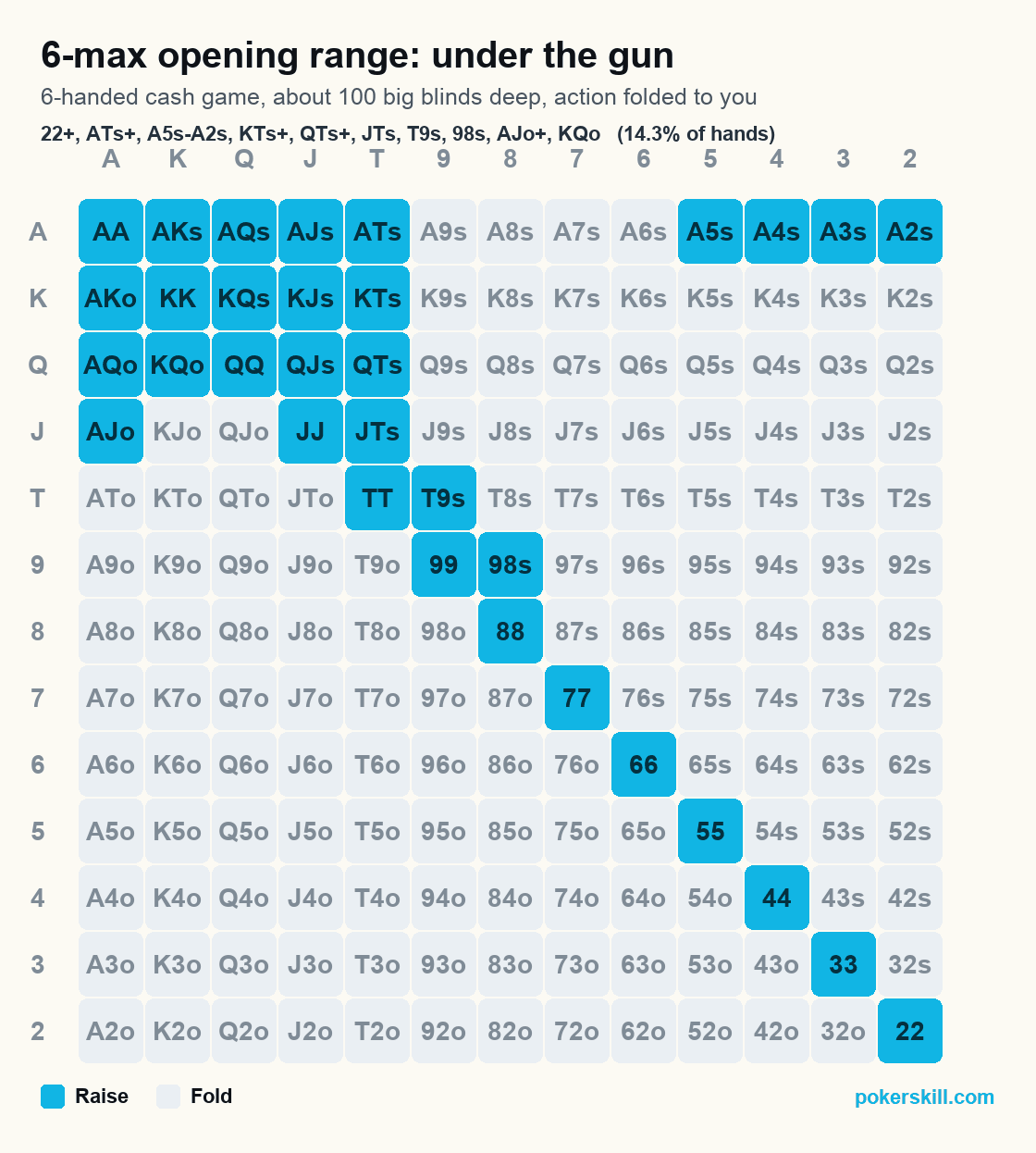
Subtract, do not re-learn
The mistake is treating each seat as a fresh chart to memorise. It is not. If you know the button and you know which band leaves next, you can rebuild the cutoff from the button in about three seconds, and the hijack from the cutoff. Six charts is a memory problem. One chart and an order is a rule.
Self-check: which of these opens from the cutoff?
Three hands, one seat. Pick the one that opens, then check yourself against the cutoff grid above.
Show answer
Hand B, king-seven suited. The cutoff opens suited kings down to K5s, so K7s is inside it. Hand A is an offsuit ace below the cutoff’s A8o cut-off, and hand C is a suited queen below its Q8s cut-off, so both fold. Notice what the answer was not about: A7o contains the highest card of the three and is the only one of them you fold without thinking.
Why A5s opens where A9o folds
A5s is not the better hand right now. It is the better hand to play. A9o wins more of the time when both hands go to showdown unimproved, and that is exactly the trap: the hands you play from a seat are not chosen by which one is ahead preflop, they are chosen by what happens after the flop.
Both hands hold an ace, which is one fewer strong ace in everybody else’s hand, so the pots you attack get folded more often. Offsuit ace-x hands struggle exactly where they look strongest: the times you get paid do not cover the times you pay.
So the rule to memorise is not about the kicker rank. It is: an ace with a low suited card has several ways to be worth money, and an ace with a middling offsuit card mostly has one, with a trap attached.
And the ones in between?
That is the sharper version of the thread question, and it deserves the honest answer: the gap is a property of the chart, not a law of the game. Plenty of published ranges open the suited aces straight through from A2s to A8s with no hole in the middle. Where a chart does cut the middle ones and keep A5s and A4s, the reason is the straight: five, four, three and two make the wheel with an ace and a seven does not, so the wheel aces cover flops the middle ones miss while being identically suited. The suited aces are close enough in value that different range builders draw the line in different places, which is exactly why memorising the cells fails and memorising the reasons works. Learn what the low card is doing and you can read either chart.
A drill schedule that sticks
Ten minutes a day beats an hour on Sunday, because recall is built by repetition rather than by duration.
Not the whole chart. One seat, and the same seat all week.
Out loud, or written down: name the hand classes that open from that seat and where each one stops. Doing it from memory first is the whole exercise. Reading it off the chart and nodding is not.
Not to grade yourself, but to find the exact hands you got wrong.
Ace-nine suited when you said fold, king-ten offsuit when you said open. Those are the hands worth ten minutes. The obvious hands are not: nobody has ever lost money forgetting that aces are an opening hand.
Then come back to the first one and see what survived.
Drilling the edge first is a choice rather than a rule, and the reason is simple. A hand you were never going to play cannot cost you anything, and a hand on the boundary costs you every time you call it wrong. Start where the errors live and the middle takes care of itself. Poker Skill’s raise-or-fold lessons keep to one seat each, and every hand in them is a raise or a fold with its reason attached.
Keep the chart until you do not need it
There is no prize for playing from memory before your memory is ready. Keep the free preflop charts open while you play online and glance at them, the same way you would keep a recipe out while you learn to cook. The opening ranges reference does the same job seat by seat when you want to check one position rather than all of them.
What changes over a few weeks is how often you look. First you check every hand. Then you check the close ones. Then you notice you have not opened the tab all session, and the method has done its job. If you want the underlying logic of why seats matter at all, poker positions covers the ground the whole method sits on.
Frequently asked questions
How long does it take to memorise preflop ranges?
There is no fixed number, and the useful marker is a behaviour rather than a date: first you stop checking the obvious hands, then you stop checking the close ones, then you notice the chart has been shut all session. What reliably does not work is one long sitting, because this is recall rather than comprehension, and recall is built by repetition spread over days.
Do I need different ranges for 6-max and full ring?
Yes, and the difference follows the same rule as position. More players left to act means more chances someone has a real hand, so a full ring table plays tighter from the same named seat than a six-handed table does. Rather than learning two grids, learn one and apply the subtraction: at a fuller table, every seat behaves like a seat or two earlier. The free preflop charts cover the format you are playing.
What should I memorise first?
The button, then the seat directly before it. Those two seats come up constantly, they are where most of your profitable opens live, and every earlier seat is a smaller version of them. Memorising under the gun first is the common mistake: it is the rarest opening range and the one you can most safely play too tight while you learn.