
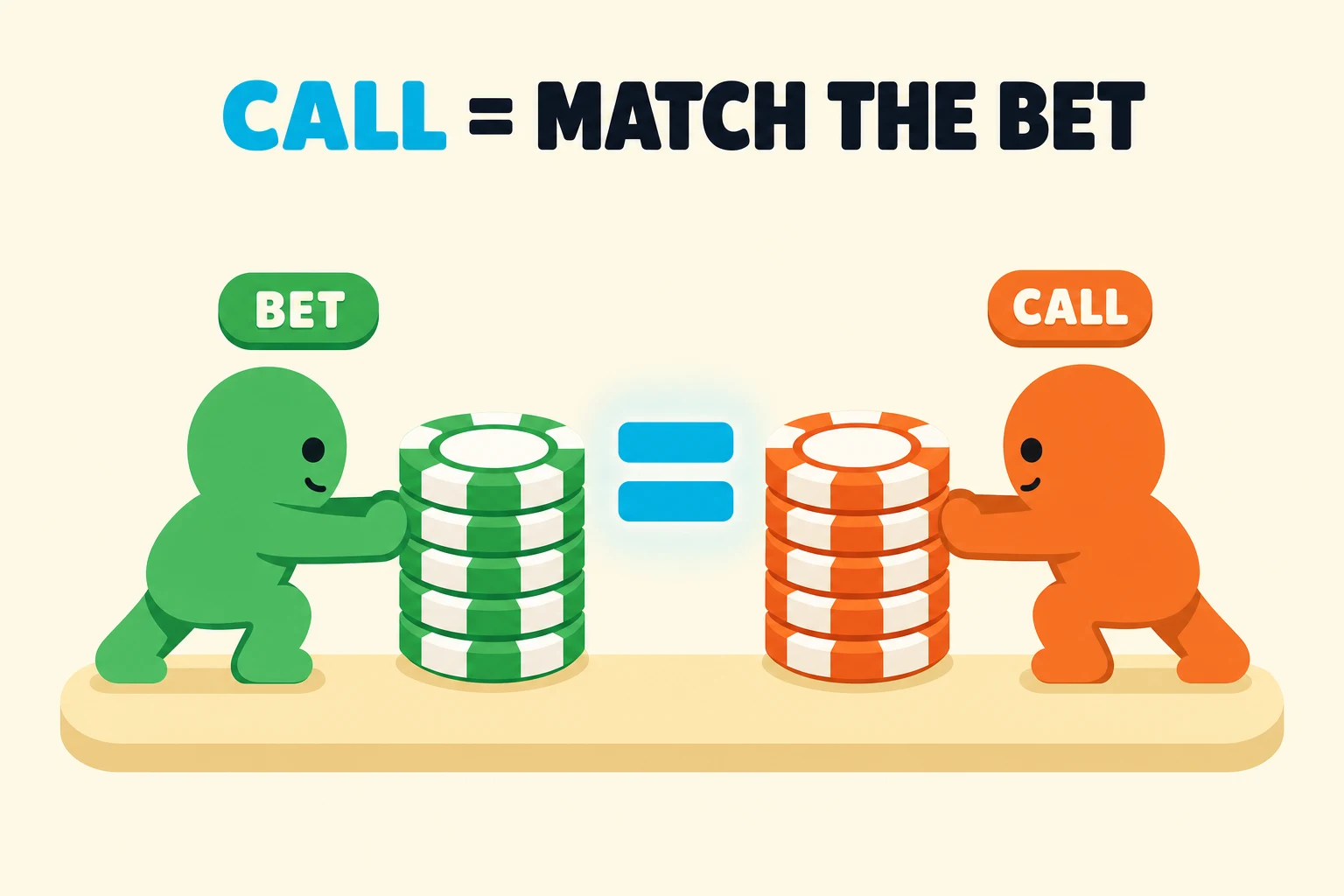
A call matches the current bet exactly: no more, no less and the hand continues. It is the middle road between folding and raising, and that is precisely its danger. Good calls are bought at a price the math supports. Bad calls are bought because calling feels safer than deciding, and they cost more per year than any bluff ever will. If the definition is all you came for, what a call is answers it in a line. This page is about when to make one.
What a call is and what it closes
When action reaches you facing a bet, you have three doors: fold and forfeit, raise and reopen the action, or call and match. A call keeps every promise small: you risk only the bet in front of you, you see the next card or the showdown, and you hand the initiative to the bettor. If everyone behind you calls or folds, the betting round closes. One special case worth knowing: if you face an all-in for less than a full raise, you can call the short amount without reopening the action to the players who already acted.
That is the rulebook. Everything else about calling is judgment, and the judgment starts with price.
The price test
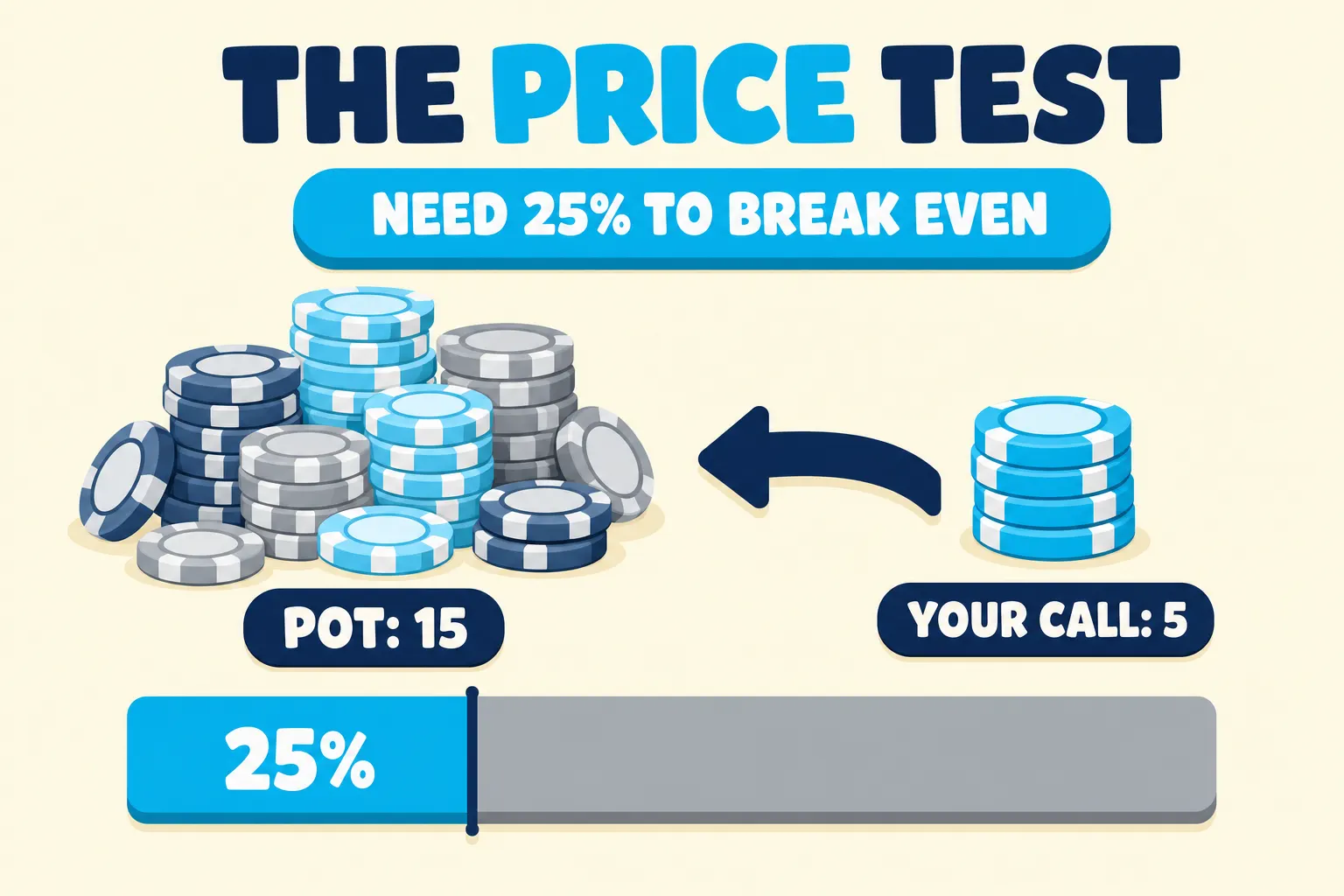
Every call has an exact break-even point, and it takes ten seconds to find. Say the pot is 10 big blinds and your opponent bets 5. You must call 5 to compete for a pot that now holds 15, so your 5 buys a shot at 20 total: you need to win 25 percent of the time to break even. Hold a flush draw on the flop, about 35 percent to arrive by the river if you see both cards, and the call is comfortably profitable before you even count the extra chips that land when you hit. Hold a gutshot at roughly 16 percent, and the same price is a clear fold on pot odds alone.
The formula never changes: call amount divided by pot-after-your-call equals the equity you need. Work through it slowly once in how to calculate the price and you will run it in your head after that. Half-pot bets need 25 percent, full-pot bets need a third. Two memorized numbers cover most of the decisions you will ever face.
The three-question filter
Price is necessary and not sufficient. Before the chips move, a good call answers three questions. Price: does my equity clear the break-even number, counting implied odds when the hand that gets there will get paid more? Position: do I act last from here on, which makes every future street cheaper and more informed, or am I calling my way into playing three streets blind? Plan: what am I doing on the next card, both when it helps and when it bricks? A call with a plan is a line. A call without one is a donation on an installment schedule. In Poker Skill’s check-call lesson the price question comes on the flop: Q♥ J♥ calls with top pair on Q♠ 10♣ 5♦, and 4♣ 3♣ folds on K♦ 9♥ 2♠ with no pair and no draw to justify the chips.
Good calls and bad calls, side by side
| Spot | Call? | Why |
|---|---|---|
| Flush draw, half-pot bet, in position | Yes | 35% equity vs 25% price, plus implied odds |
| Bottom pair vs a third barrel | Rarely | Beat almost nothing that bets three times |
| Gutshot, full-pot bet | No | ~16% equity vs 33% price |
| Middle pair vs one small flop bet | Usually | Price is cheap, hand beats bluffs |
| Preflop, suited junk vs a 3-bet | No | Dominated hands, no position, no plan |
| Set on a wet board facing a bet | No, raise | Too strong to call; charge the draws |
The last row matters most. Calling is not the default response to strength; hands that want money in should raise. The habit of flat-calling monsters “to trap” mostly traps value you never collected.
The calling-station leak
The calling station is the player who found one move and made it their whole game. Calling feels safe because it never risks the embarrassment of folding the winner or bluff-raising into the nuts. But the math is unforgiving: a station’s calls are systematically priced wrong, they arrive at rivers with second-best hands their opponents value bet relentlessly, and they never win the pots that folding-and-raising players steal. If your VPIP-to-PFR gap says passive, the fix is not calling less so much as promoting your calls: the hands strong enough to continue are usually strong enough to raise, and the hands not worth raising are usually not worth calling either. Force each hand into the stronger action and the middle door shrinks to the spots where it genuinely belongs.
The special calls
Two named calls earn their labels. A crying call matches a river bet you expect to lose, made because the pot is too big and your bluff-catcher too decent to fold at the price; correct occasionally, a lifestyle never. A hero call matches a big bet with a weak hand because the story your opponent told does not add up; the best players make these on reads and blockers, not on hope. Both live at the river, and both are priced by the same arithmetic as every other call.
When this lies to you
The price test assumes clean equity, and equity is not always clean. Implied odds justify calls the raw price rejects: a set-mine at the wrong immediate price is still right when stacks are deep, because the 12 percent of flops that hit pay off a full stack. The reverse is nastier: dominated draws fail at prices that look right, because the card that makes your king-high flush makes someone’s ace-high flush, and you pay off exactly when you connect. And multiway pots warp everything: prices improve because the pot is bigger, but your equity drops because more hands are drawing against you. Count both sides before trusting the shortcut.
A live-play pattern
Before any call, say the price to yourself as a sentence: “I am calling five to win twenty, I need twenty-five percent.” Then name your equity source out loud in your head: a draw with a number attached, a made hand that beats the bluffs, or nothing. If the sentence ends with “nothing,” you were about to call on feel, and feel is what the bettor is charging for. Ten seconds, every call, and the station leak never gets a foothold.
Where this fits
Calling sits inside the wider preflop and postflop decision tree: the cold call has its own preflop rules, raising has its own logic, and the read on who you are calling comes from the frequency work in the VPIP and PFR article. Price first, position second, plan always.
Frequently asked questions
What is the difference between calling and checking? A call matches an existing bet; a check passes when no bet exists. You can only check when nobody has bet the current street, and you can only call when someone has.
Can you call an all-in for less than the bet? Yes. When a player goes all-in for less than a full call amount, you call only what they have. Side pots handle the difference when more players are involved.
What is a cold call? Calling a raise when you have no money in the pot yet, most often facing a preflop raise from a seat that has not posted a blind. Cold-calling ranges should be tighter than most players’ are, because you enter the pot without initiative against a declared strong range.
Is calling ever better than raising with a strong hand? Sometimes, deliberately and rarely: keeping an uncapped range, trapping a maniac who will keep betting, or controlling a pot out of position. As a default, strong hands raise; the exceptions should be chosen, not drifted into.