
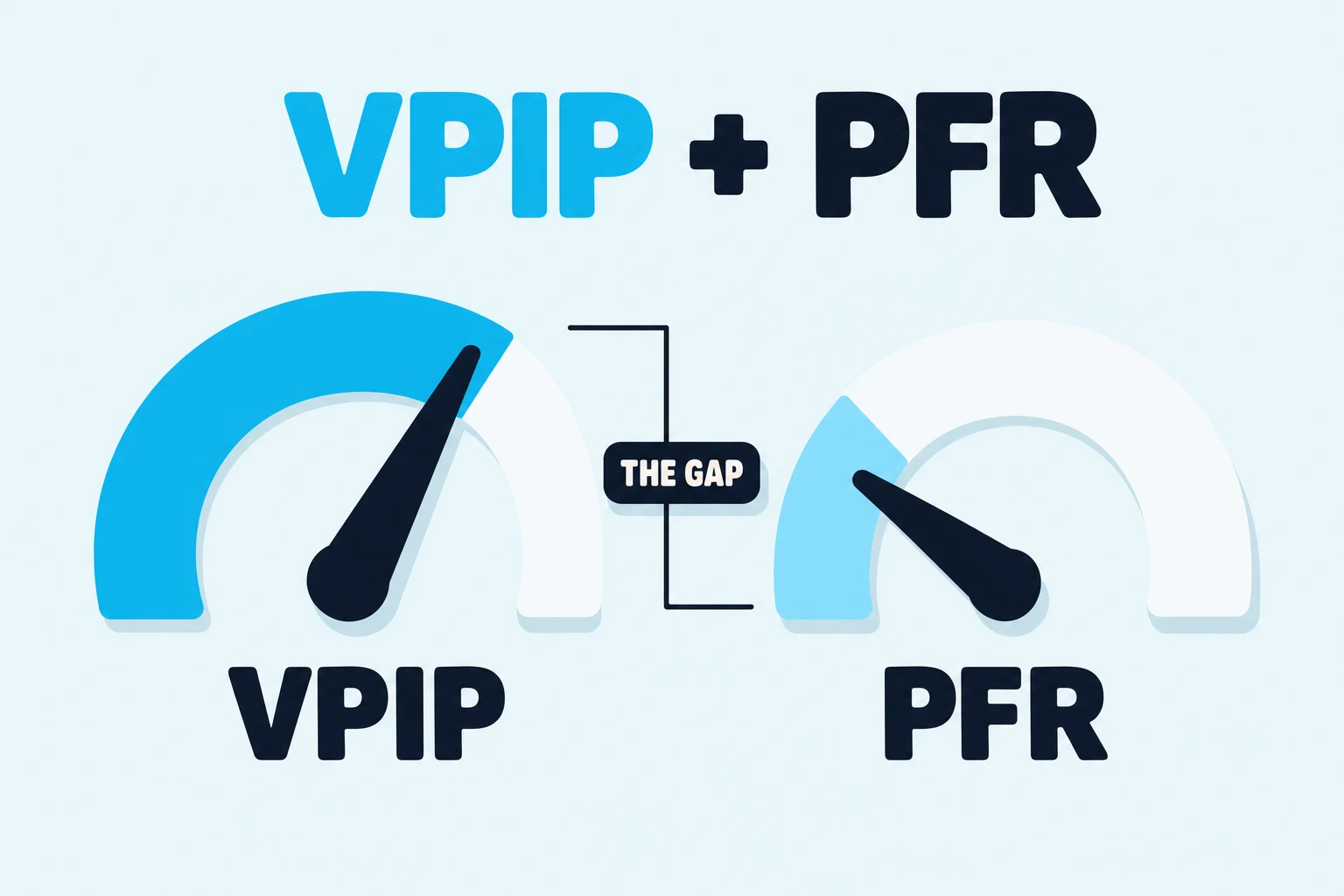
VPIP is the percentage of hands where a player voluntarily puts money into the pot before the flop: calls and raises count, blinds do not. PFR is the percentage where they come in raising. Read together, the two numbers sketch a player’s entire style in one glance, and the gap between them points at money more reliably than any other stat on the tracker.
The two stats, one hand at a time
Every dealt hand updates both counters. Fold preflop and neither moves. Call a raise, and VPIP ticks up while PFR stays put. Open-raise, and both tick together. Posting the big blind and checking your option counts for neither, because nothing about it was voluntary. That is the entire machinery: VPIP measures how often a player wants to play, PFR measures how often they want to play on their own terms. Calling a limp counts toward VPIP and leaves PFR alone, and on the button behind one limper you make exactly that call with J♥ 9♥ in one of Poker Skill’s lessons on isolating limpers, because the hand does its best work on a cheap flop and wins big when it connects.
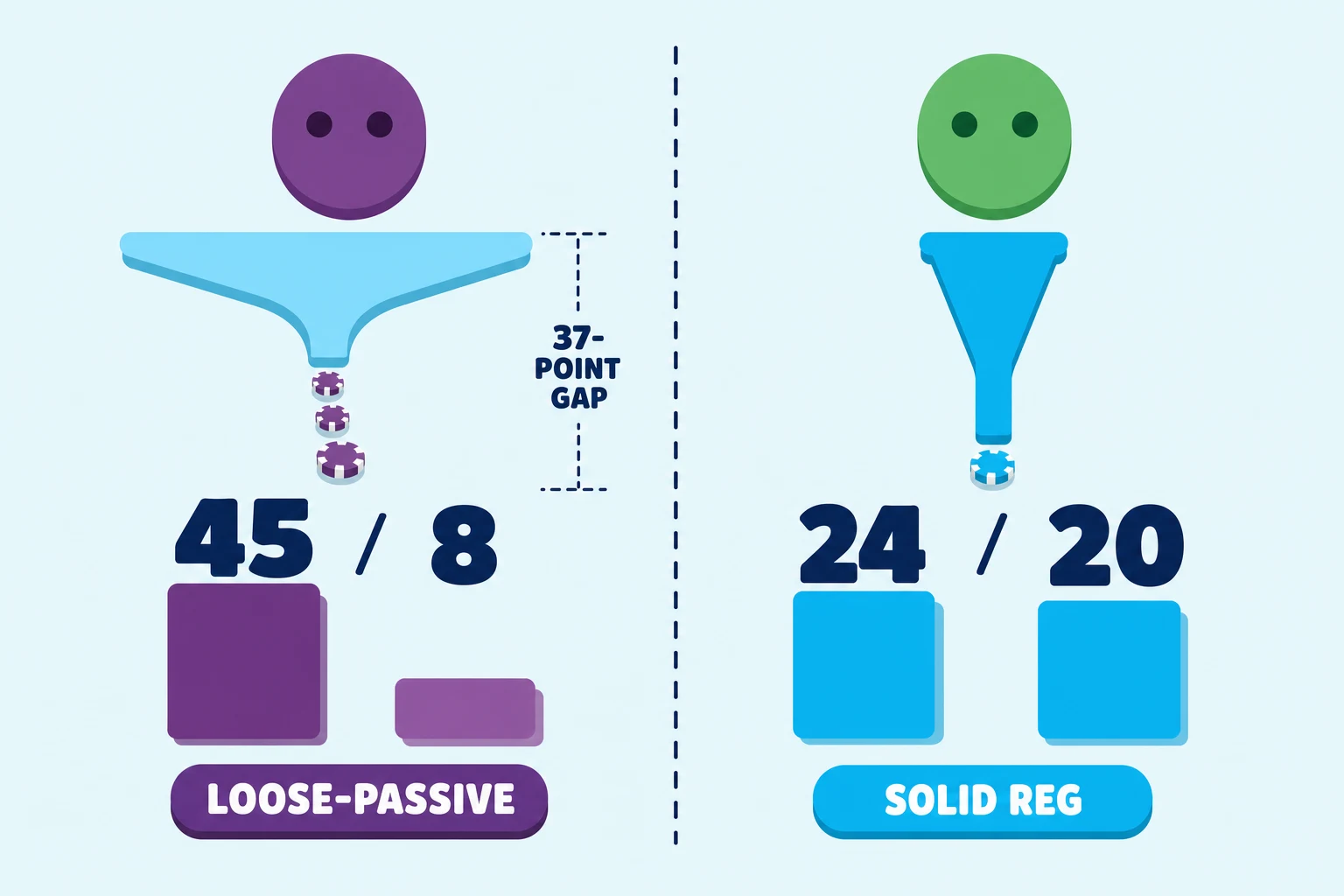
Because a raise always counts toward both, PFR can never exceed VPIP. A 24/20 player enters 24 percent of hands and raises 20 percent of the time, meaning almost every entry is a raise. A 45/8 player enters nearly half their hands and raises almost none of them. Those two players need completely different strategies against them, and the numbers told you before either showed down a single hand.
The player-type map
| VPIP / PFR | Archetype | The exploit |
|---|---|---|
| 22-27 / 18-23 | Solid regular (TAG) | Steal their blinds, avoid their raises |
| 28-38 / 22-30 | Aggressive (LAG) | Let them bluff; call down lighter |
| 35-60 / under 12 | Loose-passive caller | Value bet relentlessly, never bluff |
| under 18 / under 14 | Rock | Fold to their aggression, take their blinds |
| 45+ / 35+ | Maniac | Tighten up, snap off the barrels |
Ranges shift a little by format: full-ring numbers run several points tighter than 6-max, because more players behind demands stronger hands. The shapes and exploits stay the same.
Reading the gap
The gap between VPIP and PFR is a measure of passivity, and passivity is where money leaks. A 45/8 player has a 37-point gap: they call constantly and raise almost never. Every one of those calls is a hand too weak to raise but too tempting to fold, which means their range is stuffed with dominated hands playing out of position without initiative. Against that player you value bet three streets with hands you might check elsewhere, and you stop bluffing entirely, because calling stations do not fold. The gap told you both adjustments.
Now take 24/20. The four-point gap says nearly every hand this player plays arrives with a raise, so when they do just call, that narrow calling range deserves attention: it is usually pocket pairs set-mining or suited hands with a plan. Tight gap, deliberate player, and their calls are scarier than most players’ raises.
The gap matters more than either number alone. A 30/25 and a 30/8 share a VPIP and play nothing alike.
Sample size honesty
Here is where most players ruin a good tool. Stats converge slowly, and early numbers swing wildly on card luck alone. After 30 hands, a 50 VPIP might be a maniac or might be a normal player who picked up a rush of playable hands; you genuinely cannot tell. After 300 hands, VPIP and PFR have settled to within about five points of the truth, and the archetype is usually clear. The situational stats built on rarer events, like how often someone folds to a river raise, need thousands of hands before they mean anything, because the event itself only happens a few times per session.
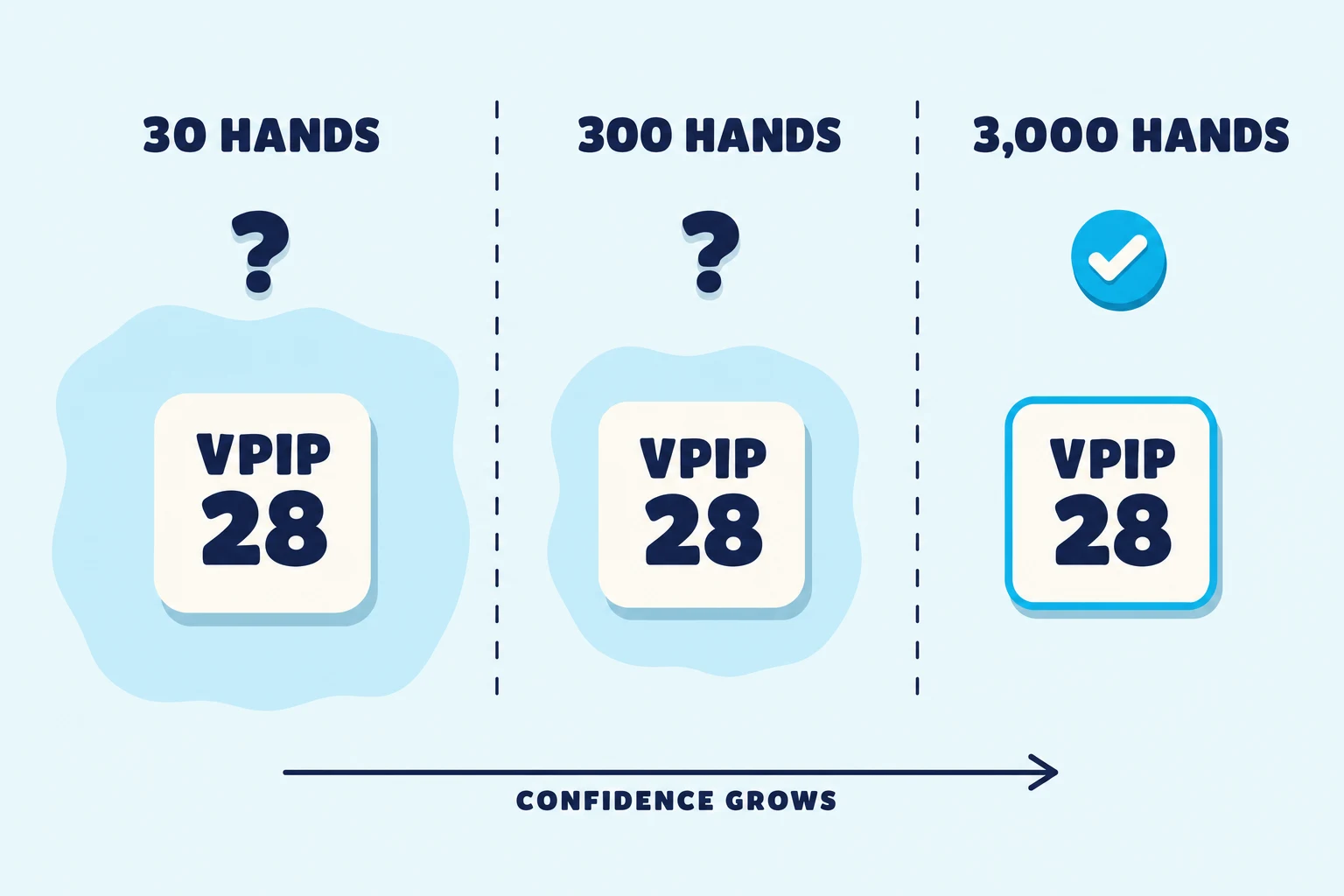
The discipline is matching your confidence to the count. At 30 hands, lean on the loudest signal only: someone playing two-thirds of hands is loose, full stop. At 300, trust the archetype and the gap. Only past a few thousand do the fine-grained reads earn a seat at the table.
Pointing the tool at yourself
The most profitable player these stats can profile is you. If you track your own play, pull your numbers over your last few thousand hands and read them with the same table: a gap of ten points or more says your calls have quietly outgrown your raises, and the fix is the one prescribed for every station, promote or fold the middle. If you play live and untracked, run the three-orbit tally on yourself for one session; the real number usually comes back looser than the one you would have guessed. The stats do not care whose leaks they expose, which is exactly what makes them trustworthy.
When the numbers lie to you
Three distortions to guard against. Table dynamics bend stats: a player seated behind a maniac will show a tighter VPIP than their real style, because they are adapting, and their numbers snap back when the maniac leaves. Position mixes hide inside the average: a player who opens half the button but plays tight up front can show the same overall PFR as someone spraying raises from everywhere, and only positional stats separate them. And a player who knows they are being watched, common at higher stakes, will play their first orbit against you differently than their thousandth. Stats are a portrait of the past; the player in front of you is allowed to have changed.
A live-play pattern
No HUD at a live table, but the stats still exist; you just have to count them yourself. Watch three full orbits, roughly 25 hands, and keep two tallies: how many hands each player entered, and how many they entered with a raise. Someone who played twelve of those hands and raised twice just showed you a 48/8 in the flesh. The archetype table above works exactly the same whether the numbers came from software or from paying attention while you were out of the hand, and paying attention is free.
Where this fits
VPIP and PFR are the entry point to reading players by their frequencies instead of their faces. The natural next layer is what those frequencies mean street by street, and the biggest single consumer of the read is your calling decisions: the same bet deserves a different response from a 22/18 than from a 45/8.
Frequently asked questions
What is a good VPIP for 6-max? Most winning 6-max players land between 22 and 28, with PFR three to six points behind. Tighter than that leaves money unclaimed in the blinds; much looser demands postflop skill that most players overestimate in themselves.
What gap between VPIP and PFR is a red flag? Ten points or more signals a passive game built on calling. Fifteen or more is a leak you can plan a whole session around: value bet them relentlessly and put your bluffs away.
Do VPIP and PFR apply to live poker? The concepts apply completely; only the automatic counting is missing. Three orbits of deliberate observation produces a rough VPIP and PFR for every player at the table, and rough is enough to pick the right archetype.
Is a high VPIP always bad? No. High VPIP with high PFR is a style; some of the toughest players run 30/26. High VPIP with low PFR is a leak, because it means entering pots wide without initiative. The gap, not the volume, decides which one you are looking at.