
Suited Hands in No-Limit Texas Hold’em
What “suited” means and why it matters
A suited hand is two hole cards of the same suit. That suit link increases your chance to make a flush and improves post-flop equity. Suited cards also combine with connected board cards to create straight and flush possibilities, so many suited holdings play better than their unsuited counterparts.
Example: 7♠-9♠ can make both straights and flushes. A♣-5♣ gives you high-card strength plus a nut-flush draw if two clubs hit the flop.
The suit itself carries no rank in hold’em, whatever the kitchen-table version of the game taught you. For where that myth comes from and the two spots where suit order is real, read why no suit beats another.
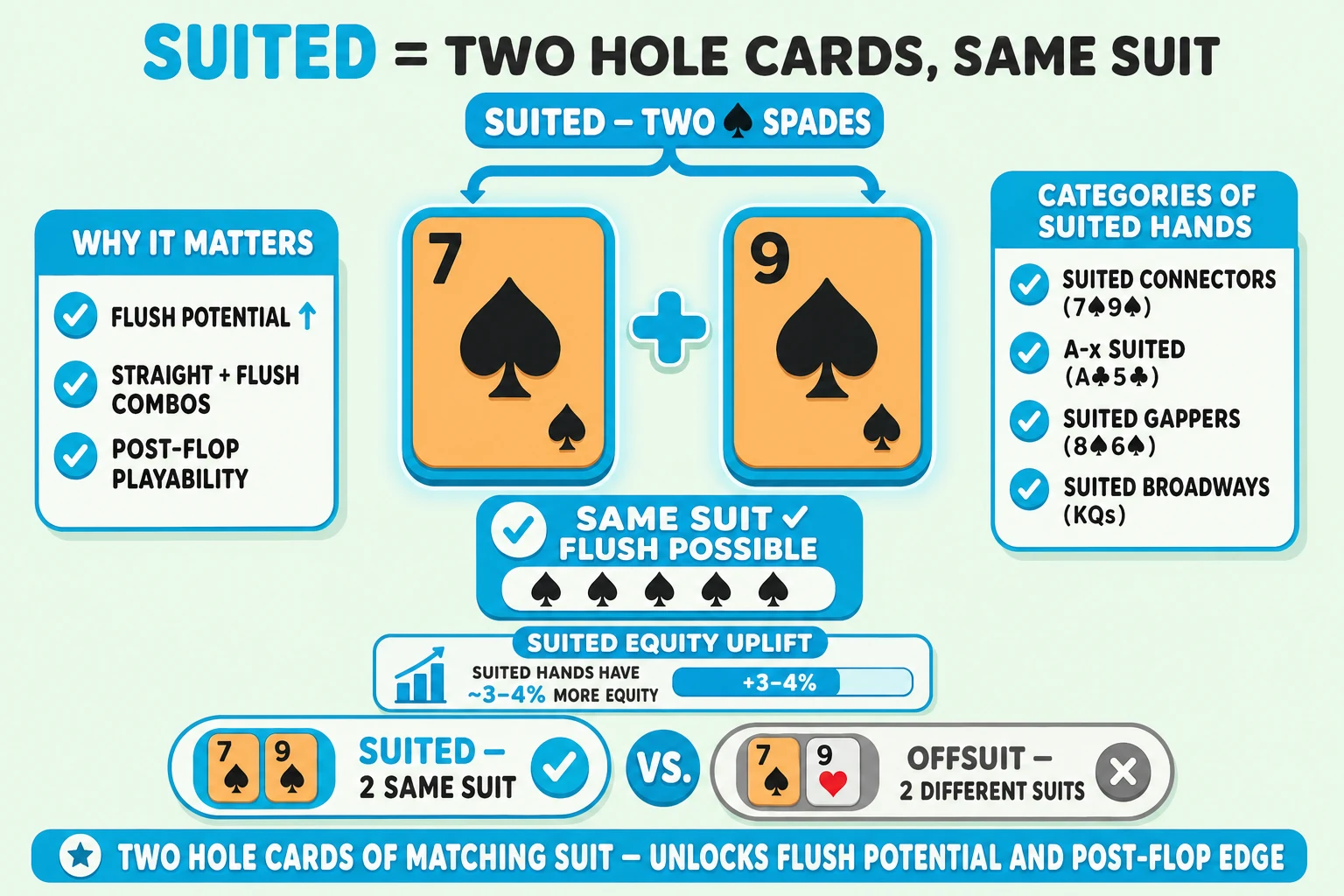
Common categories of suited hands
- Suited connectors: e.g., 7♠-9♠ or 6♦-8♦. They form straights and flushes and often produce disguised, high-payoff hands. Example: holding 7♠-9♠, a flop of 8♠-6♠-T♦ gives both a straight and a flush draw.
- A-x suited: Ace with another suited card, for example A♣-5♣. These combine top-end strength with flush potential and strong implied odds when you make top pair or a nut flush.
- Suited gappers and low suited combos: hands like 8♠-6♠ or 4♥-6♥. They’re speculative but can pay off in multiway pots or deep-stack situations.
Pre-flop considerations and when to play them
- Position: Play more suited hands from late position. Acting last gives you more information and lets you extract implied odds - the future chips you expect to win when your draw completes.
- Opponents: Suited hands gain value versus loose, aggressive players who build larger pots and pay off draws. Versus tight, passive players, speculative suited hands lose value.
- Stack size and risk: Avoid committing large portions of your stack pre-flop with speculative suited holdings unless stacks are deep enough to realize implied odds. Beginners should prefer folding or calling in position rather than large bluffs or commits.
Jargon: a cold call is calling a raise when you haven’t invested money earlier in the hand; a three-bet is a re-raise.
Post-flop play: drawing, semi-bluffs, and caution
Use suited hands to pursue flush and straight draws and to make timed semi-bluffs - betting with a draw that can still improve - when you have fold equity. Example: on K♣-Q♣-3♦ with A♣-5♣, a semi-bluff can win the pot immediately or produce the nut flush on later streets.
Be wary of being “coolered” - making a strong hand only to run into a better one. Example: you make a 9-high flush with 7♠-9♠ on a spade-heavy board, but an opponent holds A♠-J♠ for a higher flush. Read opponents and size pots down or fold when heavy aggression suggests stronger made hands.
Stack depth, multiway pots, and board texture
- Deep stacks: increase suited hands’ value because the payoff when your disguised hand hits is larger. Suited connectors shine with 100+ big blinds.
- Multiway pots: more players boost implied odds but raise the chance someone already has you beat. Suited speculatives work better multiway than heads-up against big stacks.
- Board texture: coordinated boards (two suited cards or connected ranks) make speculative suited holdings more dangerous. Tighten up or control the pot size on such boards.
Practical tips for different skill levels
- Beginners: play suited hands in position, avoid big pre-flop commitments, and fold to heavy post-flop pressure on coordinated boards.
- Intermediate: add suited connectors and A-x suited into selective cold calls and three-bets to leverage implied odds and disguise.
- Advanced: balance suited hands in your range, exploit opponent tendencies, and use semi-bluffs and pot control to extract maximum value.
Quick checklist
- Prefer suited hands in position and against loose, aggressive opponents.
- Increase reliance on suited connectors with deeper stacks and in multiway pots.
- Fold or control the pot on coordinated boards or when facing heavy aggression to avoid being coolered.