
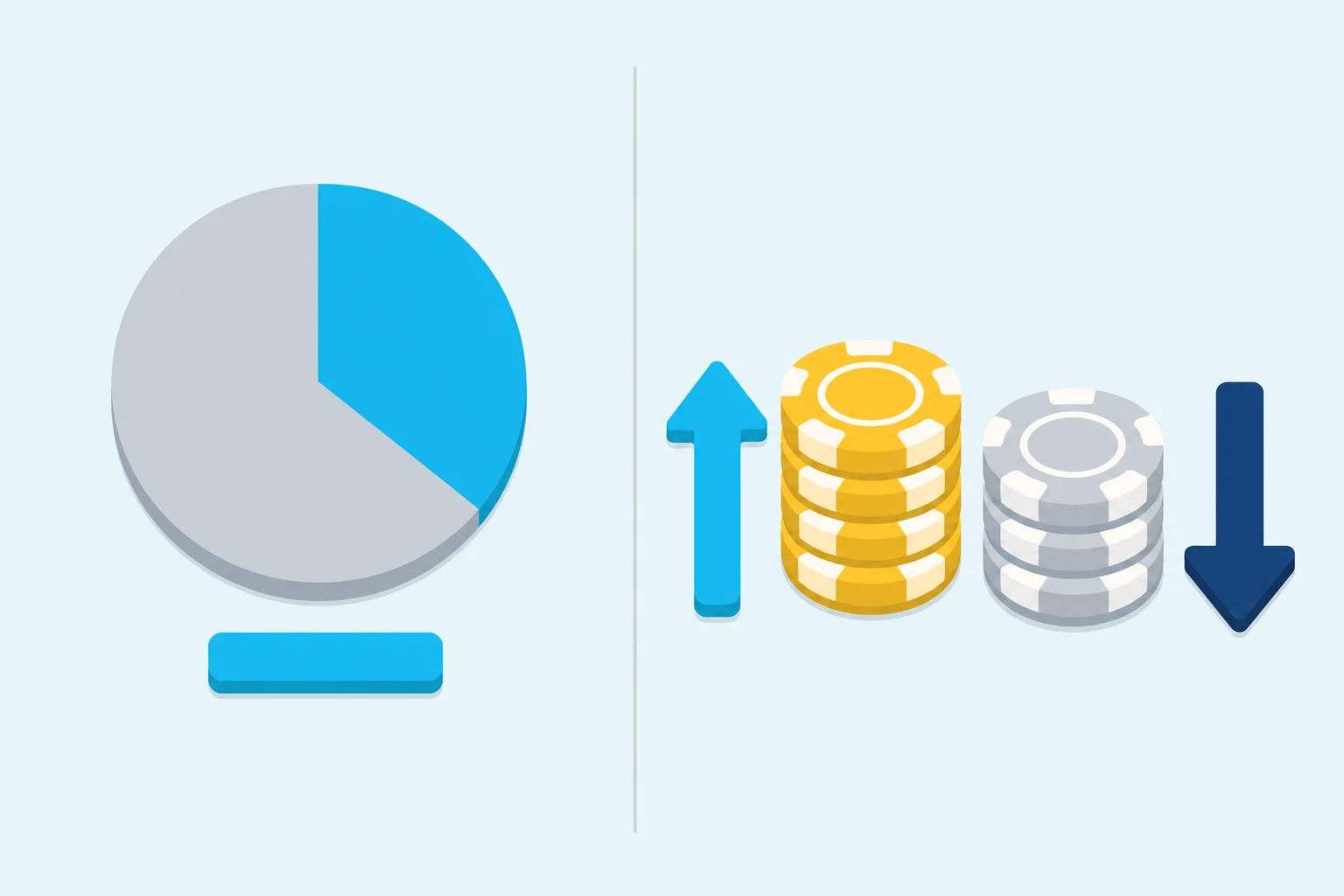
Equity is your share of the pot right now, written as a percentage: how often this hand wins or splits if the rest of the cards just ran out. EV is what a decision earns on average once the price is included. They are different numbers about different things, which is why you can have the bigger one and still be making the losing play.
That gap is where almost every equity question that drives people crazy actually lives. The player with more equity is not always the player making money, and the player who folds is often the one who did the right thing. “I had the flush draw and he only had a pair, so why was folding right?” is not really an equity question. The equity was fine. The price was wrong. Once you can tell which of the two numbers a spot is asking about, most of the confusion clears.
Equity vs EV at a glance
| Equity | EV | |
|---|---|---|
| The question it answers | If the cards ran out now, what share of this pot is mine? | Is this action profitable on average? |
| What it is about | Cards | A decision |
| Measured in | A percentage of the pot | Chips gained or lost per attempt |
| What it ignores | The price, the bet still to come, the folds | Nothing, that is the point |
| When you use it | Working out where you stand | Choosing between call, fold and raise |
Equity: your share of the pot right now
Equity is the share of the pot your hand is worth if no more betting happened and every remaining card was dealt. It is not money you have, it is the portion of the pot you would take on average from this exact spot.
An example with real cards
Counting nothing but those nine cards, this hand completes about 35% of the time by the river.
That number is not what you win. It is how often the hand you are drawing to arrives. Your ace and king can also pair up and take pots the flush never makes, so against a hand like 9♠ 9♣ your real share of this pot is higher than the flush figure on its own. Notice what the number has not told you yet: nothing about whether to call, because nobody has bet.
Where the percentages come from
Count the cards that improve you, then use the shortcut. Multiply your outs by four when two cards are still to come, or by two when only the river is left. Nine outs, counted out card by card, is what the whole number rests on.
Nine outs gives 36% by the river and 18% on a single card, which is close enough to the real 35% and 19% to make decisions with. The rule of 2 and 4 has the whole method and the places it drifts, and poker odds explained has the reference tables for when you want the exact figures rather than the mental version. The same count is drawn on the poker odds chart, on its own flush-draw board, above four tables that run every draw out to twenty outs. Those are the two numbers Poker Skill’s lesson on quick rates asks for with A♠ Q♠ on 10♠ 6♣ 2♠: about 35% by the river and about 19% on the next card alone.
EV: what the decision earns
Expected value is the average result of an action if you took it in this exact spot a thousand times. Positive means the action makes chips over the long run, negative means it burns them. Being ahead is a fact about your hand. EV is a verdict on your decision.
The EV of a call
Now put a price on the hand above. The turn is the K♦, the flush has not come, and your opponent bets. Players betting big into you on this board are betting made hands, so a pair of kings is not winning this pot: you are drawing to the flush and nothing else. That makes the flush number your whole share of the pot, and with one card to come it is about 19%.
The pot is $100 and your opponent bets $100. Calling costs $100 to win the $200 already out there, so you need to be right about 33% of the time to break even.
| The call, run out 100 times | ||
|---|---|---|
| You hit, 19 times | win $200 | +$38 |
| You miss, 81 times | lose $100 | -$81 |
| Average per call | -$43 |
Nineteen percent against a price that needs 33% is a fold, and it is not close. There is nothing wrong with the hand. There is something wrong with the price you are being offered for it. Pot odds is the tool that turns a bet size into the percentage you need, and it is the other half of every call you will ever make.
The EV of a bet
A bet earns from two places. Sometimes you get called and your hand has to win, and sometimes your opponent folds and you take the pot immediately. That second source is why a bet can be profitable with a hand a call could not justify: calling only pays when your cards arrive, while betting also pays every time the other player gives up.
Same hand, different answers
Take that flush draw back to the flop and change nothing about the cards.
| The same draw, two prices | The bet | What the price asks | What the hand is worth | Verdict |
|---|---|---|---|---|
| On the flop, all in | $50 into $100 | 25% | about 35%, both cards coming | Call |
| On the turn | $100 into $100 | 33% | about 19%, one card coming | Fold |
On the flop, you are risking $50 to win the $150 in the middle. Because they are all in, both remaining cards are coming with no more betting, so the draw really is worth about 35%, and any ace or king that ends up winning only adds to that.
On the turn, the price has gone up and the hand has gone down: the same nine outs are worth about 19% with a single card left.
Identical cards, identical opponent, opposite answers. Nothing changed except how many cards were still coming and what you were being charged.
The all-in on the flop is doing quiet work in that first line, and it is worth naming. When your opponent is not all in, calling on the flop buys you the turn card only, because they can bet again and charge you a second time for the river. That is why a flop call with a draw is a plan for two streets rather than a single price, and why comparing the two-card number to a one-street bet is the most common way a call that looked correct turns out not to be.
Check yourself: call or fold?
Same nine-out flush draw on the turn, so about 19% with one card to come. The pot is $100 and your opponent bets $25 instead of $100. Call or fold?
Show the answer
Call, comfortably. Your $25 goes into a pot of $150 once you put it there, so the price asks for $25 divided by $150, which is 16.7%. Your share is about 19%. You are ahead of the price before anything else gets counted, and two things stretch the edge further: your ace and king can pair up and win pots the flush never makes, and a small bet leaves money behind that you collect when the flush does arrive. Nothing about the hand changed between this question and the fold above. Only the price did.
Fold equity in one paragraph
Fold equity is the part of a bet’s value that comes from your opponent folding. Your hand’s share of the pot is one source of value, the chance they give up is another, and only betting collects the second one. It is why a hand with 35% can be a clear bet and a marginal call in the same spot: as a caller you have to win at showdown, and as a bettor you can also win right now. This is also where the shape of your whole range starts to matter, since your strong hands and your weak ones are not spread evenly across every board, which is what equity distribution describes.
Frequently asked questions
Can you have good equity and negative EV?
Yes, and it is the single most common source of confusion at the table. Equity says how often your hand wins from here. EV says whether the action is profitable at the price you are being offered. A draw with 19% is a fine hand and a losing call against a pot-sized bet, because that price needs 33%. The hand and the decision are graded separately.
What is a positive EV play?
Any action that makes more chips on average than the alternatives, if you took it in the same spot over and over. It has nothing to do with whether it worked this time. Folding a draw at a bad price is the better decision even in the hand where the card would have come, and calling while behind can be the better decision too, whenever the price is good enough to cover how often you get there.
How do you calculate equity quickly?
Count your outs, then multiply by four with two cards to come or by two with one card to come. That gets you within a point or two of the real number, which is all a table decision needs. The rule of 2 and 4 covers the method properly, including the spots where the shortcut runs wide.