


Hearts
One of the four suits in a standard deck, and one of the two red suits. Thirteen hearts per deck, and suits never break a tie in Hold'em.
Practice this in Poker Skill. The Straights & Flushes lesson puts four hearts on the board, A♥ 9♥ 5♥ 2♥ K♠, where any heart in your hand finishes a flush.
Get the free appHearts
What the hearts suit is
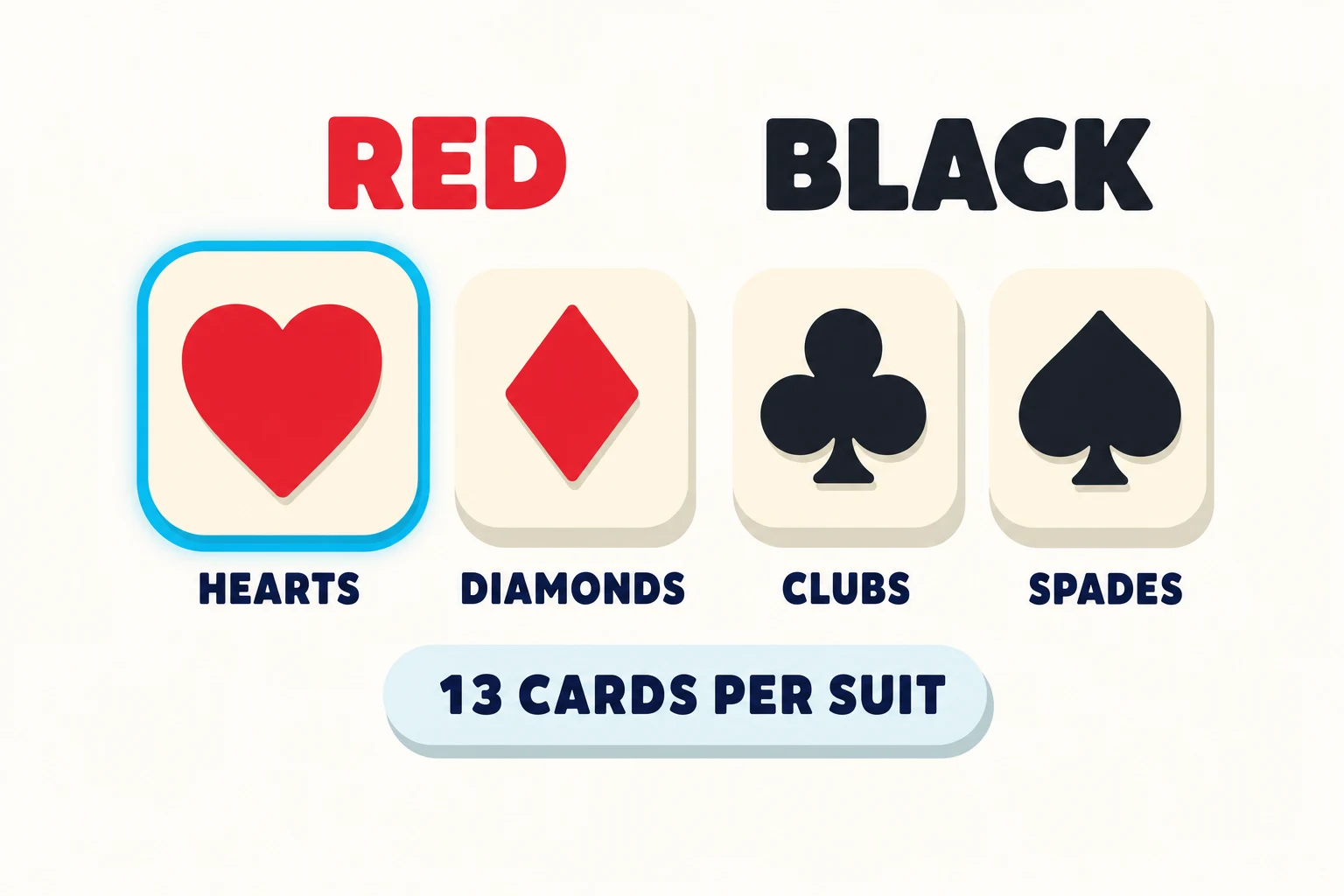
Hearts is one of the four suits in a standard deck, alongside diamonds, clubs, and spades. Every suit holds the same thirteen ranks, ace down to two, so a deck holds exactly thirteen hearts.
Which suits are red
Hearts and diamonds are the red suits. Clubs and spades are the black suits. Two red, two black, no exceptions, and that is the whole of the colour rule.
The colour has no effect on hand strength. It is a printing convention that makes suits easy to tell apart at a glance across the table.
Suits do not break ties
In Texas Hold’em, suits are not used to break ties. No suit outranks another, so a king-high straight made with the K♥ does not beat one made with the K♠. If two players finish with the same five-card hand in different suits, they split the pot.
This trips up players who arrive from games where suits do rank, such as some forms of bridge. In poker the ace of hearts and the ace of spades are worth exactly the same.
Where hearts do matter
Suits decide flushes. A flush is five cards of the same suit, so the only time hearts matter more than clubs is when you are holding hearts.
That is also where the counting comes in. Say you hold two hearts and two more hearts land on the flop. Thirteen hearts exist, you can see four of them, so nine hearts are unseen. Nine is your out count for the flush, and that number is the reason suits get counted at all.
Common mistakes
- Thinking a heart flush beats a club flush. It does not.
- Counting outs from the whole deck instead of from the thirteen cards in the suit.
- Calling a hand “suited” when the two cards are red but not the same suit. A heart and a diamond are not suited.
Quick checklist
- Hearts is one of four suits: hearts, diamonds, clubs, spades.
- Hearts and diamonds are red. Clubs and spades are black.
- Thirteen hearts per deck, one of every rank.
- Suits never break ties, so equal hands split the pot.
- Suits do decide flushes, which is where out counting happens.