


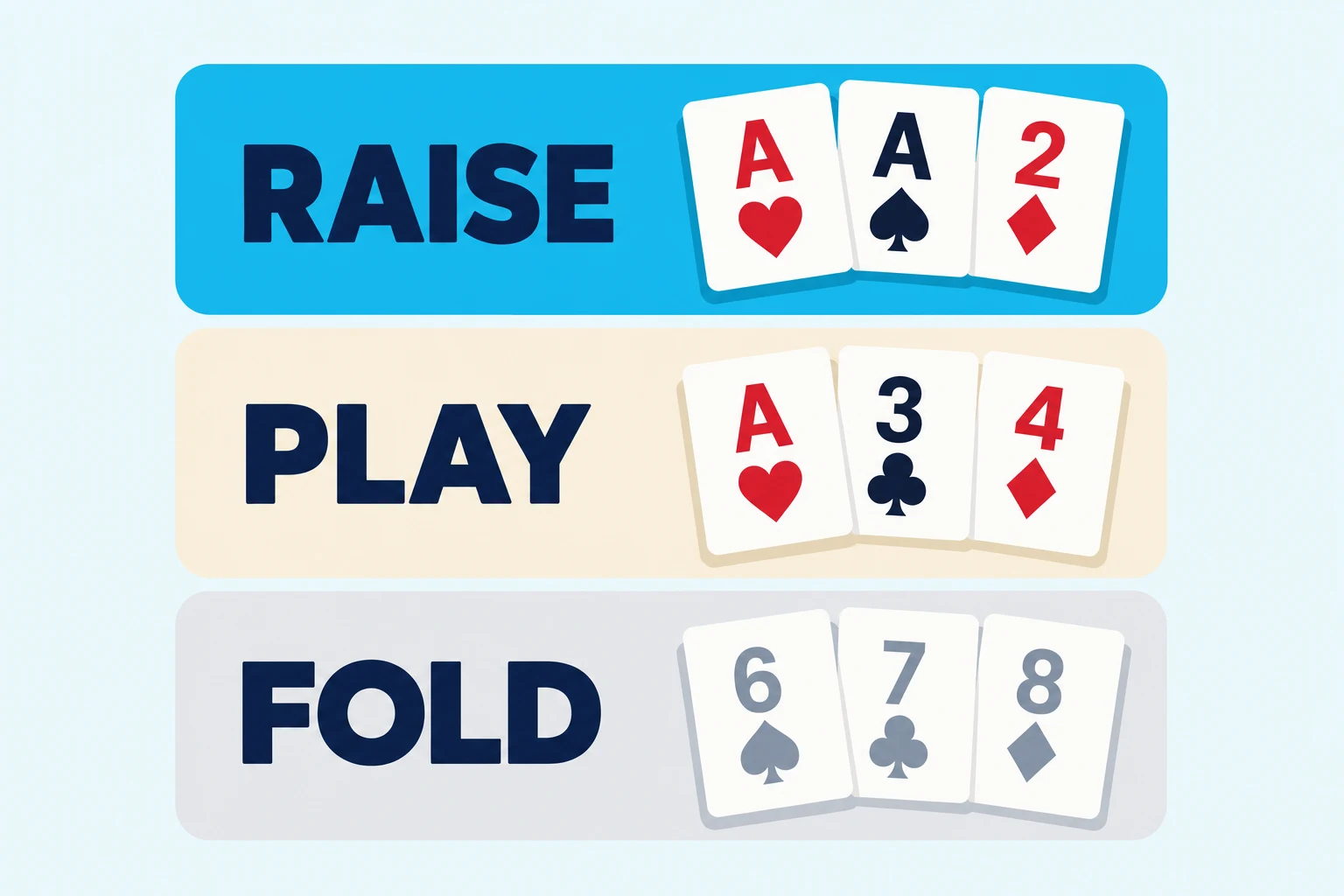
The best Big O starting hands are ace-based, lean on a deuce, and can develop into the nuts on both halves of the pot. A-A-2-x, A-2-3-x and A-2-4-x are the shapes worth raising in a multiway pot, and they are worth more when the ace is suited.
Getting five hole cards instead of four feels like it should widen your range. It does the opposite. Everyone else got the extra card too, so every nut draw you can hold is a nut draw somebody else is more likely to already have.
Where the hand guidance actually comes from
There is no published starting-hand chart written specifically for five-card hi-lo. What exists is the Omaha eight-or-better guidance, and it transfers cleanly, because what it teaches is a filter rather than a list: play hands with obvious potential to develop into the nuts, and aim to scoop rather than settle for half.
The arithmetic is the part that does not transfer. Every frequency in the game shifts when you add a card, and the shift runs against the intuition most players bring from four-card Omaha.
What to raise, play, and fold
| Tier | Shape | What to do |
|---|---|---|
| Raise | A-A-2-x, A-2-3-x, A-2-4-x, ace suited | Raise in a multiway pot |
| Raise | Two aces with real support | Raise, aces play best against fewer opponents |
| Raise | Any A-2 suited, several players already in | Raise |
| Play | A-2-3-4 and similar one-card draw shapes | Strong, viable for raising bets |
| Play | A-3 suited, very loose table | Acceptable raising hand in that game only |
| Play cheap | Four big cards, nine or higher | Limp an unraised multiway pot, do not raise |
| Fold | Small cards without a suited ace | Not playable |
| Fold | Middle cards | Almost never scoop |
| Fold | Anything you are unsure about | Fold |
The standing advice in hi-lo is that when you cannot decide whether a hand plays, folding is the better guess. Big O hands you five cards to talk yourself into instead of four, so the rule comes up more often here.
Why the ace is the whole filter
The ace does two jobs at once, which is why so little is playable without one. It is required for the best low hands, and it is the highest card in the deck for the high half, so it also makes the highest pair, the highest two pair, the top of a broadway straight and the nut flush. A hand with no ace is a hand that hands the premium card to somebody else, and in a full game most of the aces are already out there.
The deuce is the second filter. The best possible low is 5-4-3-2-A, so an A-2 low beats an A-3 low, and a deuce is worth more to you than a trey for exactly that reason. Small cards without an ace behind them are not playable at all.
Now the arithmetic, which is where the fifth card earns its reputation. Deal four cards and you hold at least one ace 28.1% of the time. Deal five and it becomes 34.1%. An ace and a deuce together arrive 6.4% of the time in four-card Omaha and 10.0% of the time in Big O.
Read that the right way round. The extra card does not make your A-2 stronger. It makes everybody else’s A-2 close to twice as likely, which is why second-nut anything is the most expensive habit in the game.
The same effect runs through the rest of the hand. Two hole cards give you one two-card combination. Four give you six. Five give you ten. You must use exactly two of your hole cards and exactly three board cards, for the high hand and for the low hand separately, so ten combinations per player is the real reason somebody almost always has it when the pot gets big.
The raise that is actually a mistake
A hand like A-4-3-2 double suited is genuinely powerful, with a high expectation of profit. It is also entirely speculative. Reraising it before the flop is a mistake, because the hand wants as many opponents in the pot as possible, and a reraise chases away exactly the weaker players it was going to profit from.
So the two pieces of advice sit together without conflicting. Raising with A-A-2-x or A-2-3-x in a multiway pot is right, because you are building a pot with a hand that can take all of it. Reraising to narrow the field with a drawing hand is wrong, because narrowing the field is the one thing that hand cannot afford. Ask what the raise is for before you make it.
Two aces are the exception in the other direction. They fare best against fewer opponents and are strong heads up, so most two-ace hands are worth protecting with a raise. That is a hand playing for the high half now rather than a draw playing for both halves later.
When the shortcut lies to you
Middle cards are the trap that catches good Hold’em players. Hands built around them are the lowest form of life in hi-lo, and they stand virtually no chance of scooping unless no low is possible at all. A straight-heavy middle hand makes straights that lose to higher straights, and double-suited medium cards make flushes that lose to bigger flushes. Second best twice over, in a game that pays the nuts. Poker Skill’s button lesson, Hold’em like everything in the app, raises 9♥ 8♥ because suited connectors play well in position, and that is the instinct this section asks you to leave behind.
High-only hands get a narrower verdict. Four big cards nine or higher play best in an unraised multiway pot, where the price justifies how often they miss. Raising with them is usually not beneficial, because the raise costs the hand the very thing it needs, which is a cheap look with plenty of company.
And the pot goes entirely high whenever nobody makes a qualifying low of eight or better. On those runouts your carefully assembled low cards are blanks. That is why the raise tier keeps asking for a high-side route: it is the half of the hand that pays when the low never arrives.
A two-pass read for live play
Look at your five cards twice, and give each pass one question.
First pass, the low half: do I have an ace, and do I have a deuce or a trey behind it? An ace with a deuce is the shape the guidance is built around. An ace with a trey is playable and clearly weaker, because any opponent holding A-2 makes the better low and you find that out after you have paid for the river.
Second pass, the high half: can any two of my cards make the nut flush, the top of a straight, or a set? A suited ace is the cleanest yes, which is why the nut flush draw carries so much equity here, and why the guidance keeps repeating that the ace is worth more suited.
Two yeses means raise, and raise to build the pot rather than to clear the field. One yes means play it cheap and prefer late position. No yeses means fold, and folding is most of what a winning Big O player does before the flop.
Where this fits in your game
The hand selection above assumes the standard game, which is five-card pot-limit hi-lo with an eight-or-better qualifier. For the rules themselves, the must-use-exactly-two-cards trap, and how hands play across the streets, read Big O Poker: Rules, Hand Selection, and Beginner Mistakes. For the short definition and how the variant sits next to PLO, see the Big O glossary entry.
FAQ
What is the best starting hand in Big O?
Ask about shapes rather than one hand. The strongest shapes are ace-based with a deuce and a route to the high half: A-A-2-x, A-2-3-x and A-2-4-x, all better when the ace is suited. A-2-3-4 is a strong one-card draw shape and is viable for raising. The common thread is nut potential on both halves rather than a big-looking hand on one.
Should you play a hand with no ace in Big O?
Rarely. The ace is required for the best lows and is the highest card for the high half, so very few hands are playable without one. Small cards without a suited ace are not playable, and a beginner who folds every aceless hand gives up very little.
Should I raise or just call with a big drawing hand?
Depends what the raise is for. Raising in a multiway pot with A-A-2-x or A-2-3-x builds a pot for a hand that can win all of it. Reraising with a speculative hand like A-4-3-2 double suited is a mistake, because that hand wants opponents and a reraise drives them out.
Are big pairs good in Big O?
Two aces are, and they are usually worth a raise because they play better against fewer opponents. Kings and queens on their own are not. They are high-only, they miss often, and half the pot leaves any time somebody makes a qualifying low. Play four big cards cheaply in an unraised multiway pot or not at all.