
Static Board
What is a static board?
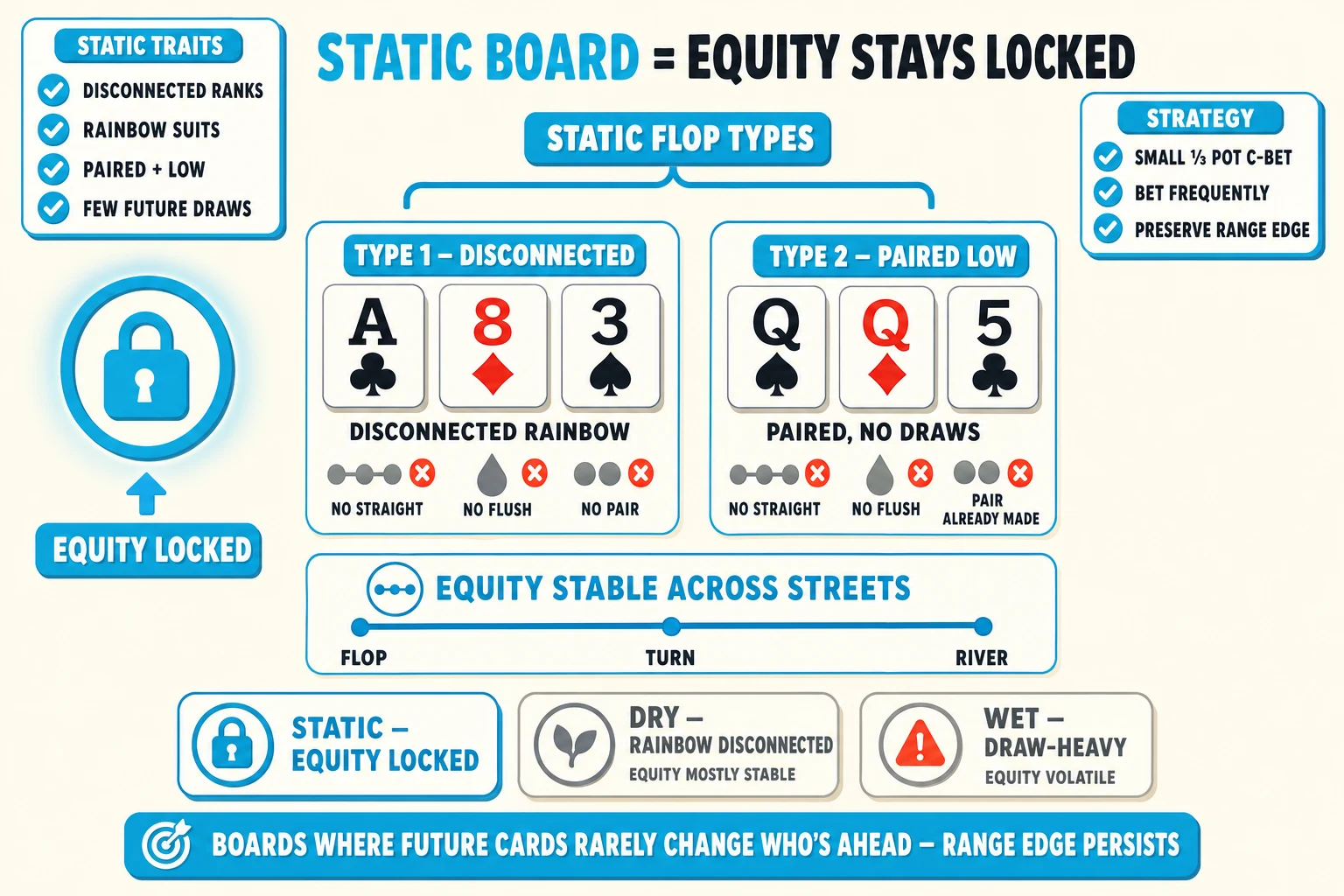
A static board is a flop texture unlikely to change hand strength on later streets. You see unconnected, unsuited flops with little straight or flush potential, for example A♣-8♦-3♠. You also see paired flops that don’t open draws, for example Q♠-Q♦-5♣. On these boards made hands tend to remain made and draws are rare.
Key characteristics to recognize at the table
Spot these traits quickly:
- Disconnected ranks: cards sit far apart (A-8-3), so straights are improbable.
- Rainbow (unsuited): no immediate flush possibilities.
- Paired flop: the board contains a pair (Q-Q-5), shifting hand distribution but rarely creating draws.
- Low equity shift: turn and river are unlikely to flip hand ordering; strong hands usually stay strong.
Recognizing a static board means future streets will mostly focus on extracting or protecting value.
How static boards shift equity and range advantage
Range refers to the set of hands a player could hold. The pre-flop aggressor typically has a range richer in high cards and strong pairs. On static flops containing high cards or a pair, that aggressor’s range connects more often than a caller’s.
Example: on A♣-8♦-3♠ the raiser often holds suited broadways, A-x combos, and medium pairs. Callers more often bring small pairs or speculative hands that don’t improve. Because later cards rarely produce big draws, the initial range advantage usually persists.
Continuation-bet strategy on static boards
A continuation-bet (c-bet) is a postflop bet by the pre-flop aggressor. On static flops:
- Use small sizes. Bet about 1/4 to 1/3 of the pot to leverage range advantage while risking less.
- Bet frequently. Disconnected boards seldom help the caller’s range, so high c-bet frequency profits.
- Vary lines with strong holdings. Occasionally check top hands in position to stay balanced and avoid exploitation.
Example sizing: pot = $100; standard c-bet ≈ $25-$33. This charges worse hands while preserving your stack against rare traps.
Responding as the caller: pot control and protection
Callers should stay disciplined on static boards.
- Don’t chase weak equities: few draws exist, so speculative hands realize little equity.
- Prioritize showdown value: continue with top pair, overpairs, sets, or hands that beat much of the aggressor’s range.
- Pot control: prefer calling to bloating the pot with marginal holdings, especially out of position.
- Protection: large protection bets are less necessary when draws are minimal-smaller bets or checks often perform better.
Example: Out of position facing a 1/4-pot c-bet on Q♠-Q♦-5♣ with 9♠-9♥, calling to see the turn is reasonable. You have real showdown value and low blocker risk to sets.
GTO principles and exploiting common population tendencies
GTO (game-theory optimal) play mixes checks and bets to remain unexploitable. On static boards, GTO solutions often check back a portion of strong hands in position to avoid predictable lines.
Many players over-c-bet air on static flops. That creates exploitable opportunities:
- OOP (out of position): raise your check-raise frequency to punish habitual small c-bets.
- IP (in position): call more thinly against frequent small c-bets when your hand has showdown value.
Quick checklist
- Identify disconnected, unsuited, or paired textures immediately on the flop.
- Favor small, frequent c-bets as the pre-flop aggressor (≈1/4-1/3 pot).
- As the caller, prioritize pot control and continue only with real showdown value.
- Watch for opponents over-c-betting air and counter with disciplined check-raises or value lines.