
Size Sequence
Why a size sequence matters
A planned sequence of bet sizes controls expected value by shaping fold equity and bluff ratio. If your sizes jump around, opponents map size to strength and exploit you. A repeatable sequence preserves range ambiguity and keeps opponents guessing.
Example: if you always lead big with top pairs and tiny with bluffs, opponents fold your small bets and call your large ones only with better hands. A consistent sequence lets you mix bluffs and value more effectively and pressures opponents unfamiliar with those sizings.
Key terms: “range” = the set of hands you could have; “fold equity” = the probability an opponent folds to a wager.
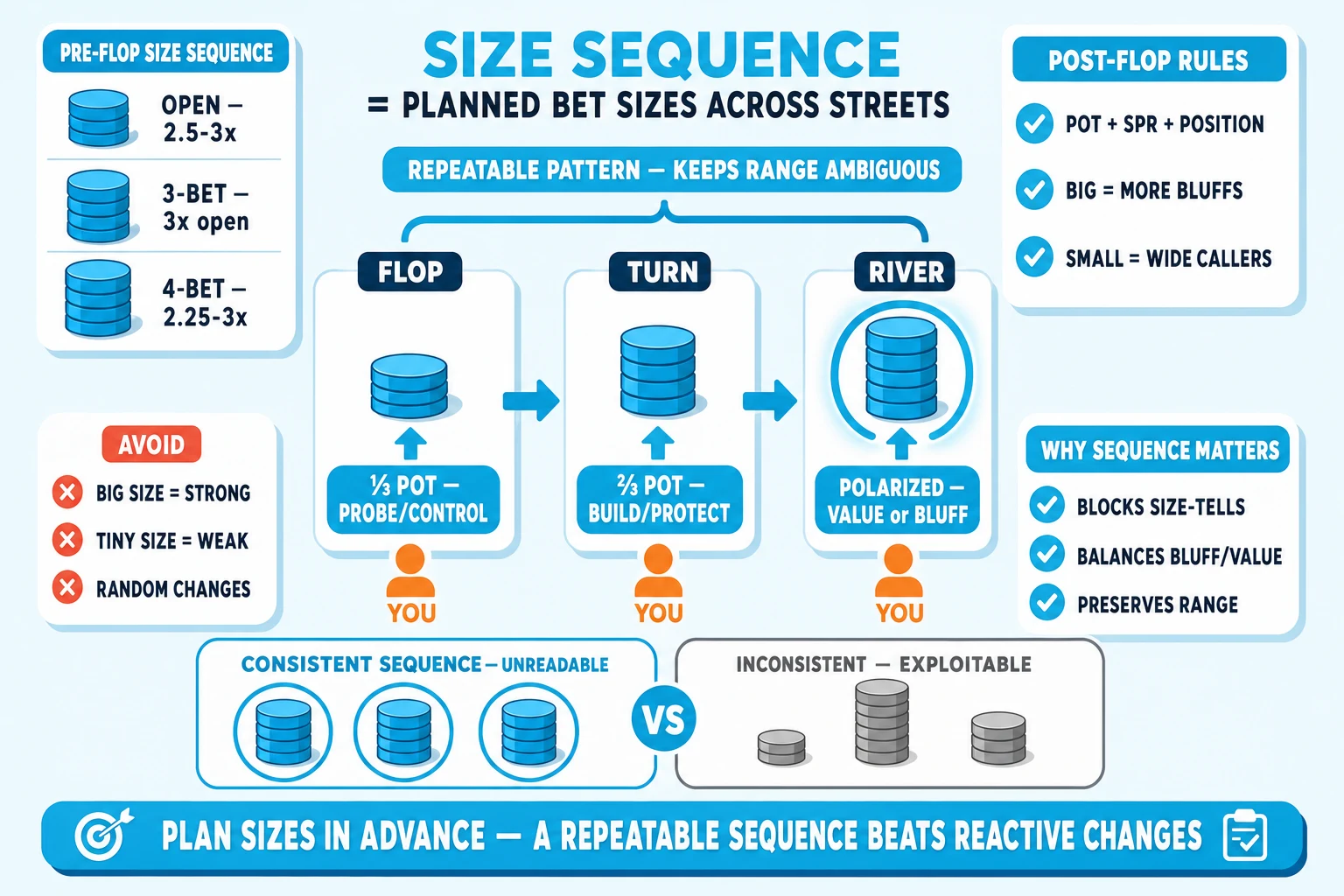
Pre-flop size sequences: opens, 3-bets and 4-bets
Pre-flop sizing rules should stay simple and remain stack-aware.
- Opens: use smaller opens in early position and slightly larger ones near the button. Keep only a few standard open sizes to reduce errors. Against shallow stacks (≤25 big blinds, bb), prefer a min-raise open to force difficult all-in decisions.
- 3-bets/4-bets: from the small blind use smaller 3-bets than from the big blind because you will be out of position after the 3-bet. If a 3-bet would commit more than one-third of your stack, shove all-in instead. A non-all-in 3-bet that commits that much often leaves you pot-committed. Convert 4-bets to all-in when stacks are under about 40bb. With 50-100bb stacks, non-all-in 4-bets of roughly 2.25-3x are standard, depending on position. Any 5-bet should be all-in.
Concrete scenario: if a 3-bet to X commits one-third of your stack, shove rather than leave awkward SPR (stack-to-pot ratio) on later streets.
Post-flop size sequencing: choosing amounts through the street
Post-flop, base sizes on pot size, remaining stack, position and the EV outcome you want-not merely raw hand strength.
- Larger bets raise fold equity, allowing more bluffs. Use them to apply maximum pressure or on boards that favor polarization (strong hands versus bluffs).
- Smaller bets target wider calling ranges. On wet boards with many draws, smaller sizes keep medium-strength hands and draws in.
- Keep consistency across streets. Let turn and river sizings respond to board texture and SPR, not merely whether your hand improved.
Example: on a medium-wet flop with deep stacks, a small continuation bet keeps worse hands and draws in. On a dry board where you want folds, use a larger bet to support a higher bluff:value mix.
Heuristics and solver lessons for practical sizing
Solvers show tiny differences (for example, 2.2x versus 2.3x) usually create minimal EV gaps when ranges play optimally. The practical lesson: simplify.
- Favor a small, repeatable set of opens and 3-bet sizes by position to reduce execution mistakes.
- Don’t chase marginal EV by micro-tweaking sizes. Pick sizings that create unfamiliar decisions for opponents.
- Use solver intuition-bigger sizes allow more bluff room; smaller sizes attract wider calling ranges-rather than squeezing a few EV points from near-identical sizings.
Adjusting sequences for opponents and stack dynamics
Adapt your sequence to opponent tendencies and stack depth.
- Versus opponents who fold too much, use larger bets to extract value and force mistakes. Against sticky callers, favor smaller, value-heavy bets to get more calls.
- Let stack depth dictate escalation. Shallow stacks push toward earlier all-ins; deeper stacks justify larger non-all-in bets to deny free equity to drawing hands.
- Vary size strategically to disrupt opponents, not to mechanically signal strength.
Quick checklist
- Use a small, repeatable set of opens and 3-bet sizes by position.
- Convert to all-in when a bet would commit >1/3 of your stack or when under ~40bb for 4-bets.
- Size post-flop based on pot, SPR, position and desired bluff:value ratio.
- Prefer sizings that create uncomfortable decisions for opponents.
- Avoid varying size solely by hand strength; let board texture and opponent factors drive changes.