


Fish
A weak, losing player. Spotting one and adjusting to how they actually play is worth more than any refinement to your default strategy.
Practice this in Poker Skill. The Check-Fold lesson trains the fold a fish skips: 6♦ 2♠ on K♣ 10♥ K♦ lets a bet go, since the board’s kings give it no pair or draw of its own.
Get the free appFish
What fish means in poker
A fish is a weak, losing player. It is table slang, used the way it sounds, and the working definition is simple: fish are the players who lose money over time.
How to spot one
You are not looking for bad luck. You are looking for repeated choices that cost money:
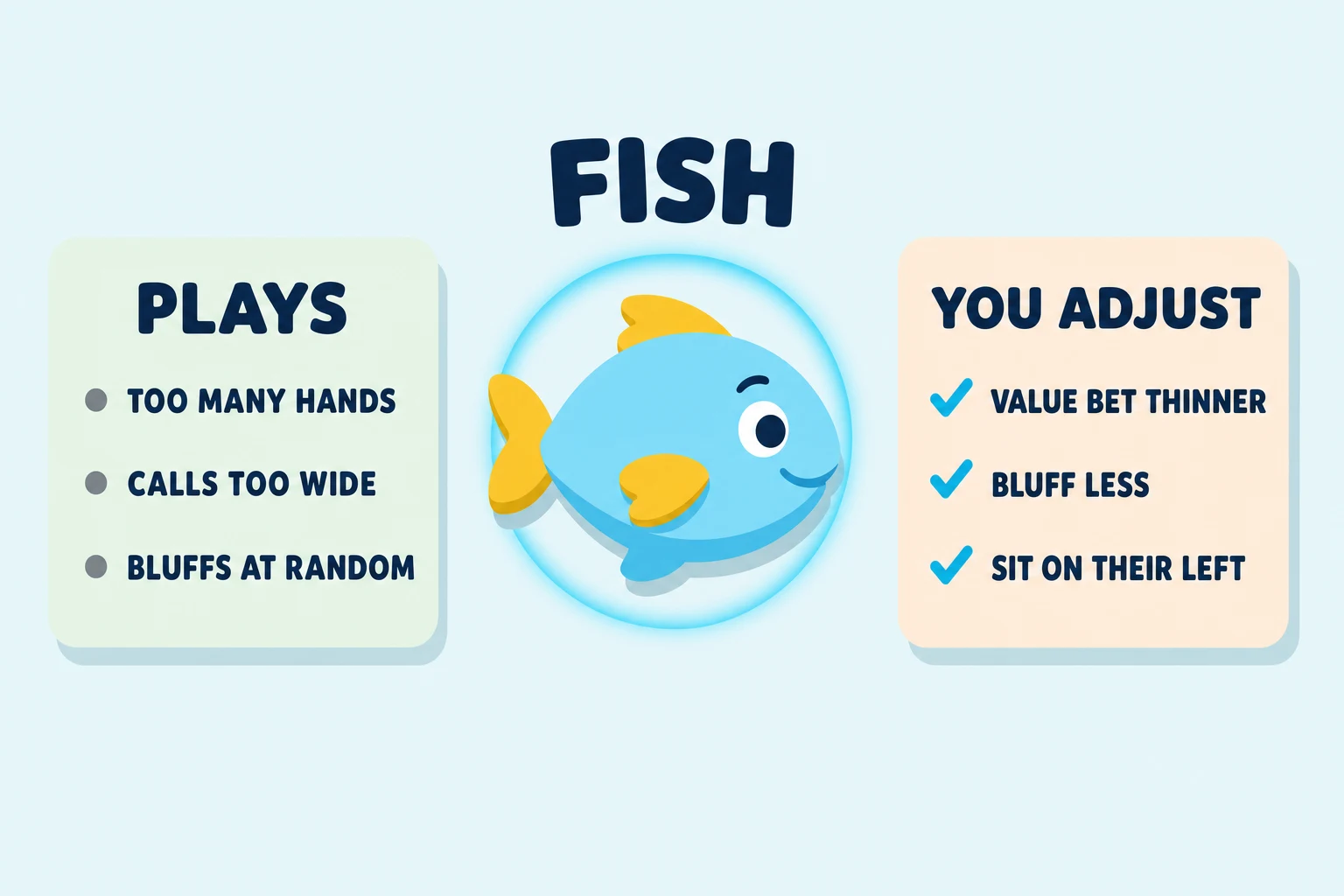
- Playing far too many starting hands, including from early seats.
- Calling bets down with hands that beat almost nothing.
- Bluffing at random rather than on the boards where a bluff makes sense.
- Never folding a pair, or never raising without the top of their range.
One hand tells you nothing. Three orbits tells you a lot.
How to adjust once you find one
The winning move against a weak player is not a clever one. It is to work out how that specific opponent handles the hands they are dealt, then take the obvious line against it.
Put them in a category first: loose, tight, passive, aggressive, calling station. Then answer the questions that actually change your decisions. How do they play a draw? What do they do with a pair? Do they ever bluff?
From there the adjustments follow directly. If they call too much, value bet thinner and stop bluffing them, because a player who does not fold cannot be bluffed. If they bluff a lot, widen the hands you are willing to call with. If they are on a draw and you can tell, raise and charge it. If they only ever put money in with the top of their range, fold when they finally do.
Against a weak player, straightforward poker beats fancy poker. Fancy lines only work on opponents paying enough attention to be fooled.
Why finding one matters more than the adjustment
Every adjustment above needs a weak player at the table to act on. Which table you sit at is the decision that decides whether the rest of your work has anything to work on, so watch a table before you sit and keep watching after you do.
Common mistakes
- Labelling someone a fish after one bad-looking hand.
- Bluffing a player who has already shown you they will not fold.
- Getting frustrated and playing the same loose game back at them.
- Staying at a table long after the weak player has left.
Quick checklist
- Fish means a weak, losing player.
- Judge from repeated choices, not from one hand.
- Categorise them, then answer how they play draws, pairs, and bluffs.
- Calls too much means bet thinner. Bluffs too much means call wider.
- The table you pick matters more than the line you take.