


Chip
The token you bet with. Chips stand in for money at the table, with each denomination told apart by its colour.
Practice this in Poker Skill. Counting what a call costs is part of the Raise Mechanics & Reopening lesson: with 500 already in and a bet of 1,500 to match, you add the 1,000 that’s missing.
Get the free appChip
What a poker chip is
A chip is the token you bet with. Chips are the currency of the table: you call, raise, and go all in by pushing chips forward, and the pot is a pile of them in the middle. They exist so nobody is counting cash mid-hand.
How denominations work
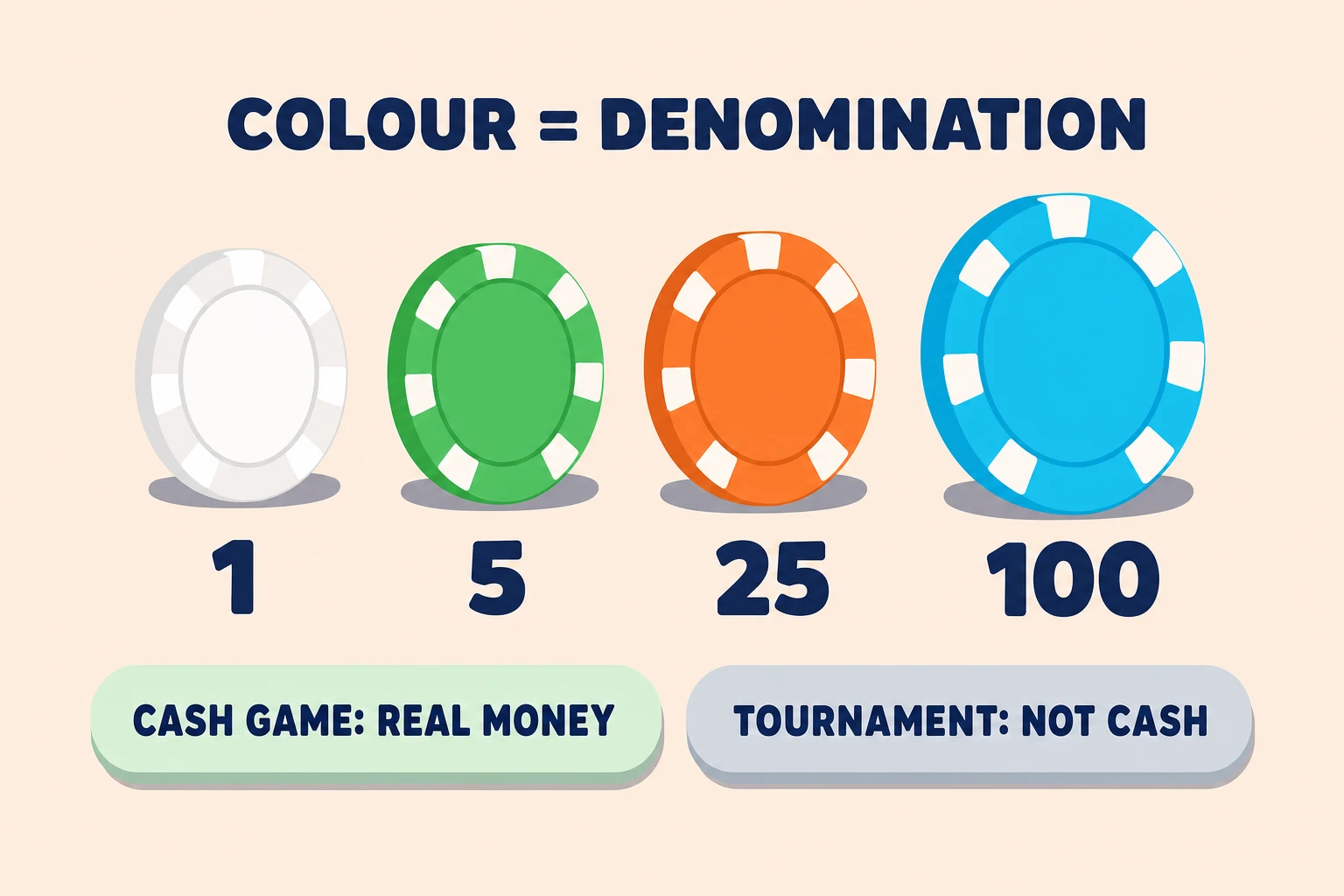
Chips come in different denominations, and each denomination has its own colour. A dealer or a player can read a stack across the table at a glance because colour carries the value, not the number printed on the face. In some card rooms the printing wears off entirely and colour is the only thing left telling you what a chip is worth.
Learn the room’s colours before your first hand. Misreading a stack is how players call a bet they thought was a quarter of the size.
Cash game chips against tournament chips
In a ring game, the chips in front of you represent real money. Your stack is your money, you can stand up between hands, and you cash out for exactly what is in front of you.
In a tournament, chips are not dollars. Everyone buys in for the same amount and receives a set starting stack, and those chips are scrip that moves between players until one person has all of them. You cannot leave in the middle and cash them in. What you win is a share of the prize pool determined by where you finish, not by how many chips you were holding at the time.
The practical consequence: a chip you are about to risk in a tournament is not worth the same as the chip that bought it, and stack sizes late in an event carry a survival value that a cash game never has.
Counting chips in big blinds
Once you are seated, stop counting your stack in chips and start counting it in big blinds. A stack of 200 chips means nothing on its own. A stack of 20 big blinds tells you which decisions are available to you.
Common mistakes
- Reading a bet by chip count instead of by colour, then calling the wrong amount.
- Hiding high-denomination chips behind smaller ones. Stacks must stay visible.
- Treating tournament chips as if they cash out like ring-game chips.
- Thinking about your stack in chips rather than in big blinds.
Quick checklist
- Chips are the tokens that stand in for money at the table.
- Colour tells you the denomination.
- Ring-game chips are real money; tournament chips are not cash.
- Keep your stack visible and count it in big blinds.