


Min-Cash
A min-cash is the smallest payout in a tournament, earned by the players who finish just inside the money. It is the floor of the prize structure, not the target.
Min-cash: the floor of the prize structure
What a min-cash is
A min-cash is the smallest prize a tournament pays. It goes to the players who finish just inside the money, immediately after the bubble bursts. Survive one place longer than the last player to leave with nothing and you have min-cashed.
What it is actually worth
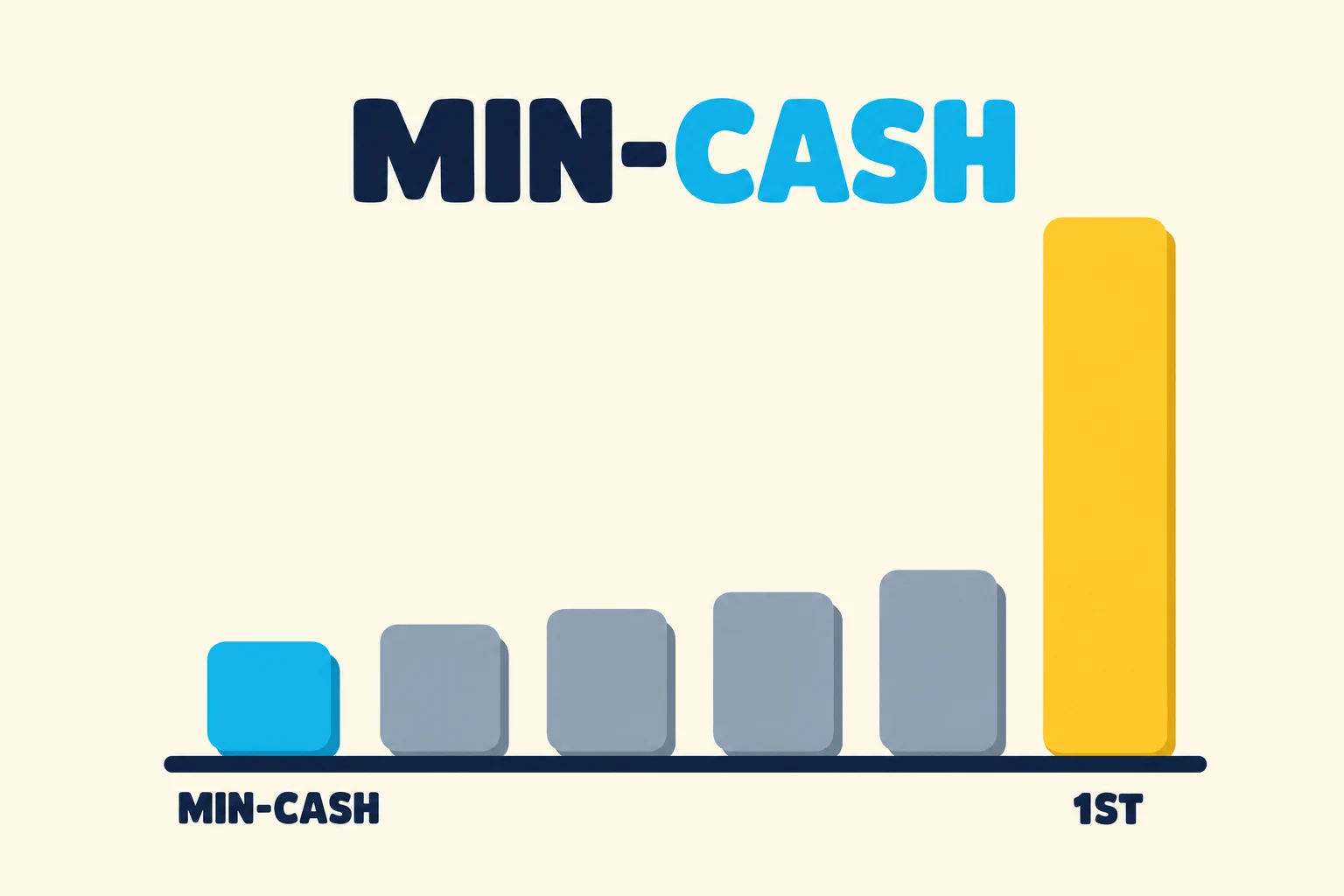
Less than the relief of reaching it suggests. Tournament payouts are top-heavy: first place typically takes around 30% of the prize pool on its own. Roughly 15% of the field gets back at least 1.5 buy-ins, and the step from busting on the bubble to the first paid finish is worth at least that much, sometimes two buy-ins or more.
So the min-cash is a real jump. It is also one of only two large ones. The gap from the bubble to the first paid spot and the gap from second place to first are the two most significant steps in the structure, and everything between them is comparatively small.
Why playing for it costs money
Because the two big jumps sit at opposite ends of the ladder, a strategy that optimizes for the near one gives up the far one.
Folding into the money protects a payout worth a buy-in and a half while surrendering the chips you would need to reach the payout worth thirty percent of the pool. The pay jumps between min-cash and the final table are small enough that laddering through them slowly rarely compensates.
This does not mean the min-cash is worthless or that ICM pressure is imaginary. Near the bubble, ICM genuinely tightens correct calling ranges, and a short stack can be right to avoid a marginal flip. The distinction is between letting the money influence one decision and building your whole tournament around reaching it.
ICM never tightens a call in Poker Skill, which runs no tournaments, so its Big Blind: Call or Fold lesson decides each hand on its strength against an under-the-gun open.
Example: 9 big blinds, three from the money
You are at 9 big blinds in a 1,200-entry MTT with 180 paid and 183 players left. Three bustouts and you are cashing. The min-cash is about 1.6 buy-ins.
Folding every hand for two orbits will very likely get you there, and it will also leave you at 4 big blinds when it happens. You will have bought a 1.6 buy-in payout and spent the stack that could have reached the top of the ladder to do it.
The alternative is not recklessness. It is taking the good shove-fold spots that are actually there, from late position, into players who are folding because they are protecting their own min-cash. Those opponents fold more near the bubble than at any other point in the event, which is exactly what makes the spots profitable.
Common mistakes
- Treating the min-cash as the goal. It is the floor of the structure. Most of the prize pool is at the other end.
- Folding down to a stack that cannot win. Reaching the money with 4 big blinds converts a tournament into a lottery ticket.
- Confusing bubble discipline with min-cash chasing. Declining one marginal flip on the bubble is ICM. Declining everything for two orbits is not.
- Assuming every pay jump is worth the same. The bubble-to-cash and second-to-first jumps dominate. The rungs in between are small.
FAQ
What does min-cash mean in poker?
It is the smallest payout a tournament pays, earned by the players who finish just inside the money right after the bubble.
How much does a min-cash usually pay?
It varies by structure, but the first paid finish is commonly worth about 1.5 buy-ins, and sometimes two or more. Around 15% of the field typically gets back at least that much.
Should I play to min-cash?
No. Use it as the floor rather than the plan. First place alone is usually around 30% of the prize pool, and the jumps between the min-cash and the final table are small, so a strategy built on reaching the money gives up most of the value in the event.